
Vintage Shiny Brite Ornaments: History & Values
Few things capture the magic of Christmas quite like a box of Shiny Brite ornaments. Whether you remember them sparkling on your grandparents’ tree or you’ve recently discovered their charm at an antique shop, Shiny Brite ornaments bring classic holiday joy that never goes out of style.
Manufactured in the US by Corning Glass and then decorated and sold to retailers by Eckardt & Co., these little beauties won a place in the hearts of Christmas lovers across the country.
I just wish I had a few of the bulbs that I remember hanging on my sweet grandmother’s little Christmas tree that she set on a tabletop in her “parlor” every year. Sigh.
That said, I do have a large Santa die cut and a Night Before Christmas book that I inherited from her, so I feel blessed (and will stop whining!).
Table of Contents
German Glass Ornament History
American Shiny Brite History
Is it a Shiny Brite?
How to Identify & Date Shiny Brites: Caps
How to Identify & Date Shiny Brites: Boxes
Where to Sell Shiny Brites
Shiny Brite Examples
Where to Find Shiny Brites
Shiny Brite Values
German Glass Ornament History
In the early 1600’s, glass blowers in Nuremberg, Germany began to develop the technology to create glass beads (primarily for garments).

By the mid-1700’s that technology had been adopted by glassmakers in Lauscha (central Germany), who began creating garlands of these tiny glass “baubles” (like the one above) that could be hung on the boughs of Christmas trees. Value: $40-50
Soon, they developed a method for creating larger blown glass ornaments using clay or wooden molds into which molten glass was blown.
By the mid-1800’s, a “cottage industry” had developed to handle the growing market for these ornaments. Often an entire family was involved in the business, with fathers blowing the glass, mothers lining the interior with silver (mercury + tin, later safer silver nitrate), and children hand-painting decorations on the exterior.

An early German Santa Claus-shaped ornament. Value: $30-40

An early clown head German ornament. Value: $30-40
By 1890, these Christmas ornaments, in all shapes and sizes, had made their way to the American market.
American Shiny Brite History
Here’s how these German glass ornaments came to the U.S.: F.W. Woolworth, founder of Woolworth’s the five-and-dime, began buying small amounts of German glass ornaments from wholesalers in Philadelphia. He sold out quickly two years running.
In 1890, he traveled to Lauscha to make direct purchases and became known as “the big buyer of Christmas tree ornaments” (Brenner, Christmas Past, 104).
But with the start of WW II, a lack of resources reduced the output of ornaments from Europe and blockades ultimately prevented their import into America entirely.
Max Eckardt, a German immigrant, correctly identified the rising turmoil in Europe prior to the outbreak of WWII. This led him to work with the Corning Glass Company to create an American made alternative to European blown glass ornaments.
Together they developed round glass ornaments based on the light bulb and in 1937, the Shiny Brite line came into existence.
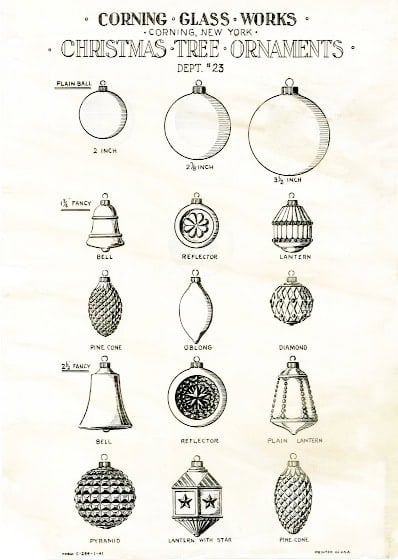
As you can see from this Corning Glass catalog page (1941), it didn’t take long for the company to begin developing ornaments in a myriad of shapes and sizes. The clear glass ornaments would be sent out for lining with silver nitrate, over-all coloring in a lacquer bath, and painted designs like stripes and stenciled images or words.
Eckardt’s contract with Woolworths for 200,000 ornaments facilitated the agreement with Corning for production. Available beginning in 1939, the ornaments sold for 2-10 cents each and were not marked initially with the classic “Shiny Brite” logo. The caps simply read, “Made in U.S. of A.”
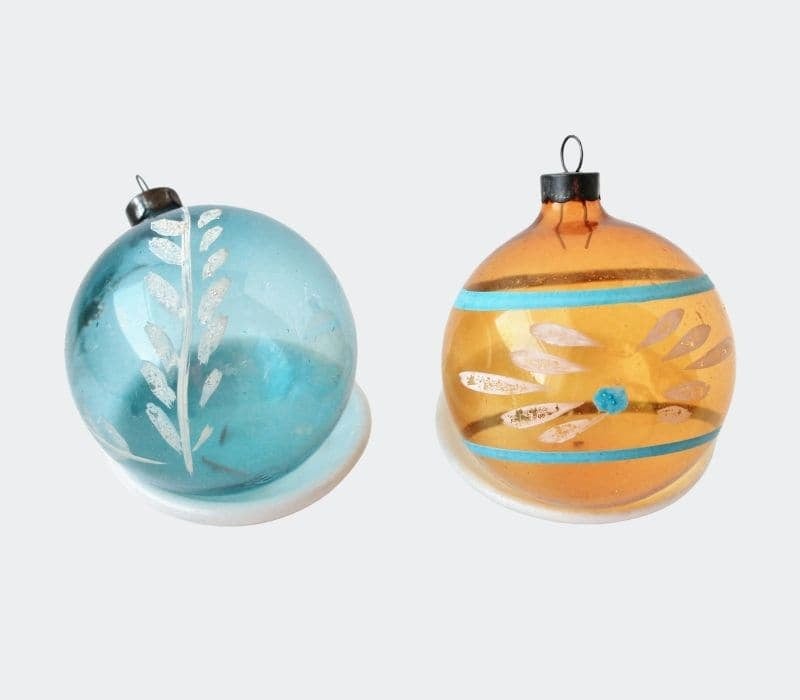
During WWII the silver nitrate used for lining the bulbs was needed for war purposes so unsilvered bulbs like these, with a bit of hand painted decoration, were the only type available for purchase.
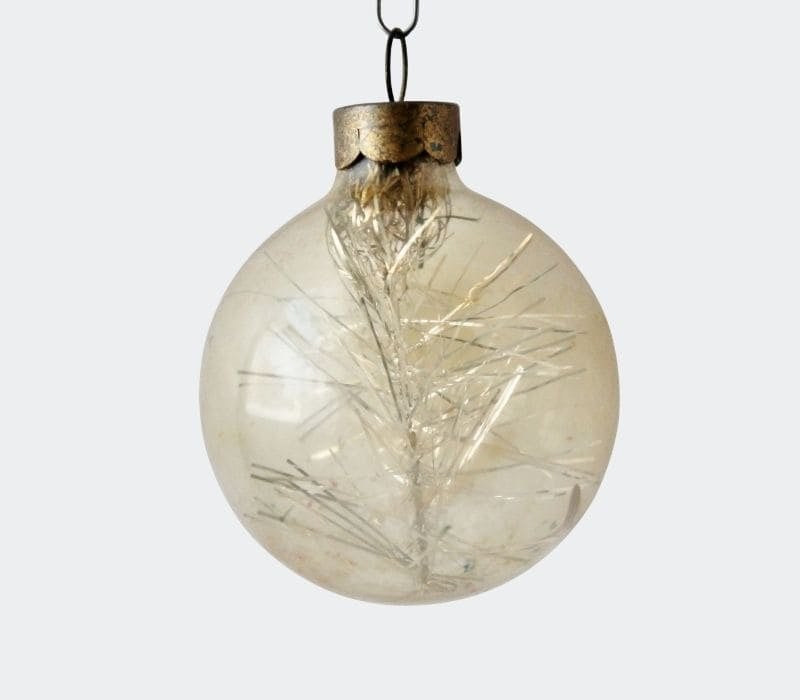
Sometimes buyers might find a bit of tinsel inside the ornament, until those materials became unavailable, too. Ultimately, even the metal caps were replaced with cardboard versions.

Transparent bulbs were so popular, they continued to be produced after the war and into the 1950’s but with the iconic crimped metal caps.
After the war, Ekhert traveled to West Germany (at the request of the U.S. government) and worked with ornament makers there for a time. This resulted in some glass ornaments shipped to the U.S. with plastic caps marked, “Shiny Brite, West Germany.” Though, I’ve never seen one myself.
Due to the popularity of fully plastic ornaments, introduced in the 1960’s, Shiny Brites went into decline. Ekhert sold the business to Poloron in 1974, but it ceased ornament production in1981.
Christopher Radko bought rights to the name Shiny Brite in the 1990’s and began producing reproduction ornaments made in Poland in 2001, and more recently in China.

This 1948 ad from a Sears catalog shows a number of Shiny Brites offered for sale, including stenciled, transparent, shapes (bell and teardrop), and indents.
Is It a Shiny Brite?
Typically, only sellers with a lot of experience can look at a glass bulb alone and tell whether it was made by Shiny Brite or another company, like Franke or Colby. This is due in part to the fact that Corning glass manufactured bulbs for all three companies. Even though each had their own hand decorators and decorating machines, they all tend to look very similar.
That said, by looking at ornament caps and boxes, buyers can glean helpful information that may point to whether a specific ornament (or collection of ornaments) can correctly be called a Shiny Brite.
How to Identify & Date Shiny Brites: Caps
You can find Shiny Brites with a variety of caps: smooth metal, crimped metal, cardboard, and plastic, each produced during a different time period, with some overlaps.
Unfortunately, because Shiny Brite caps are easily removed and replaced, unscrupulous sellers may put a Shiny Brite cap on a bulb manufactured by another company, like Franke or Colby.
Below you’ll learn the five categories of caps attributed to Shiny Brites.
(1) 1938-42 Caps (Before WWII)

Before WWII, Shiny Brites bore smooth-sided, scalloped metal caps with the phrase: “Made in U.S. of A.” They came in both gold and silver. You would find these ornaments in a box like this.
NOTE: Many other companies used the smooth sided, scalloped caps, including Franke, Colby, and Pyramid. Rauch also, but they marked their caps “Rauch.”
(2) 1942-45 Caps (During WWII)

During the war, with metal at a premium, Shiny Brites sported cardboard caps like the ones you see here.
Many thanks to Etsy seller San Diego Vintage for allowing me to use this photo, which features six unsilvered (transparent) Shiny Brites some with cardboard caps. Sold: $155
(3) 1946-1960’s Caps (After WWII)
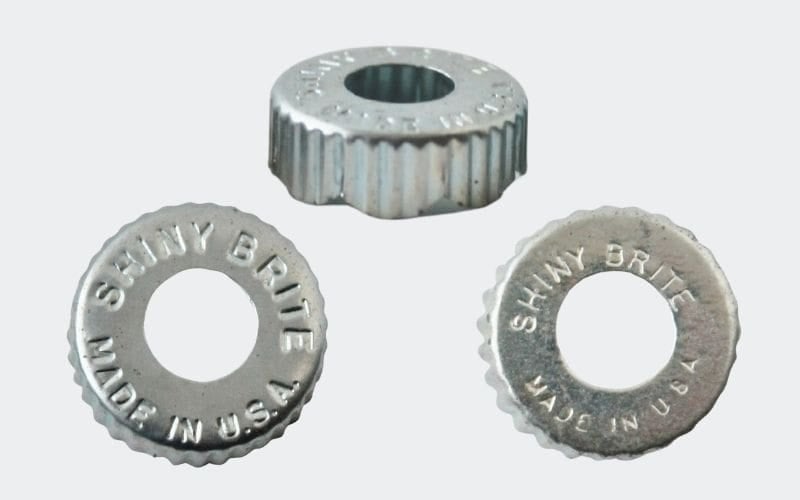
After WWII the Shiny Brite cap received a makeover. Now the caps had crimped sides and read: “Shiny Brite, Made in USA.” The cap on the left is what I call “classic Shiny Brite.” Perhaps the version on the right, which is much shallower, dates to later production?
Ornaments with these caps could have been found in boxes like these.
(4) 1960’s-1974 (Poloron)

It’s unclear exactly when Shiny Brite turned to plastic caps, persumably in the late 70’s up until they went out of production in in the 1980’s. It was during this period that Proton owned the brand. They could have been found in one of these boxes.
Just to keep things confusing: Poloron oranaments sometimes also had the classic crimped cap with “Shiny Brite, Made in USA” imprinted on it AND the classic crimped cap with “Made in USA”(!).
Buyers may also come across plastic caps labeled “Shiny Brite, West Germany,” which date to the 1960’s when Eckert worked with West Germans to rebuild their economy (in part) by producing glass ornaments for Shiny Brite.
(5) 2001-Present (Radko)

New, 21st centry Radko ornaments are nicely signed: “Shiny Brite, Radko, Made in China” (sometimes “Made in Poland”) and have the same crimped sides we’ve come to expect. They can be found in this type of box.
How to Identify & Date Shiny Brites: Boxes
1938-42 Box (Pre-WWII)

This simple cardboard box with the red tree and assorted information housed pre-WWII ornaments with the caps marked, “Made in U.S. of A.” It emphasizes that Shiny Brites were made in America, rather than Germany.
1946+ Box

Just after the war, Shiny Brites were sold in simple cardboard boxes, like this one featuring their logo, a collection of ornaments, and info about Max Eckardt & Sons, Inc.
Look closely and you’ll see Uncle Sam and Santa Claus shaking hands to emphasis that these ornaments are American, rather than German-made. Caps would have been crimped.
1957+ Box

Acknowledging that buyers prefer to see the ornaments they’re buying up, this box, with green boughs and red ornaments, is open in the center with clear cellophane. It dates to 1957 and beyond. Caps would have been crimped. Value with ornaments: $90-110
1963 Box

This 1963 box has a simpler (less appealing, some would say) look than many others, but it still manages to create a festive vibe with the red ornaments lining both sides. Caps would have been crimped. Value with ornaments: $35-50
1967 Box

All the bright colors and decorations have been replaced on this 1967 box with pale gold lines and fussy corners. Caps would have been crimped. Value with ornaments: $25-35
1974-1981 Box (new owner: Poloron)

As mentioned, in 1971 Poloron purchased Eckert & Sons, Co. and hence the box design was altered slightly to add a bit more color. Though this photo shows smooth-sided caps, Poloron continued to use classic crimped caps (and possibly plastic ones as well). Value with ornaments: $25-35

This bright blue box is the most common of the Poloron boxes. Value with ornaments: $20-30
2001-Present Box (new owner: Radko)

Radko Shiny Brites are clearly marked with a classic, crimped cap marked “Shiny Brite, Radko, Made in China” and are packaged in very sturdy red boxes like the one you see here.
Where to Sell Shiny Brites
Without question, the best place to sell Shiny Brites (in my experience) is Etsy. Sure they’ll sell from an antique booth or eBay, but at a lower price point. In the case of an antique booth, a much lower price point.
In fact, over the past few years, I’ve struggled to sell them for more than a few dollars each. I turned to eBay first and found much greater success. Next I gave Etsy a try and found even more success, as I’m sure you’ve noticed up to this point and as you’ll see below, too.
Shiny Brite Examples
Undecorated

Shiny Brite produced plain, undecorated ornaments throughout it’s history. Early on you’d find primary colors (red, blue, and green) plus gold and silver. This pink set of nine would date to the 1960’s. Value: $30-40
Glitter

Collectors and decorators prize glittery Christmas ornaments, particularly Shiny Brites. This set glows prettily with shiny colors and silver glitter. Value: $70-90

A closer look at one of these glittered beauties.
Mica

The center row of this box shows ornaments with mica decoration. Mica, a silicate mineral, gives ornaments the (slightly sparkly) illusion of snow. Value for the entire box: $34-50

Here’s a close-up of one of the mica-decorated bulbs.
Indents

Indents (also called “reflectors”) have decorative pockets cut out of one or both sides. The three you see here are indented on just one side and also happen to be heavily coated with mica. Value: $12-15 each
Stenciled

Wildly popular with collectors, stenciled Shiny Brites, come in all colors and with a wide variety of images. Available here.
On this pair of pink bulbs you see: “Merry Christmas” and Santa on skiis (left) and Santa pulling a wagon full of toys (right). Value: $15-20 each

Here’s a close-up of another stenciled ornament, featuring “Silent Night” and a snowy church.
Value: $15-22
Shapes

Over the years, Shiny Brites have been produced in a multitude of different shapes, including the small “atomic” examples above. Value for all: $40-60

They also produced urn shapes, like this pale pink one (value: $10-12), along with bells, tear drops, lanterns, and more.
Where to Find Vintage Shiny Brite Ornaments
While Shiny Brites certainly show up at garage sales, I find them more frequently at estate sales. Prices are often reasonable, particularly when the former owners collected large quantities.
Pricing ornaments and other decorations individually can be time consuming so often sellers price whole boxes of Christmas goods for one low price.
And of course, they’re readily available at antique shops, but as you likely know, prices tend to be quite high.

While out shopping before Christmas, I came across this display of vintage glass ornaments at a local antique shop: Waverly Square Antiques. Most of the Shiny Brites were priced at $15 each or more.
Values
You’ll have noticed as you read this article that I placed values on each of the ornaments or collection of ornaments below their photos.
Individual ornaments can achieve prices from $5-30, depending on their condition and decoration. Highly decorated examples are more sought after and bring higher returns.
I recommend selling plain orbs as sets and pricing them from $25-35, if in their original Shiny Brite Box, add another $5-10.
Keep in mind that because these ornaments are so fragile, even those with condition issues, like fading or loss of paint, are valuable. In fact, most Shiny Brites you come across are going to have some sort of issue, but don’t let that stop you from picking it up if priced low.
Other Articles I Know You’ll Love


Final Thoughts
Shiny Brites are hot right now. Keep an eye out for them as you’re out vintage shopping. No need to wait until the fall to start listing them since they sell well all year long. In fact I’m still listing and selling them as I write this article!
Thanks for stopping by–
If you enjoyed this post, subscribe today
and get a FREE copy of my eBook:

Bye for now,

I’d love it if you’d pin this to your fave Pinterest board. Thanks!


This is a great article. I love learning the history of these beautiful ornaments. Thank you for all your Research and Time you put into this article. Great photos.
That said I feel very rich. I have bin after bin of these ornaments…through the years as a young married couple having children, many relatives and their friends helped decorate my Christmas by giving me unwanted or “old” decorations and ornaments. That has continued through the years, anything my family is wanting to get rid of lands on my doorstep. They know I really appreciate the “older” things.
Your great article has reinforced my love of these Shiny Brites, their sparkly glitter and mica, the beautiful colors and shapes.
Again, Thank you so much, Elizabeth
I’m so glad you enjoyed the article and that it helped you evaluate your own [amazing!] collection. You’ve been truly blessed to be the recipient of so much vintage goodness 🙂
Have a Wonderful New Year, full of “great finds” and shiny baubles.
Thank you for this wonderful information! Love everything you do and make. Have a blessed Happy New Year❤️🙏
Lori
You’re so welcome Lori!! It blesses me so much to know that my resources are helpful 🙂 Happy New Year!!
Excellent resource!! Appreciate all the photos and history as we have collected Shiny Brite ornaments for so many decades. Thank you.
You’re welcome Cheryl! Glad you enjoyed the article 🙂
Great article. I always enjoy reading your well researched articles.
I “inheritated” many old Christmas balls from my husband working at a Rescue Mission years ago. Lots of old ornaments came in and he brought home boxes of interesting balls. It has been an adventure to learn about them and know their history.
Thank you for sharing your knowledge and representation of these collectables with lots of pictures. So fun!
Thanks so much for such a kind comment Martha 🙂 I love hearing how people have acquired their Shiny Brite “collections.” Happy New Year!
Thanks for the great history of Shiny Brights. I’ve collected more than 200 boxes of them.
Whaaat?!! That’s so amazing Jeanette! You’re the envy of every Shiny Brite collector 🙂
I too have a couple bins full of Shiny Brites in their original box. Others are in different vintage boxes most people would probably trash, like Woolworth or any other discount store box. I use these ornaments every year and pack them away securely after the holidays.
Sounds like a wonderful [and well cared for] collection Glenda! I like all the old boxes, too, whether they’re Shiny Brite or something else.
I love my Shiny Brites. I also have a few of the mini balls in the small boxes and some elves that were made by Shiny Brite. Anything with that name designator I am eagle eye! So many beautiful items were made by that fabulous company. I am happy that Radko picked up the name but too bad he couldn’t keep the manufacture of the ornaments here in USA rather than China. Poland would even be good since it was an early maker of baubles and have the know-how.
Thanks for your response and Happy New Year!
What a well-crafted and informative article. Thank you
You’re welcome Kathy! Thanks for the super-encouraging comment 🙂
Thank you for all the research this post involved; I learned a lot. My favorite are the “indents”; they have been my favorite since childhood along with the delicate rosy pink ones! Wish I had more of them; will keep looking!
Diana,
Thank you so much for this article! I was thrilled to realize many of my ornaments in your article. I have been collecting glass ornaments for 43 years…just drawn to them!
I’m even wondering if the “new” one s we purchased when first married may have been the “new” shiny brites?? Wish I’d have kept the boxes. I certainly will be examining them much more closely when decorating my tree next year!
Thanks again…Cyndi 💗🎄
You’re so welcome Cynthia! Glad you enjoyed the article. Sounds like you have a pretty great collection going!
thank you so much Diana for your concise article! I have sold vintage ornaments for many years and love seeing how beautiful they are and how many memories they bring back to those who purchase them! I wish they could talk!
You’re so welcome Christian–I’m so glad you enjoyed the article 🙂