
A Guide to Vintage Putz Houses [History & Values]
Vintage glitter-dusted Putz houses have captured the hearts of holiday decorators for over a century. Originally crafted in Germany, later produced in Japan, and even later in the US, these miniature cardboard houses allow stylists to create delightful villages beneath their Christmas tree or on a mantel.
With their delicate cellophane windows, shiny glitter, and vibrant colors, they are a delight to decorate with. In this article, we’ll explore their fascinating history, their values, and how to spot authentic pieces.
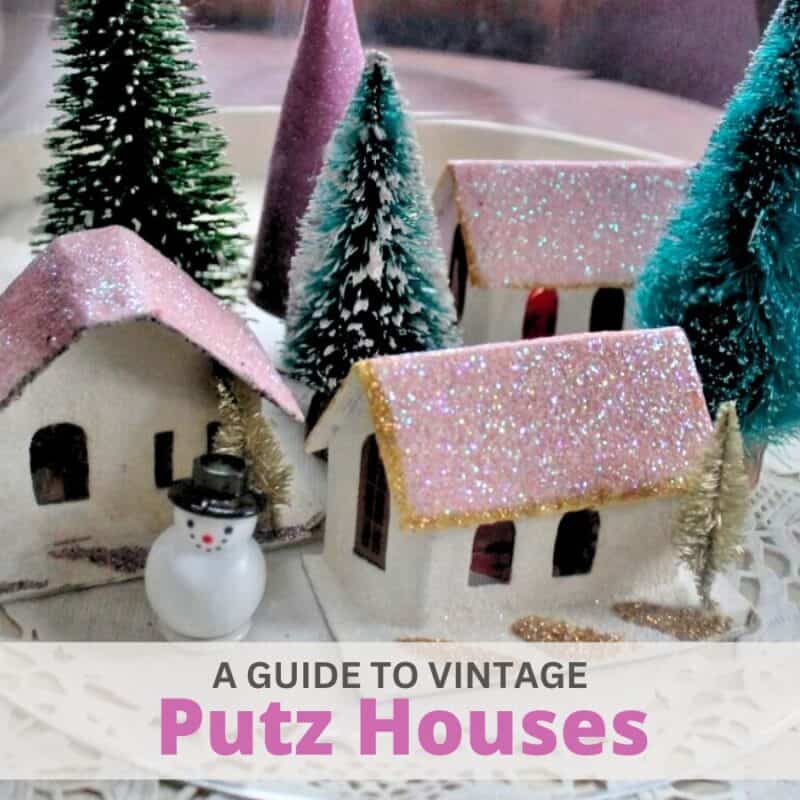
Table of Contents
Meaning of Putz
What Does a Putz House Look Like?
German Houses
Japanese Houses
USA Houses
Japanese Putz House Examples
Reproductions
Where to Sell Putz Houses
Embellished Putz Houses
What Does “Putz” Mean?
The German word putz means decoration, finery, or trappings. With respect to Christmas decor, it refers to elaborate decorations that Germans, and those of German decent in America, would set up beneath their Christmas trees.
However, in Yiddish putz also has the connotation of puttering around. One can imagine that setting up a village containing numerous parts might involve some puttering around over a series of days before the entire decorative scene would be complete.
So perhaps the term Putz house derived from both of these meanings: fine decorations that take time to set up into a vast village. Ultimately, no one knows for sure when or why the term Putz began to be applied to thees villages and their component parts, like the houses.
Due in part to the lengthy commitment of time such displays required, friends and family would visit each other’s elaborate putz villages, perhaps while enjoying some holiday refreshments and carol or two.
What Does a Putz House Village Look Like?
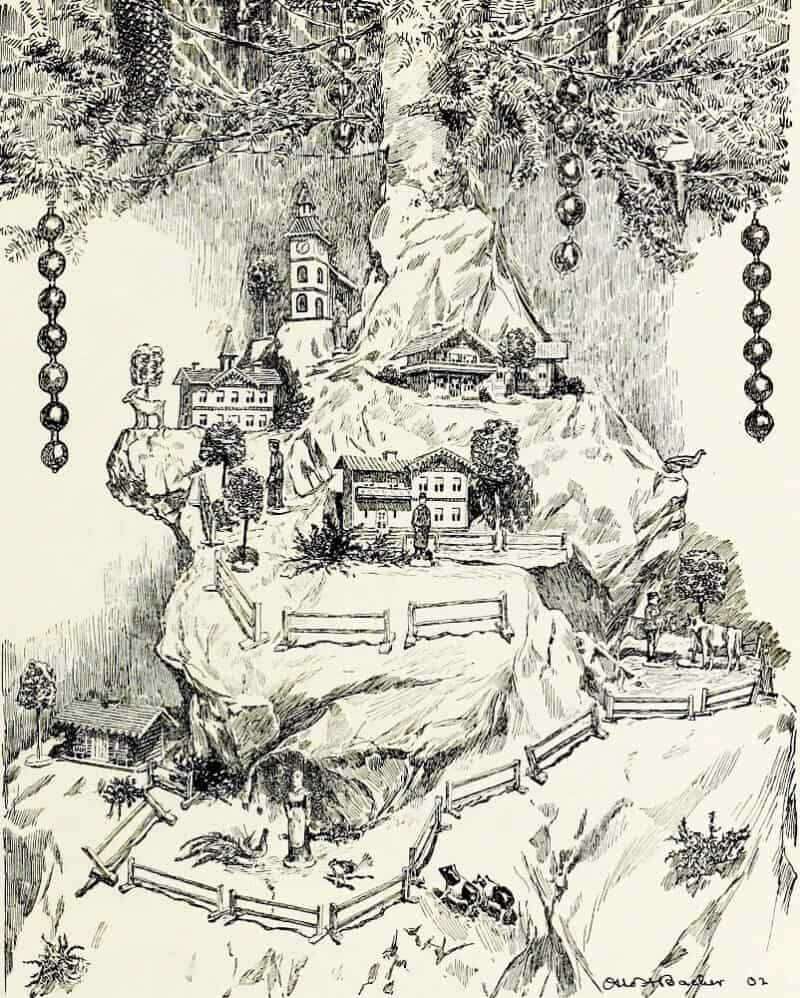
Not surprisingly, Putz house scenes like the one shown above especially delighted children who tend to love anything in miniature. Though I’m sure they experienced disappointment at (generally) not being able to play with the houses and figures(!).
Typically a scene would start with a layer of white cotton batting to serve as snow. Atop the batting everything might start with the placement a Nativity scene.
Then Putz houses, bottle brush trees, wooden animals and human figures would be artfully arrranged to create a perfect village scene. Farm animals with stick legs and textile bodies are extremely desirable and valuable.
The Evolution of the Putz House
1. Germany
Originally the houses (and other buildings) in a Putz scene would have been constructed of wood or strong cardboard. Some would have been manufactured in Erzgebirge, Germany, known for its manufacture of wooden and cardboard toys of all sorts, including buildings and figures used for Putz scenes.

Erzgebirge toy manufacturers are still in business today and their products–even newer versions like those above–are very collectible. Value: $30-40
At some point late in the 19th century, German companies began to manufacture cardboard boxes in the shape of houses designed to hold candy. The containers came in different styles, some had a removeable roof that allowed candy to be stored below, in the “house”.
Others were more like large matchboxes with a house on top of the matchbox base. The candy would be revealed when you slid the “hidden” box out of the base. These German candy containers, shaped like houses, were so darling that they began to be added to Putz scenes.
2. Japan: Pre-WWII
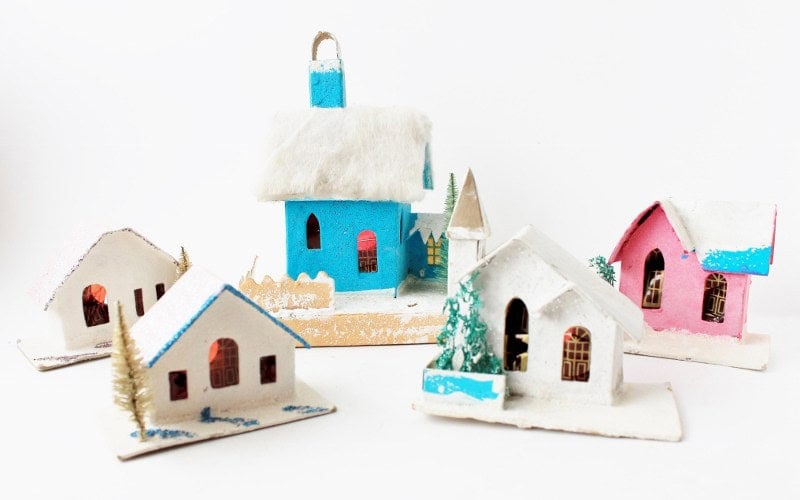
By the turn of the 20th century, Japan began manufacturing similar candy boxes, also in a variety of styles. Eventually, they turned away from candy containers to the houses we’re familiar with today. Values: $10-30 each
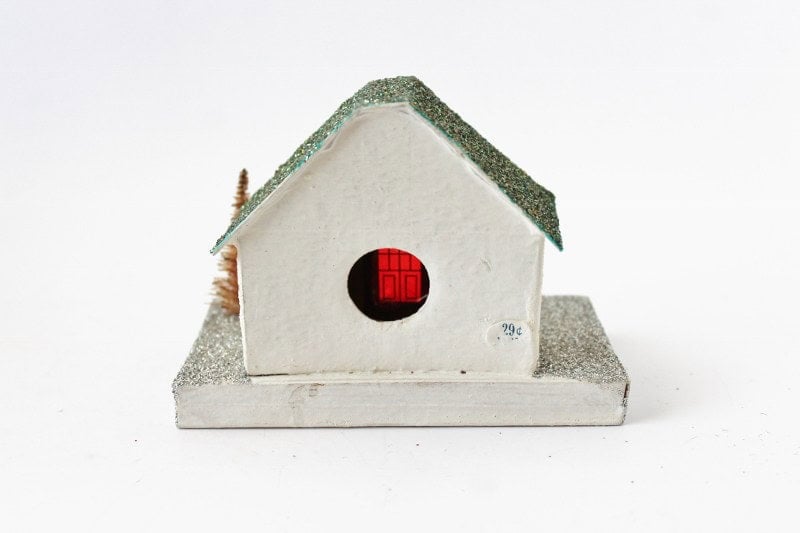
These houses contained openings in the back for insertion of a holiday light. Red celophane windows allowed the lights to create a warm glow that added a wonderful new dimension to one’s Putz village.
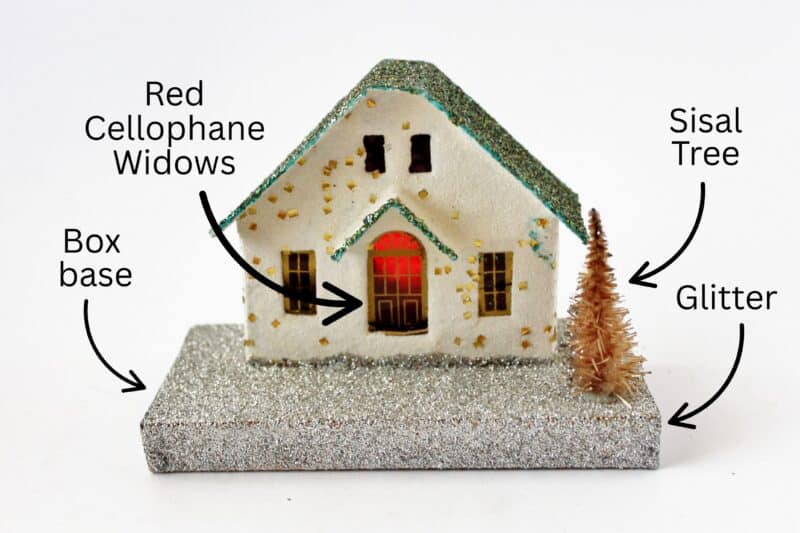
Other elements you may find on Putz houses:
- Green paper doors
- Mica
- Glitter
- Trees (loofa, sisal, or bottle brush)
- Fences

Here are a variety of “Japan” marks that you will likely see on the base or back of a Putz house manufactured in Japan. Most will be marked in some way though sometimes a house slips through with no mark, especially with some of the later (1960’s-70’s) houses.
See down below for more examples of Putz Houses made in Japan.
3. USA
With the onset of WWII, and particularly after Pearl Harbor, American retailers had to find new sources of Christmas goods since they would no long be receiving imports from either Germany or Japan.
As a result, some American companies began to manufacture Putz houses, though not nearly of the same quality or inventiveness as the Japanese variety.
One company in particular, Dolly Toy (1923-2008), filled the gap in consumer desire for these cute houses from about 1938-1950. Most are marked “Made in U.S.A.”
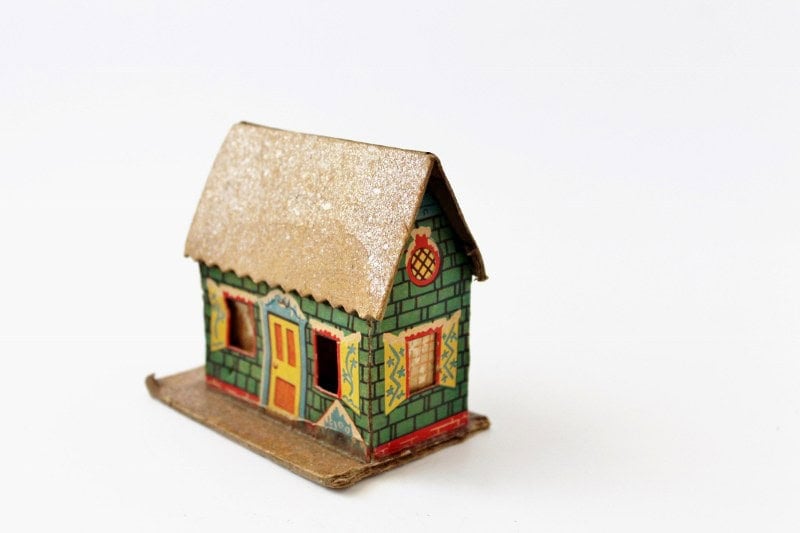
Here’s an example of a Made in USA house in a delightful, printed design but with a thicker, unpainted base and roof. Value in this condition: $8-10
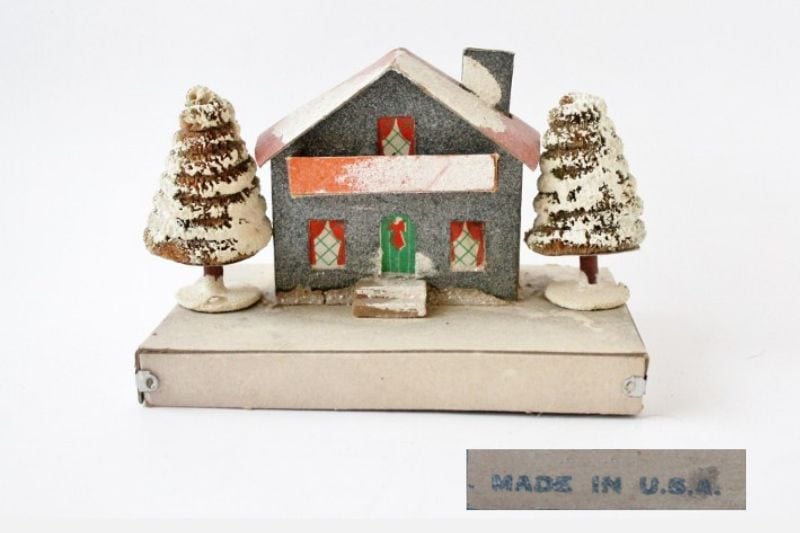
This larger house with muted colors, paper windows, and unusual trees, is marked “Made in USA”. Value: $15-20
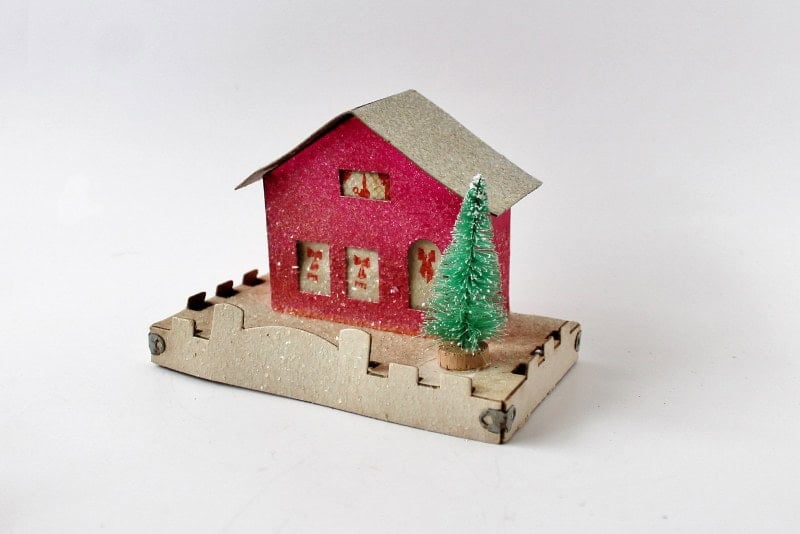
This unmarked glitter house has a very Made in USA vibe with its unique cardboard fencing and bow-decorated windows and doors. Value: $15-25
4. Japan: Post WWII
Almost immediately after the end of WWII, Japan began manufacturing and shipping Putz houses to the US once again. Those marked “Occupied Japan” can be dated to the post-war period when the US occupied Japan: 1947-52.
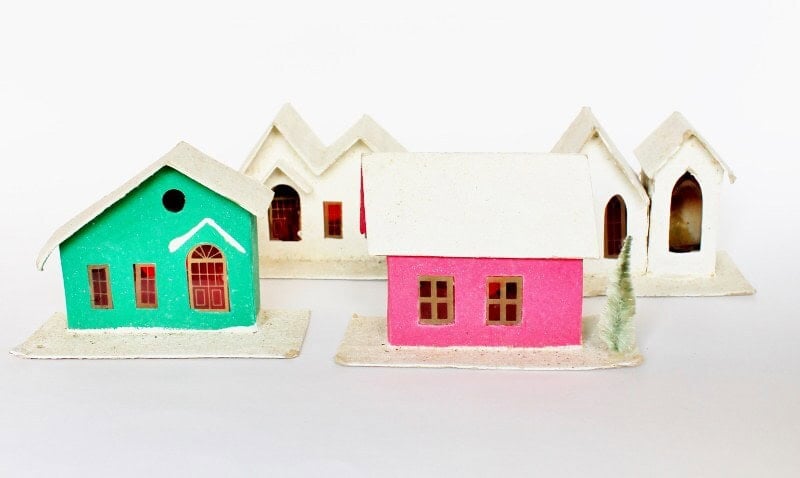
Many of the houses produced during the late period (1960-1970) had lost much of their original charm–reduced to simple houses on simple bases with little or no embellishment.
Values: $10-12 each
Japan continued to export Putz houses until the early 1970’s, after which their popularity waned.
Japanese Putz House Examples
1. Haciendas
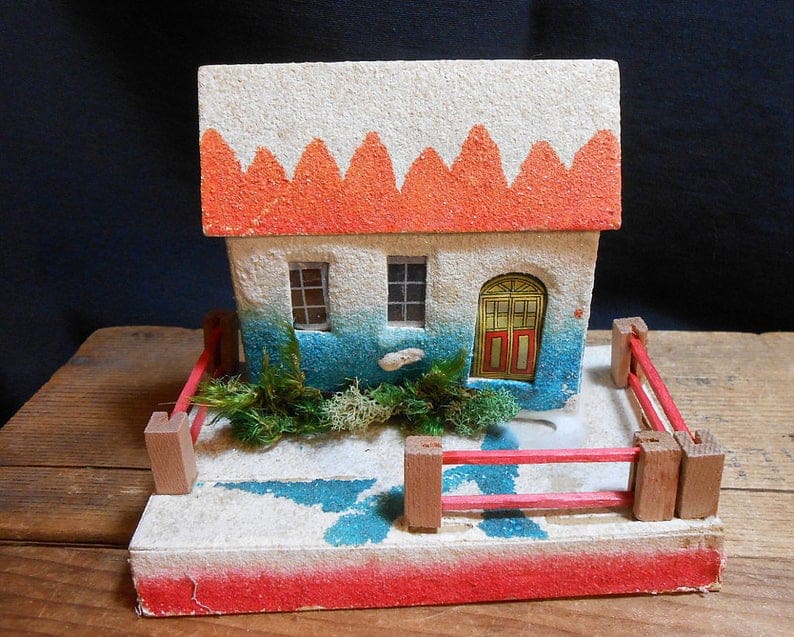
The period before WWII, from 1928 to 1935, is known as the “golden age” of Japanese Putz houses. Made of sturdy cardboard, they contained a lot of detail, including box bases, bright colors, and figurines, like Santa.
The example in the photo above, known as a hacienda because of its Southwestern colors and stucco-like texture, dates to the mid-1930’s. They were produced right up until WWII. Value: $40-50
Houses dating after this Golden Period were typically made of flimsier cardboard and contained less detail. It is these houses that are most commonly found on the market today. They are quite collectible but less valuable than earlier versions.
2. Cottons
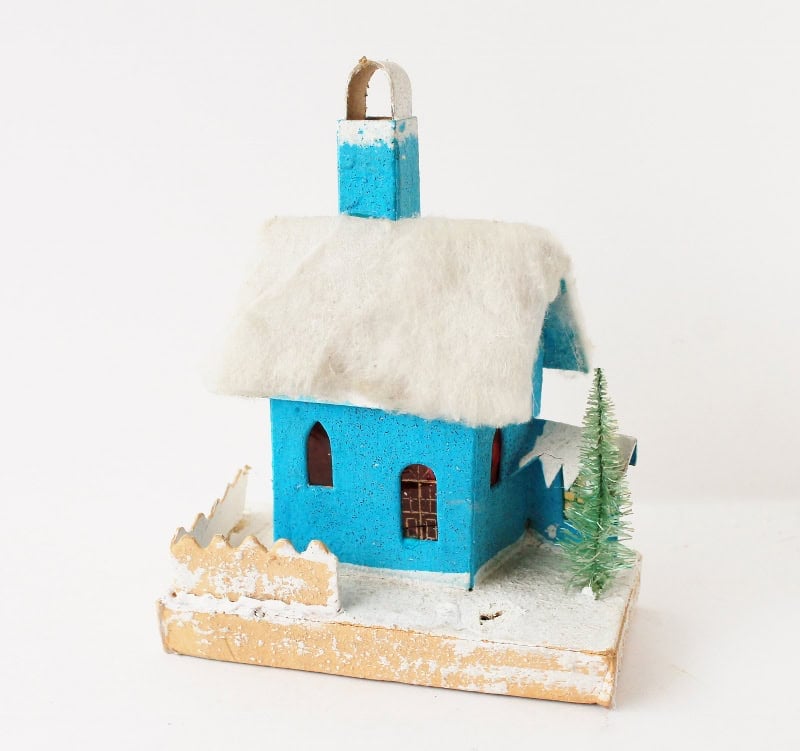
Houses with cotton batting snow on their roofs, like the 1950’s one you see above, are referred to as cottons or cotton toppers by some collectors. Value: $25-30
3. Printie
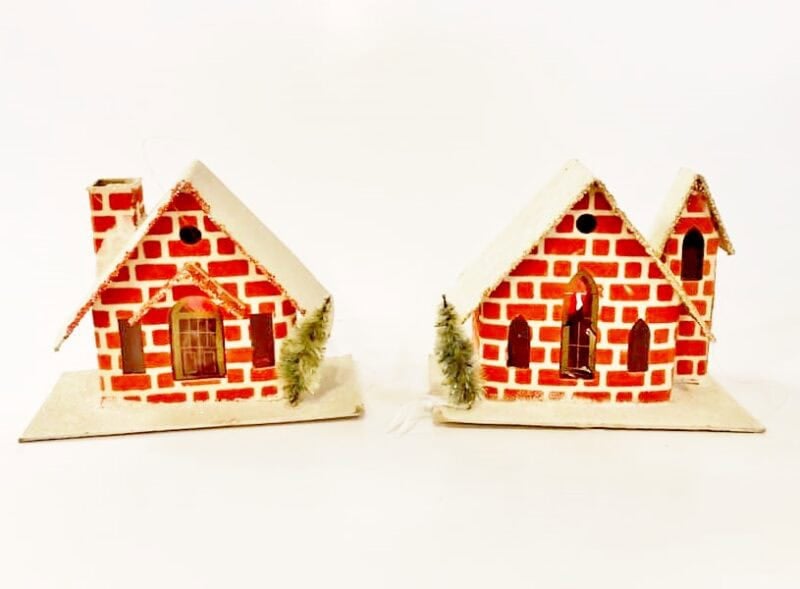
Houses covered with printed paper, like these, are referred to as printies by some collectors. Value: $28-35 for the pair
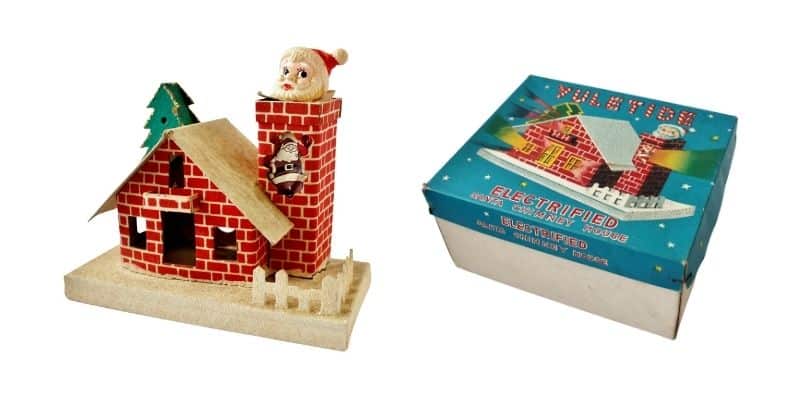
This amazing printie came with its own light-up bulb for insertion in the back. It’s large size, perfect condition, original box, and details (cardboard tree and Santa head) make it quite desireable. Value:$45-55
4. Coconut & Mica
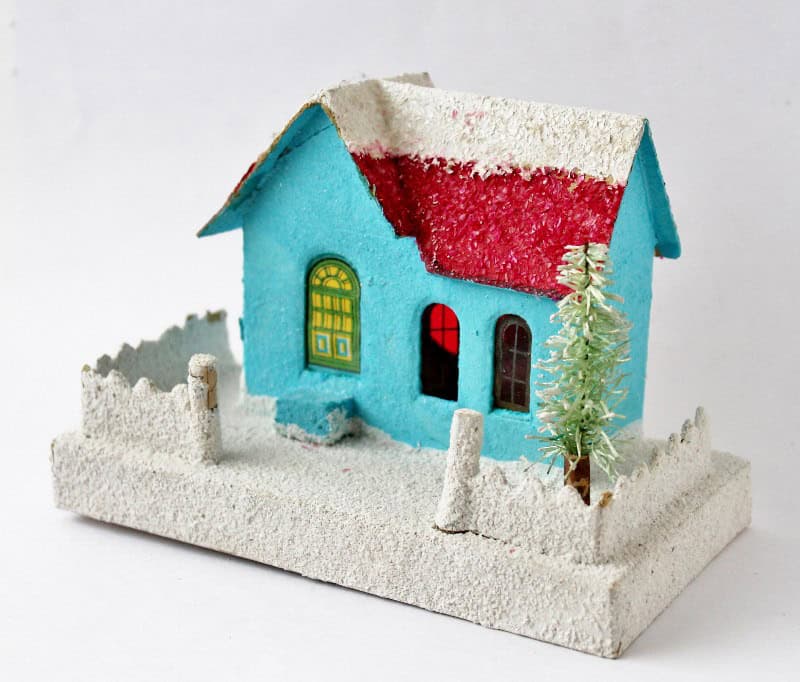
Here’s a good example of a house using mica (on the base) and coconut (on the roof). Mica adds a bumpy texture and can be found on any aspect of a house: base, house, or roof. Coconut refers to the shaggy texture that you see on the roof. Value: $25-30
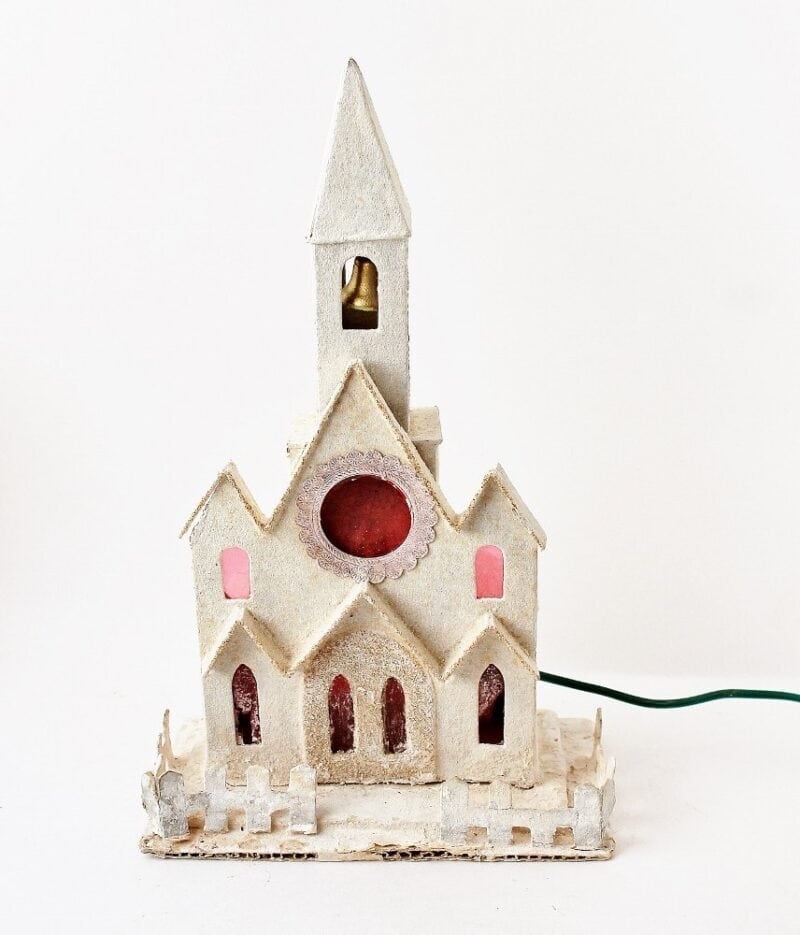
This detailed church, with multiple roofs, cardboard fencing, and built-in light fixture dates to the 1960’s. Despite its rough condition, it sold for $39 on Etsy in 2019.
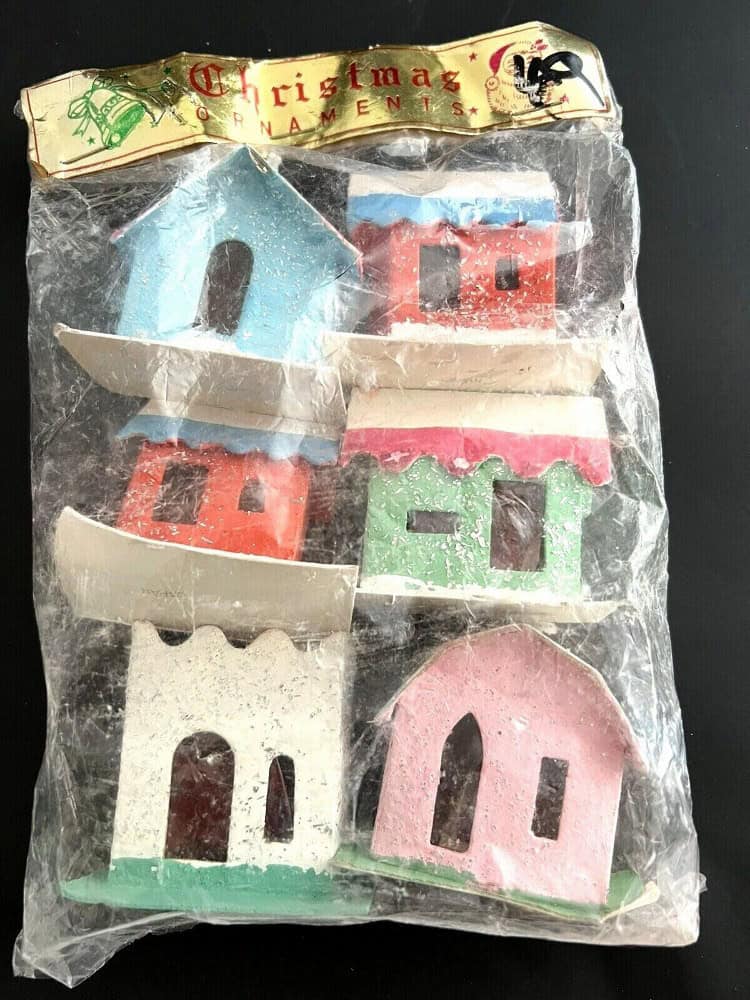
It’s rare to find a complete set of Putz houses (c.1970’s) still in its original packaging. This set of simple houses with no cellophane windows or trees, on a flat bases would sell for $50-75.
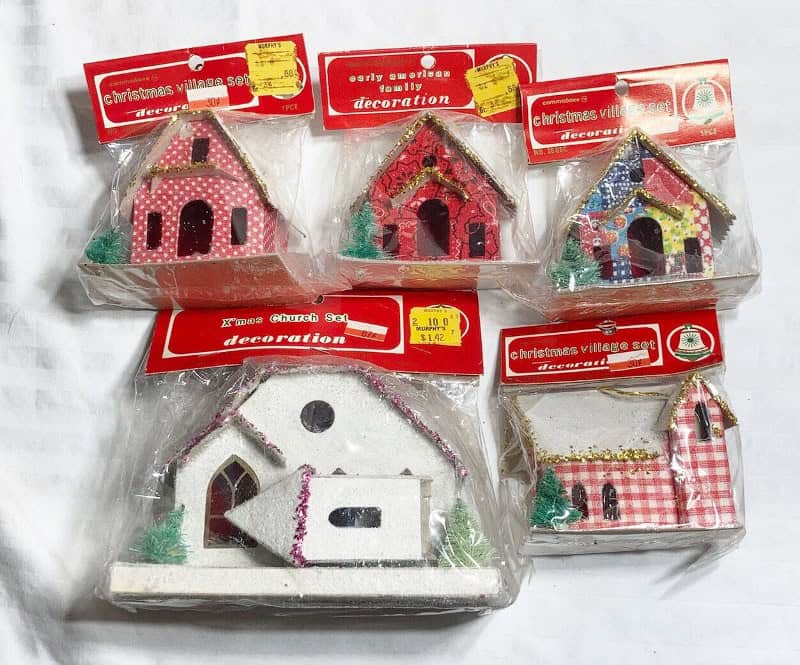
These individually packaged houses have more charm than is typical of 1970’s houses.
Values: $15-25 each
Reproductions
With the renewed interest in decorating with vintage Putz houses, a small crafting industry has developed around the creation of these darling little abodes.
Some are made to mimic vintage versions, right down to the ground mica and loofah trees, while others have their own special charm that sets them apart.
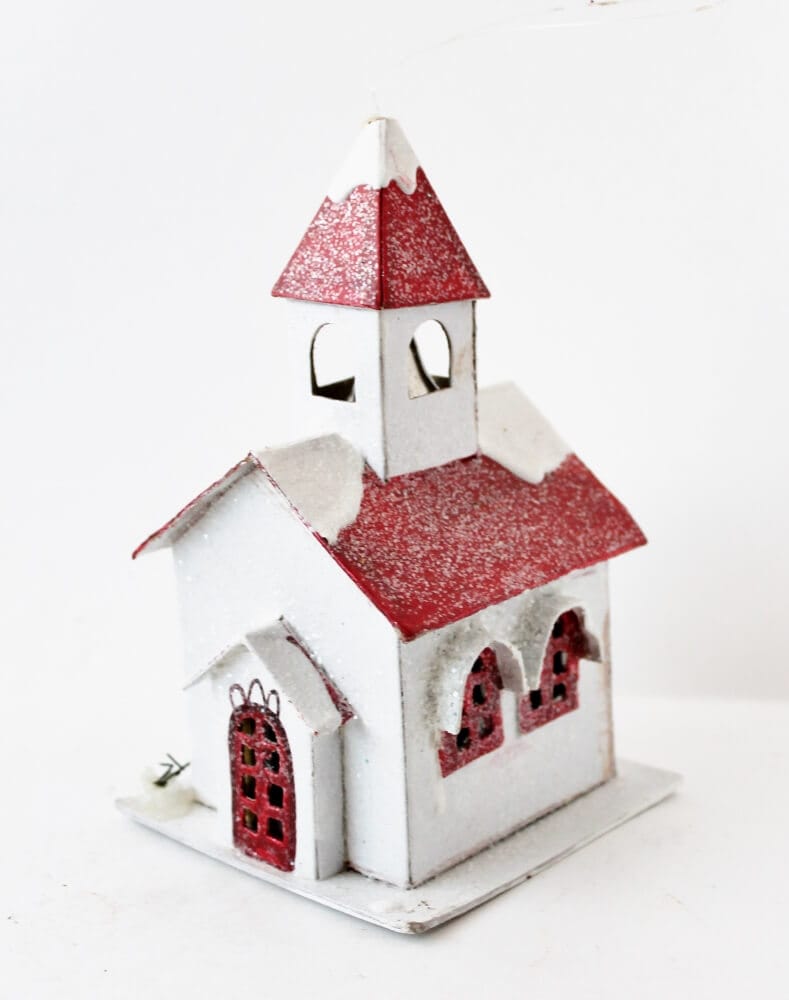
Here’s an example of the latter type–not made to be a replica but more of an homage to vintage houses. Reproductions abound but they tend to be marked on the bottom, by the person who handcrafted it.This thankfully removes any of the guess work. Value: $8-10
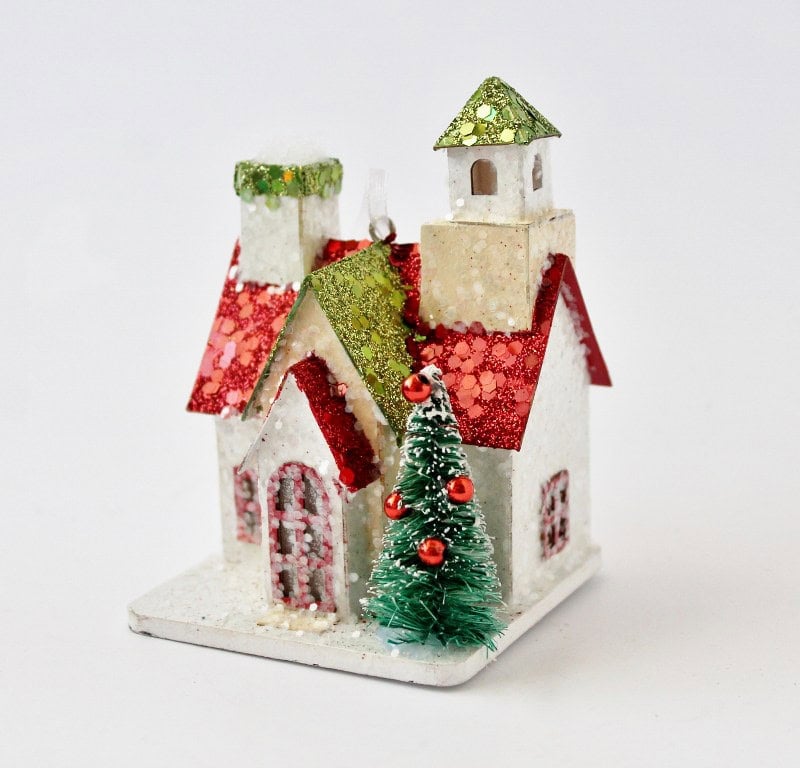
In the case of manufactured “replicas,” I’ve not come across any that bare much resemblance to vintage versions, so that’s a relief. They also tend to have stickers on their base indicating their country of origin, although they can be easily removed. Value: $8-10
Once you are familiar with the “real thing” you should have no trouble differentiating between new and old.
Where to Sell Putz Houses
From my experience, the best place to sell putz houses is on Etsy. Since 2019, I’ve sold 20 house for prices ranging from $13-53 each.
I have not had great success selling them from my antique booth, but if you live outside of the Albany, New York area, you may want to give them a try from your booth to see if you might have better luck than I have.
I’ve studied the sold listings on eBay and while the houses seem to sell fairly well there, my feeling is I can secure higher prices for mine on Etsy.
Embellished Putz Houses
If you’re a repeat reader, then you know that I sell vintage-inspired projects at an annual Holiday Market at the Shaker Heritage Society.
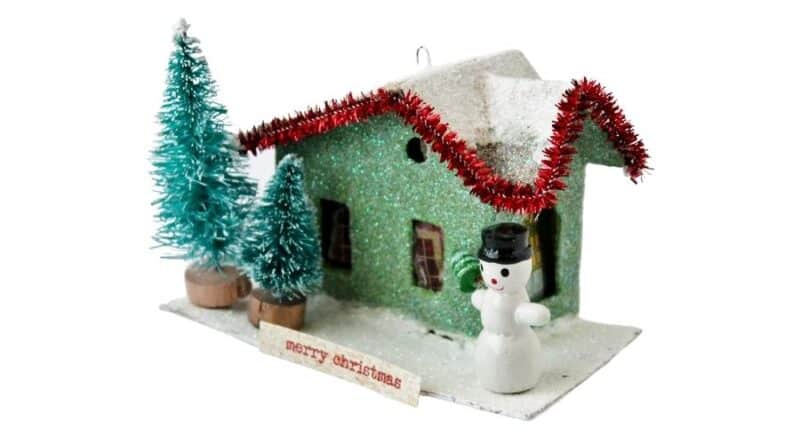
One of the projects I developed for this show takes ratty vintage Putz houses and turns them into even cuter versions of themselves.
The example above got a big makeover with the addition of two modern bottle brush trees, a wooden snowman, a “merry christmas” tag, red pipe cleaner, and a touch-up of the base with some white paint. I sell these for $18-25 depending on their size and embellishments.
Other Articles You Will Enjoy



Conclusion
If you’ve never sold (or collected) Putz houses, then I hope I’ve inspired you to consider giving them a try. These cute-as-can-be collectibles make a great addition to your Christmas inventory.
Thanks for stopping by–
If you enjoyed this post, subscribe today
and get a FREE copy of my eBook:

Bye for now,

Would you pin this image to your favorite Pinterest board?


Are the Putz Houses that are in Miniature/ornaments and have a metal ring for hanging considered Putz houses too? Are the dates for these about the same as what you have listed? I have collected the tree ornament houses for years and always assumed they were also Putz houses but I did not see any examples of these in your article. Would love more info. By the way love your videos, always very informative and I always learn something new.
Yes! I consider them Putz houses for sure. They have a tiny loop at the top and the opening in the back for a light, right? So glad you’ve been enjoying my resources Christy!
I have always liked those little Putz houses, having grown up in NE Pennsylvania where they were a staple in the stores and homes waaaay back in the 1960s and 1970s. I hope to buy some “blanks” — or make my own — and embellish them for the nostalgia they bring to our 21st century holidays.
Thank you for another great article!
Great article; I will have to be on the lookout for these more than I have been! Your research and additional pictures must have taken a lot of time; we appreciate your distilled wisdom!
I love these houses. We grew up in NY with them in the 70s in my grandparents’ house. My mom had some too. Over time they were lost. Just now a local thrift store had them in the window. They were stamped “Japan.” They were from someone’s collection. I wish I could have bought them all. I will put them on our fireplace mantel this year. Thanks for the info. & pictures.
What a fun find, Kris! So glad you got to fulfill your nostalgic love of Putz houses. Thank goodness for thrift stores, right?!!
I stumbled over this by sheer accident. Those houses are part of my childhood! My German-descent grandmother had a bunch of the pre-WWII Japan-made houses; in fact, I remember that she had that exact same pink house with the blue snow-covered roof that’s shown in the photo. Every year when I was a child, she’d put them under her tree. I haven’t seen them for ages and am afraid they disappeared somewhere; Grandma herself has been gone for 12 years, and those houses are a vivid reminder of her and my cherished old memories. Thank you for posting this!
You’re welcome Kim! I’m so glad you enjoyed the post and that it brought back such lovely memories of your grandmother 🙂