
What is Folk Art? [An Antique Guide]
Folk art includes a wide variety of traditional crafts and art media but it defies easy definition. Its simplicity and intrinsic beauty captivate art-lovers worldwide, and entire museums have been established to celebrate its unique contribution to the world of art.
In today’s article we’ll consider some terms that will help us better understand what folk art is and we’ll take a look at numerous examples and discover their values.

What is Folk Art

I love a very simple definition of “folk art” that I found on a Canadian website:
Folk Art can be described as art that is of the people, for the people and by the people. These artists are interested in making art that tells stories about daily life or the culture of their community.
Glenbow
It’s “regular” folks who’ve had no technical schooling setting out to create art that’s unique to them and reflects their everyday life.
Jean Lippman, a recognized American folk art expert, explained in her text, The Flowering of American Folk Art (1776-1876), that no single term is “a satisfactory label for…folk art” (p. 6). But at the same time, she provided some terms that collectively DO help us understand it:
- primitive
- naive
- natural
- self-taught
- amateur
Folk artists are largely untrained, meaning they didn’t attend an art school, receive a college degree in art, or receive guidance from an established artist. They are in fact “self-taught”.
In addition, many, if not most lived/live in rural rather than urban areas and this is usually strongly reflected in their work. Their art provides a distinctive look at daily life and local culture in ways seldom accomplished by trained artists.
As folk art has grown in popularity, we’ve seen an explosion of retail folk art, i.e., art produced primarily for sale. These items tend to be mass-produced, often in assembly lines and usually with little attention to detail.
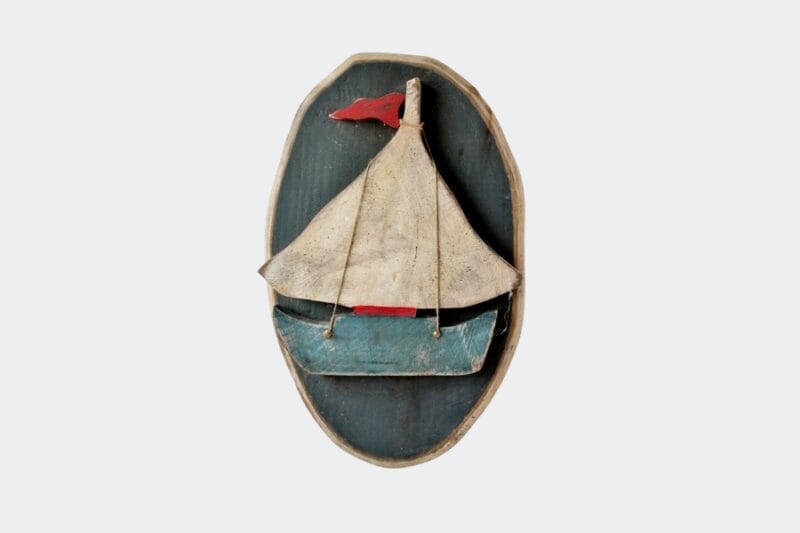
Here you see an example of “retail folk art.” This piece attempts to achieve a folk art look with its relative simplicity and popular subject matter: a sailboat. It was sold in the thousands (I’m sure) at Christmas Tree Shops within the last decade or so.
Most folk artists across time and cultures, have created for their personal pleasure (or that of their small community). Not for financial gain. In fact, the typical folk artist had/has no idea that their art may have financial value.
This is not to say that some retail folk art doesn’t have intrinsic value. You can find genuine charm in some pieces, which make them worth picking up if priced right.
The key is not to price it for resale at a genuine folk art price and to reveal its true nature in any descriptions. I typically do this on a price tag by calling the item “newer” and keeping the prices reasonable.
Values
Folk art pieces range in value from just one dollar to thousands of dollars. Higher end pieces that the average antique seller (like me) rarely if ever has the chance to buy include weather vanes, ship figureheads, tavern signs, and painted blanket chests.
But that doesn’t mean we won’t come across quality folk art pieces when we are out vintage shopping: items priced at $1-20 dollars that we can sell for $10-100 or more. It’s these type of items that I’ll be talking about below.
Types of Folk Art
For every type of art media you can think of: paint, paper, clay, metal, wood, and more, folk artists have created artworks with them.
I know vintage sellers sometimes have difficulty figuring out what sort of art to buy for resale. Therefore, with each piece I’ll try to give insights into what drew me to it and what made me think it was something buyers would want to buy.
Painting

Grandma Moses is perhaps one of the most well-known American folk artist. Her cheery scenes have delighted people for many years. Her works are valued at over $1 million.
You won’t find any Grandma Moses paintings out in the wild, but you may find some similar to those you’ll see below.
Oil/Acrylic

I picked up this oil/acrylic on board not too long ago for a dollar. Why you ask? Well the use of space is balanced, the colors work well together, and the color of the frame brings out the color of the cat.
I find the blue eyes both compelling and strangely challenging. The cat’s steely stare, in combination with his stern expression, create interest. Clearly an untrained artist painted the piece and thus, for me, it falls into the folk art category.
You may have noticed the series of tiles running down the left side of the frame. The artist (or a buyer) inserted them to make up for the fact that the frame is too big for the art. I’ve not decided what to do about that. Value: $30-40
Watercolor

As a Grandma Moses lover, I find myself attracted to any art that mimics her style. The watercolor above is a great example. Known for lovely winter scenes, like this one, she often featured horse-drawn sleighs and church buildings in her works.
Notice how the perspective isn’t quite right. The houses in the background are smaller which creates some depth but it’s all a bit flat and “off.” That’s what you would expect from someone who’s had no formal art training.
The composition is quite nice with the sleigh drawing your eye inward to the activity around the church, and the central scene is nicely “framed” by several trees around the edges. Sold for: $45
Opaque Watercolor or Gouache

This piece with its bright, opaque colors typifies a lot of folk art which can often be described as evoking joy. Again we se a delightful horse drawn sleigh but the perspective is slightly better than in the previous piece.
A father arriving home with the family Christmas tree promises joy with the expectation of ornaments, hot chocolate, and sweet treats. Sold (unframed) for: $35
Related:
Sculpture
You can find folk art sculpture made from a wide variety of media, including wood, stone, clay, and ivory to name a few.
Wood

The antique market for wood sculpture includes objects like ship figureheads and cigar store Indians, which can bring upwards of $500,000 each.
The Indian Maiden cigar store figure above is a marvelous example of this. Carved by Thomas V. Brooks in 1870, she resides in the Fenimore Museum in Cooperstone, NY.
We’ll be taking a look at items that fall more into the “wood carving” category.

I picked up this charming wooden carving back in 2010 when we lived in England. The cat is a bit oddly shaped with its thick neck and huge wide set button eyes, but he grows on you. The artist clearly had some ability as seen in the shape of and detail on the shoe. Sold on Etsy for $35

Religious themes seem to make their way into folk art more consistently than in other genres. The lifelike quality of this carving of Jesus, its interesting viewpoint, and ideal placement on the cross indicate an artist with a higher level of skill. It’s signed and dated 1959 on the back. Sold on Etsy for: $33

You often find pieces like this wooden rooster at retail stores like Home Goods. When selling a sculpture like this I would write “newer” on the tag and price it accordingly. Value: $15-20
Metal

Weathervanes pop to mind when I think of metal folk art–those rooster, horse, and whale beauties that once topped barns everywhere. Unfortunately, it’s highly unlikely that the low to mid-level antique seller will find themselves dealing with such items.
That said, I have come across smaller weather vanes made for the retail market that fit into my farmhouse style antique booth nicely. Again, I point out their age and price them accordingly.

Speaking of which, this metal angel has a terrific folk art look about her, but she was made fairly recently and falls into the “retail folk art” category.
She nonetheless will sell without any problem from my antique booth. I plan to mount her on the perfect piece of scrap wood some day. Value mounted: $30-40

This small metal ornament shows some interesting detail with incised markings and a variety of colors. It, too, is newer, likely made in Mexico. Value: $5-6
Pottery
As long as people have “harvested” clay from the ground, they’ve been shaping it into forms and figures.

In the south, some enslaved potters would create clay jugs with faces, like the one above. Their purpose, whether practical (to carry water) or spiritual (to mark a slave’s grave) is unknown. They value in the tens of thousands of dollars.
Sculpture

I fell in love with this small kooky character as soon as I saw him. Was he sculpted by a folk artist? Or perhaps a high school student artist?
I don’t really care! The pink skin is straight-out fun and the black accents (hair, eyes, and mustache) make the perfect contrast. Sold for: $20
Slip Decorated Redware
The Pennsylvania Dutch potters produced everyday utilitarian objects out of the locally available red clay and decorated them with slip (watery clay) in the same way you might with paint.
The light-colored yellow slip they often used stands out from the red clay background, creating striking decorative pieces valued in the thousands of dollars.

Modern clay artisans have revived the process to produce dinnerware, along with items like the bird ornament you see above. Value: $8-10

Companies like K & K Interiors mechanically manufacture enormous amounts of redware, like the plate above for the retail market. Some of the slip decoration appears hand applied, but that would likely take place in an assembly-line by a large number of different “painters”. Value: $15-20
Paper
Paper has long been a popular medium to work with since the requisite supply (paper) is fairly easily accessed, even by the poorest, rural artist.
Silhouette
Silhouette makers often used their craft on an itinerant basis, supporting themselves by travelling from town to town cutting paper silhouettes for mere pennies.
For country folks who couldn’t afford a painting of their family members, this allowed them to proudly hang likenesses of their children.

Silhouettes of George and Martha Washington have maintained their popularity through the decades. This pair, each measuring 3 1/2″ in diameter, sold recently on Etsy for $33.
Scherenschnitte
Scherenschnitte means “scissor cuts” in German and refers to the art of cutting intricate designs out of a single piece of paper with scissors.

This print of a patriotic scherenschnitte featuring an eagle and snake by Canal Press serves as a fine example of this type of art. Value (as a print): $40-50
While I’ve never come across a large antique piece, I have handled newer, smaller pieces that have sold in the $10-30 price range.
Band Boxes

Popular in America in the mid-19th century, bandboxes stored not just hats, but collars, gloves and any number of other items. Indeed, with string attatched for carrying, they would have even been used as luggage back in the day.
The band box above likely dates to the early 20th century and is very appealing because of its attractive wall paper covering and its sturdy construction. Value: $45-55
Related:
Textiles

Women from upper and middle class families would learn a variety of textile-related skills, including embroidery, knitting, and lace making, from their mothers, other female family members, or possibly at a “finishing school.” Early pieces are typically found in the thousands of dollars.
Quilting on the other hand was a skill frequently practiced by women in rural areas, often in community at “quilting bees.”
Participants would bring scraps of fabric from worn out clothing and together would sew a special quilt, often to be given as a gift to another community member for a special event.
Cross Stitch Samplers
Cross stitch samplers help to create a very “homey” atmosphere in one’s home. Larger pieces sewn in the 19th century and earlier are out of reach for me since they value in the hundreds and even thousands of dollars.
20th centry samplers made from preprinted designs, likewise create that cozy feeling many look to create in their homes.

Thankfully, this 1929 sampler fit in my budget. I fell in love with it because of the neutral tones and the perfect color match between the frame and the chairs the figures are seated on. It currently hangs in my kitchen. Value: $45-55

This more recent cross stitch, which shows some skill on the part of the maker, features a cozy fireplace scene. Because samplers like this were often sewn by beginners, many examples that I come across look sloppy, not fit for resale. This one recently sold (frameless) on Etsy for $14.
Related:
Quilts

I purchased this stunning full-sized quilt in Pennsylvania a number of years ago. The vibrant colors stop you in your tracks, don’t they?
It was pieced together by real pros, which you can tell by the piecing accuracy, the nine stitches/inch, and the color choices. Value: $350-400

Even more modern examples of quilting like this lavender block sell well (on Etsy in particular). Sold (set of ten) for $32
Native American
Utilitarian crafts developed by peoples who have maintained their cultural identity and have passed their skills down individually from generation to generation are typically considered folk art. This holds true even if these items are made for the retail market.
Since I live in the Northeast (US), I’m most familiar with the types of items produced by the Eastern Woodlands Native Americans.
Baskets

Baskets have always been a favorite of mine, including Native American examples like this (newer) ash splint one, which is decorated with “porcupine curls”. Look for strong, but lightweight pieces that are very tightly woven. Sold for $20
Related:
Whimsies

Native Americans are widely known for their beadwork. This piece, referred to as a “whimsy”, displays quality craftmanship. The attractive tulip design and tightness of the beadwork set this piece apart.
Likely made specifically for the tourist trade in the mid 20th century, it sold a few years ago for $50 on eBay.
Pottery

I’ve not had the opportunity to deal with a lot of Native American pottery but I picked up this small piece for a good price. Larger, older vessels are valued in the thousands of dollars, making them hard to come by.
A beautifully crafted piece, with its glass-like surface, simple shape, and geometric decoration, make it very appealing. Value: $50-60
Conclusion
There is definitely money to be made in the folk art market! I hope you’ve been encouraged to give buying and selling these charming pieces a try.
Tell me, what is your experience with folk art? Do you love it, like I do? Have you sold any through your antique biz?
We’d all love to know!
Other Articles You’ll Enjoy


Thanks for stopping by–
If you enjoyed this post, subscribe today
and get a FREE copy of my eBook:

Bye for now,

It would really bless me if you’d pin this guide
to one of your Pinterest boards!


I think I have had the most experience with framing beginner’s samplers; I often find them thrifting or at yard sales for $1-5. I have a hoard of old frames and an not afraid of investing the time in washing, starching, ironing, and mounting them in frames. I also pick up small paintings and prints to frame. A few I keep, but I sell most of them in my booth. I have a small collection of silhouettes for ME! I also look for pictures of silhouettes for my dollhouse!
I applaud all of your hard work Kathy! I do occasionally frame some of the cross stitch samplers I come across, but not all of them, LOL.