
A Native American Basket Guide
One area of collecting that I find fascinating is Native American baskets. For many antique collectors and sellers, baskets pose tricky identification issues. In particular, how to tell their age? But also, what material did the maker use and is the piece well-made?
In this article, we’ll look at baskets made by indigenous woodland people from my neck of the woods in the Northeastern United States. We’ll undertake answering some of those tricky issues and learn more about these interesting baskets. Let’s dive in.
Related Post: Vintage Basket Price Guide

Native American Basket Video
Check out my video on Native American baskets where you’ll see me handling and discussing the baskets seen in this post and please, I hope you follow me and give me a thumbs up 🙂
Who Are Woodland Native Americans?
Indigenous woodland people lived and moved in the Northeastern part of the country down the Atlantic coast, over to the Mississippi and down to the Gulf of Mexico. But the baskets we’ll look at today were made primarily by those people inhabiting the Northeastern U.S. and Southeastern Canada.
These people groups, known as the Algonkians and Iroquois, constructed vessels from natural materials native to their area to hold food and other goods. Interestingly, it’s likely that their basketry methods and designs were strongly influenced by the European settlers.
The tribes who constructed the baskets we’ll be talking about, include the Mi’kmaq, Passamaquody, Maliseet, and Penobscot of Maine, the Abenaki of Canada, and the Mohawks of New York.
Experts often have difficulty connecting a particular tribe with a specific basket due to tribal movements and intermarriages. So I will generally not be attributing any of today’s baskets to a specific tribe.
By the late 18th century, selling both baskets and birch bark boxes for souvenirs in tourist towns throughout the Northeast, contributed heavily to the Native American economy.
Over the winter they would make their wares and then move down into the Adirondack and White Mountain towns and set up stalls during the summer. All of the examples that we’ll look at today were made for the souvenir market from the 1940’s-80’s.
A Word About Birch Bark Boxes
In addition to baskets, woodland people made and used birch bark boxes for storage purposes. In fact, in many locales, boxes would have been in more use than baskets.
 Here’s an example of a woodland birch bark box trimmed with sweet grass that has been sewn to the rim with black cotton thread.
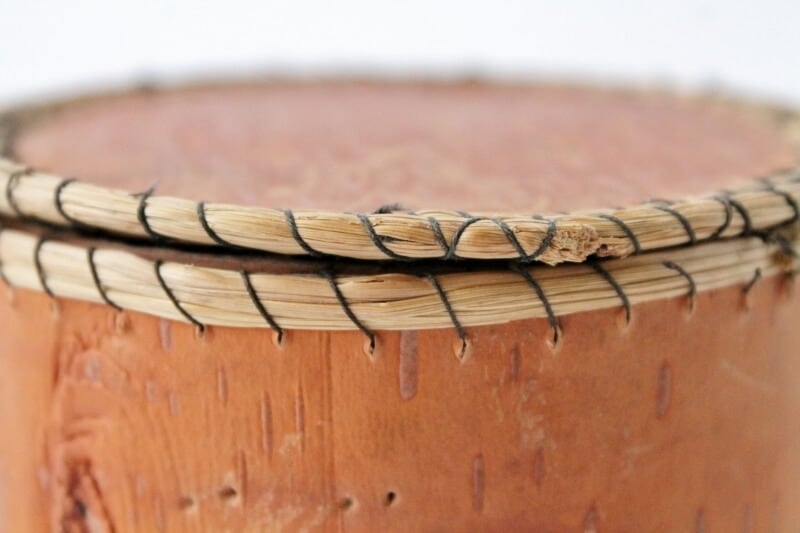 The Algonkians of Canada were known in particular for their use of sweet grass for rim trim, while eastern rims would have been bound with spruce root (Turnbaugh, 114).
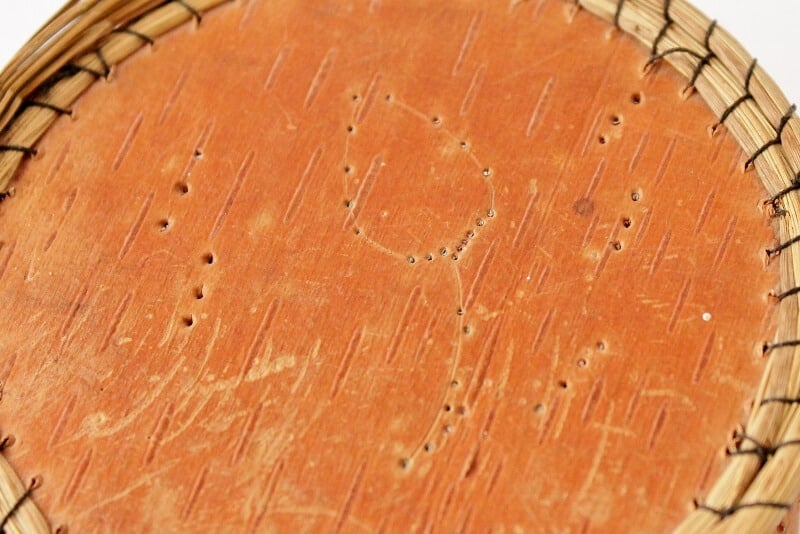 The lid to this piece bares a simple punched leaf design, but on earlier examples you would find beautifully detailed etched designs. And still other examples would have been decorated (or even covered) with porcupine quills.
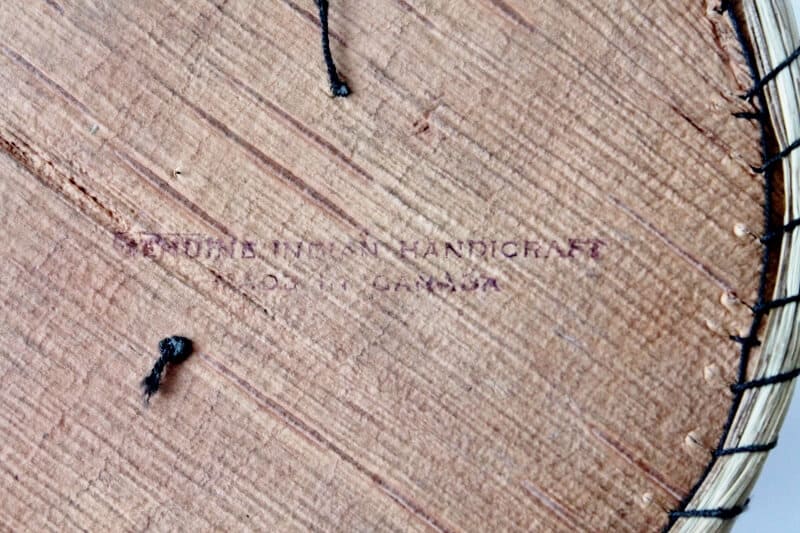 The bottom is stamped “Genuine Indian Handicraft, Made in Canada,” letting us know who made the box and where. It may also provides a hint as to when it was made since the term “Indian” became controversial in the 1960’s and 70’s and has largely given way to specific tribal names.
What Are Native American Baskets Made Of?
Woodland Native Americans made their “plain plaited” baskets primarily out of ash splint and sweet grass, while later baskets occasionally incorporate Hong Kong cord (an imported, twisted sea grass).
 Ash splints, like those you see on the bottom of this basket, historically came from black or brown ash. Trees would soak for a year in a marsh or bog, after which basket-makers would remove the logs and strip off the bark. Each log would be cut into quarters and then eighths.
These long strips would be beaten until the growth rings separated, and then finally these strips would be cut almost paper thin for weaving (Sober, 156). Typically men prepared the splints while women wove them.
 A couple of varieties of sweet grass make up the second natural resource used in woodland basket making. When dampened, you can still smell the lovely scent of the sweet grass.
The grass, found in the Northeast and Great Lakes regions, is harvested in the spring and heated over fire to allow the fibers to separate for weaving (Sober, 146).
On this basket, the horizontal weavers are primarily sweet grass (the very thin material) along with very thin strips of ash. The spokes, which run vertically, are also ash. The lid has a single wrapped, sweet grass edge.
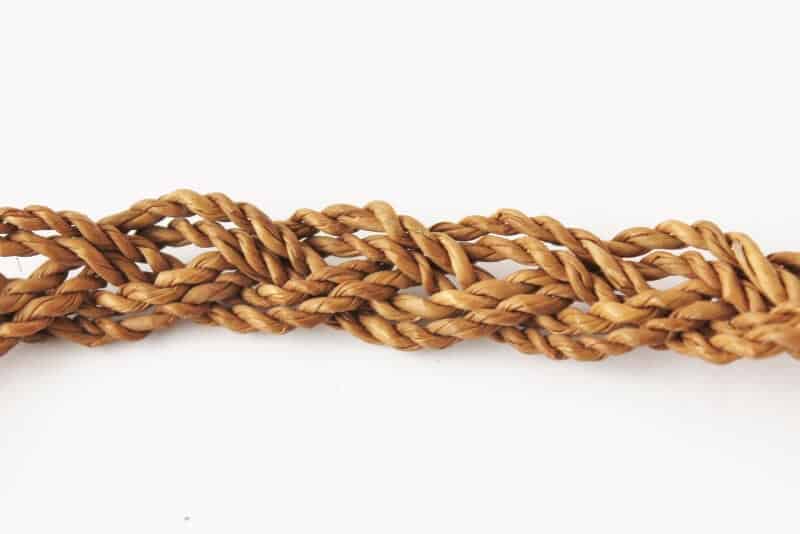 The third material one often finds incorporated in woodland baskets is called “Hong Kong cord” or “old China wire.” Made of imported, twisted sea grass, you see it used as a decorative weaver and even more often in the construction of handles.
Thanks to William Dearborn, Jr. who commented below for informing about the alternate name for Hong Kong cord.
 This basket, likely a souvenir piece meant to be a hand or tote bag, contains Hong Kong cord weavers and handles, the rest is ash splint. It has a wide reinforced rim that is single wrapped with a thin ash splint.
How Are the Native American Baskets Constructed?
 Most woodland baskets on the market are “plain plated” like this one. It’s occasionally referred to a “checkerwork,” which is easier to remember since it resembles a checkerboard. The spokes and weavers are often the same size and are pulled up tightly to each other.
Historians believe that woodland Indians likely adopted this plain plating method of basketry from European settlers sometime during the 18th century.
Native American Basket Decoration
 This cylindrical, plain plated basket is decorated with orange paint or dye, which would have been applied either before or after weaving. Braided sweet grass comprises the decoration between the orange rows as well as the handles.
 This beautifully handmade basket has a reinforced rim and is double wrapped with a thin ash splint. It is perfectly proportioned, tightly woven, and surprisingly lightweight.
Other methods of decoration frequently used by the woodland Indians include both block stamps with simple designs and “swabbing,” which involved more or less “splotching” paint onto select areas using a cotton covered splint as a paint brush.
 A unique method of decoration adopted by many woodland tribes is known as “porcupine twist” or “curly-que,” like you see on this basket. The flexibility of ash and the thinness of the splints allows the wood to be curved to create this unusual surface.
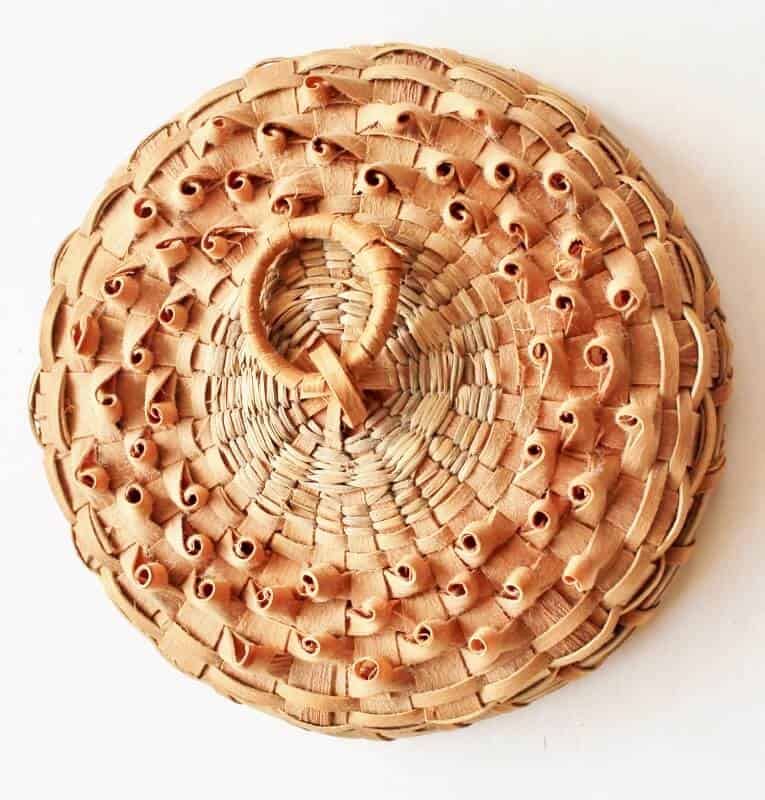 The “shaggy” appearance of the twisted splints indicates the poorer quality of this particular piece, though it sold for $20.
 This smaller, but better quality basket, has porcupine twist “feet” and a [faded] green stripe decoration.
 Here you see another version of the porcupine twist. UPDATE: When I listed this basket on eBay, a member of the Abenaki reached out and told me that this basket can be specifically attributed to the Mi’kmaq.
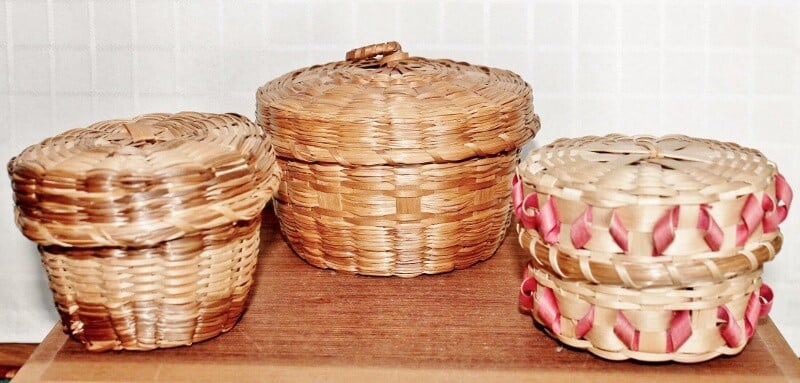 And on the far right basket, a similar red-dyed twists.
Unique Features of Woodland Native American Baskets
There are many distinguishing features of the baskets created by woodland indigenous people of the Northeastern U.S. and southern Canada. They include:
- Sweet grass or spruce root edging
- Braided sweet grass decoration
- Painted splints
- Porcupine twist decoration of various styles
- Reinforced rims
- Block-printed and swabbed decoration (no examples)
Conclusion
I hope you enjoyed today’s post as much as I enjoyed preparing it! I’m fascinated by the history of the “First Nations.” If you have any additional information to share on this topic, please do in the comments below.
Other Articles You’ll Enjoy:


Thanks so much for stopping by–
If you enjoyed your visit, I hope you’ll subscribe and never miss a post.
You’ll receive access to my MEMBER LIBRARY and get loads of FREEBIES,
like this “cheat sheet” on collecting Woodland Native American baskets:

Bye for now,

Below is an affiliate link for a book on the topic of Native American baskets that I highly recommend. This is both for your convenience as well as to support my blog, as I receive a small compensation whenever you click on such a link and make any sort of purchase, for which I thank you.

 I’d love it if you’d pin me for later!


Sources:
Indian Baskets, Sarah Peabody & William A Turnbaugh
“Baskets: Handy and Handsome Carryalls,” by Marion Burr Sober as found in
The Encyclopedia of Collectibles: Advertising to Baskets
Native American Basketry

Thank you for this informative article and for all the time you put into it! Please DO keep your blog going, we all need the diversion and I look forward to seeing you in my inbox!!
You’re very welcome, Carolyn and yes, I’ll keep coming into your inbox–thanks for the sweet encouragement!!
Hello Diana,
You may want to watch the short film “My Father’s Tools” by Heather Condo:
My Father’s Tools (Les outils de mon père) | Wapikoni mobile
http://www.wapikoni.ca/films/my-fathers-tools-les-outils-de-mon-pere
And here’s an interesting old article on the words “tribe” and “Nation.”
https://indiancountrytoday.com/archive/on-the-words-tribe-and-nation-NUTfP-tyU0uqza8cle2BSg
Congratulations for all your great work.
Thanks so much for the info Claude–I’ll go check them out!
Very interesting and educational. I enjoyed it because I love baskets and also know very little about the areas and tribes you mentioned. Thank you!
You’re welcome Karen–I’m so glad you found the post informative 🙂
Very interesting! I have a few platters that were woven by Native Americans. They were inherited from my husband’s relative who lived in Maine. She had them in an awesome cottage on a pond that you had to use a boat to get to. Miss his aunt and the cottage so much. Thanks for the memories. Jan in MA
Aww you’re so welcome Janice–what beautiful memories. I’m so glad you and your husband inherited the platters 🙂
Very informative post. Several years ago, the Farnsworth Museum in Rockland, ME had an exhibit of Maine Native American baskets. I love baskets and use them for storage and as decor along the beams in my bedroom which has a cathedral ceiling. I use thrifted ones for theme baskets for gifts and raffle items, especially my “Be Good to Yourself” baskets filled with a mix of “storebought” and homemade craft items.
That sounds like such a great exhibit Kathy–I would love to have seen it! Keep up the good work with all your basket decorating and gift-giving 🙂
Diana, please do not stop. I’m sure I’m not the only one who needs relief from thoughts of virus and empty shelves. Please tell me, how can you tell these are baskets made by Native Americans? Some of them look just like every other basket you see at thrift shops. I love baskets, and I can tell when some of them are older, but these look pristine and not unlike so many others.
I’m not sure if you watched the video or not Patty, but seeing the baskets in “real life” is really the best way to learn how to identify them. That’s one of the reasons I do the videos since they are “real-er” than photos, LOL. But they aren’t real enough! You have to go to antique shops, auctions, and the like and hold them in your hands, if possible. If not, keep your eye out for museum exhibits related to basketry and/or Native American life.
Thank you for this! I continue to learn- after 50+ years in the “trade”. I appreciate your knowledge.
Please keep up your posts. I am of the elderly population and always enjoy your posts. I spend my time with quilting, plants, internet and crafts . So, as long as I have internet, you have have got me hooked!!
All right then, BessieMae, I will keep writing, if only for you 🙂 Thanks for being a faithful follower — God bless and keep you safe.
Hi Diana, Your basket article was really well done; i’m always impressed with your many talents. I forget that you have BLOG–now I plan to check in more often. Keep up your great works–you make me very proud !
Love you, Dad
Thanks for checking out the blog post, Dad–I’m glad you liked it 🙂
So much great info! You really know your stuff:) I’ve always been baffled by various basket types. This was great reading. Hope you and the family are doing well during these difficult times! Thanks for sharing at Vintage Charm. xo Kathleen
I’m no basket expert, Kathleen, but I did enjoy learning more about these lovelies produced by Native Americans in my part of the world. Thanks for throwing a great party and I hope you and your sweet family are safe and well 🙂
I have an old indigenous people’s porcupine twist basket. My aunt gave it to me. She said it was very old and valuable . However, it has some damage like broken twists. Is it still of any value?c
Hi Carolyn–as with most vintage and antiques, condition definitely matters. It’s current value depends on how old it is, how valuable it would be if perfect, and how much and how noticeable the damage. It won’t have lost all of its value, but likely half or more.
This is very well written. another term for Hong Kong wire is old china wire. I remember many old timers referring to it as such. Another tribe that one tends to forget in the old wa’banaki confederacy which was active between 1606 and 1862 if I remember correctly is the Maliseet. They also were known for their baskets amongst other crafts.
All of us 5 tribes, Abenaki, Penobscot, Passamaquoddy, Mi’kmaq, and Maliseet all have similar languages and crafts, as well as legends and tales with subtle differences that separate us. But enough similarities that when we traveled the Canadian maritime and down through New England we could understand each other.
Thank you so much for the visit William and for the insider info 🙂 I’ll be amending my post to reflect your comments. I wish you the best!
hi! 5 years since you published this interesting article, and I enjoyed the lessons! I was blessed to receive a very special woven basket, that belonged to my daughter’s Great Grandmother, who received the basket, in Kansas, when she visited a Native American Site, as a child.
The basket has 2 OR 3 colors of materials, grass, and a lid. It has tiny, tiny weave and rests in my hiding place where it is safe, inside a wooden cabinet. I do so treasure the basket and hope to find more of your writing that pertains to the plains tribes of Kansas and their basketry.
I thank you for your work and for sharing the knowledge. I’ve wanted to take classes for years. Maybe this is my year. Many thanks!!
TRACEY PEDIGO, WARD, AR.
Sounds like a fascinating basket Tracey. I’m so glad you enjoyed the article and found it informative. Go take that class you’ve been dreaming about!!