
Should Vintage Etsy Sellers Allow Offers? [Plus FAQs]
A couple of years ago Etsy introduced a new feature allowing buyers to make offers on merchandise for sale on their platform. I’ve had several people ask me if allowing offers is a good idea. My answer is always “If you want to make more money, yes, allow offers!”
Let me tell you why.
Table of Contents
What is an Etsy Offer?
Why allowing offers is a great idea!
PRO TIP: Make sure your prices are high enough to allow offers
How to start receiving offers on your Etsy merchandise
How to manually allow offers on only certain items
Should you ever counter-offer
Can customers also use a coupon (with an offer)?
Will free shipping still apply?
Examples of offers I approved
An offer I didn’t approve
Other Etsy articles you’ll enjoy
What is an Etsy Offer?
If activated, the Etsy offer option allows customers to make offers on products. Sellers get to set the amounts they’ll consider (see below).

If a seller allows buyers to make offers, the option will appear next to the Buy it now button in the product listing. You can see it circled in red above: Make an offer.
As of this writing, offers are only allowed in the case of sellers who deal with USD (US dollars), and it’s not yet available on the Etsy seller app, i.e., on smart phones or iPads.
Why Allowing Offers is a Great Idea
Allowing offers on your products serves your antique business well in at least four ways:
1. People love to haggle!
Many people are looking to make deals. They cut coupons, look for sales, shop at thrift stores, and will be delighted to learn that you allow offers.
In fact, buyers of vintage items have come to expect (in many cases) to haggle a little bit. Whether we’re talking garage sales or flea markets, making offers has become the norm. Even at many antique malls, managers are given permission to take a 10% discount if a buyer asks.
So take advantage of this great love many buyers have and allow offers–but only after you factor possible offers into your initial pricing (see Pro Tip below).
Related Article:
2. Be among the few sellers that allow offers
At the moment (2/26) I have not come across many sellers who allow offers. Those of us who do, therefore have an edge over those that don’t. Anyone who loves a good haggle will naturally gravitate toward sellers who aren’t affraid to be flexible in their pricing.
3. Stay competitive with sellers who do allow offers
Should the day come when more sellers allow offers, we’ll want to stay competitive and offer the same service.
4. Sell items listed a long time
Offers made on merchandise that’s been languishing in your shop (eight or more months), are extremely desirable. In these cases, recouping some of your costs and moving items out of your shop makes a lot of sense, financially and emotionally.
—>>> Ultimately, you get to choose
You get to decide whether or not you want to take an offer. Just because someone makes an offer, doesn’t mean you have to accept it. Only accept those that you feel comfortable with, that allow you to make a reasonable profit.
PRO TIP: Make Sure Your Prices Are High Enough to Allow Offers
If you decide to allow offers on your merchandise, it’s important to factor in a potential 20% (or more) reduction in your price, when you go about setting the initial price. In other words, make sure you have enough of a profit margin, should you accept a buyer’s offer.
For example, lets say you allow offers on a $20 item that you paid $5 for. If you accept an offer of $16, you will net $8.45.
The Math: The Etsy fees of (approx.) 10% of $21 (offer + shipping) + .45 = $2.55. This plus your cost of good sold ($5) = $7.55. $16 minus $7.55 = $8.45.
If making $8.45 on an item is enough for you, then go ahead and accept offers on that item. My point of view is that the labor put into this item (buying, cleaning, photographing, listing and shipping) is worth far more than $8.45.
For this reason, I don’t allow offers on anything with a list price of less than $30.
Let’s look at a new price for the same item: If you set the price at $30 + $5 shipping and accept an offer of $24, you’ll net $15.88 ($24 – $3.12 – $5). This makes more sense, right?
Lesson Learned: Always set initial prices that allow you to make a reasonable profit should a buyer make an offer.
How to Start Receiving Offers on Your Etsy Merchandise
If you would like to allow buyers to make offers on all or some of your listings, you can set that up in Shop Manager. You can establish the maximum offer that you’ll consider: 20%, 30%, 40%, or any offer.
- Go to your Shop Manager
- Click on Marketing
- Click on Sales and discounts
- Scroll down to Drive traffic and move inventory
- Click Edit settings and this screen will open:

You can allow offers on all of your merchandise, or you can decide for each item separately. I’ve opted for the latter because I don’t want offers on anything that I’ve priced less than $25. So I manually determine (for each item) whether I allow offers or not (see below)
I allow offers up to 20% off of an item’s listed price. So if an item is listed for $100, the lowest offer a buyer can make in my shop is $80. Personally, I would never go higher than 20%.
That said, a buyer can offer you anywhere from 1%-20% off of an item’s list price. So in the $100 item example, the buyer could theoretically offer $99 (1% off).
Etsy delivers any offers on your products in both of two ways: (1) via Etsy messages and (2) via your email. You’ll have 24 hours to decide whether or not you want to take an offer.
I started allowing offers as soon as Etsy offered it, but did not start receiving many until the last half of 2025. With just one exception, I have always taken any offer I’ve gotten. They have all been extremely fair. In the one case that fell through, I made a counter-offer and the buyer refused it.
How to Manually Allow Offers on Only Certain Items
Remember, you don’t have to allow offers on ALL of your merchandise. In settings, under Which listings can buyers make offers on, you can choose: My selection under “Edit your settings”(see above).
This means you get to decide for each individual listing whether you want to allow offers (or not). Here’s how you do it:
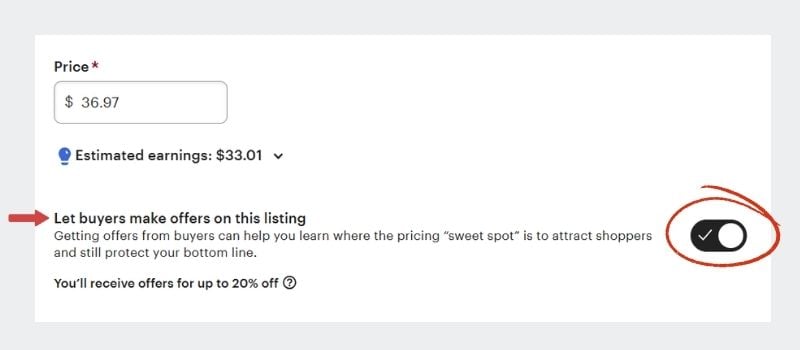
Just below the price you set for the item in your listing, you’ll see the option to Let buyers make offers on this listing. You want to check this off, if that’s what you decide you want.
ALERT: As of this writing (2/26), the default on this option is set to allow offers! In fact, if you go in to make any adjustments to a listing, e.g., add new photos, change the description, or raise the price, it gets set back to the default (which allows offers).
Should You Ever Counter-Offer?
Making (or not making) counter-offers is up to each seller. Personally, I go by the proverb that a bird in the hand is worth two in the bush.
In other words, money a buyer puts on the table is more reliable/better than my counter-offer that might not be accepted.
If you’ve done your job in advance, and made sure that you’ve left room to make a good profit on a 20% offer (or whatever amount you’ve chosen) then accepting most offers should be a no-brainer.
That said, if you’ve decided to be open to ANY offer and a buyer offers only 50% of your asking price, then I guess a counter-offer is in order. But this example shows that my decision to only allow offers with a maximum of 20% off, makes good sense.
Another case where making a counter offer might make sense is when you receive an offer shortly after listing an item. If I list an item for $100 and the next day receive an offer for $80, I might consider making a counter offer of $90, since the listing is so new.
Lastly, if for whatever reason you struggle emotionally with an offer, just feeling like it’s too low, go ahead and make a counter offer that feels more in line with what you think the item is worth. I did this not too long ago with an offer on a quart-sized Dundee marmalade jar (see below).
Can Customers Also Use a Coupon?
So long as the customer goes through the “official” Etsy offer process, they will not be offered or allowed to use any coupons. The discounted offer basically takes the place of any available coupons, e.g., abandoned cart, thank you, etc.
How I learned my lesson: Official offers must be made through the Etsy make an offer button, not through direct email. I learned this the hard way. Someone sent me an email asking for a lower price. I said yes, then changed the price, and put “Reserved for Jane Doe” at the front of the listing.
When she went to purchase the item, Etsy offered her my “abandoned” cart 15% coupon. No fault on Etsy since they would have no way of knowing that I’d already given the buyer a discount. I decided to go ahead with the transaction, but learned a valuable lesson.
NOTE: I’ve since lowered my abandoned cart coupon from 15% to 10%.
Will Free Shipping Be Applied?
Yes! If you offered free shipping on an item that you receive an offer on, then yes, the free shipping still applies. Something to consider when reviewing any offers.
Examples of Offers I Approved
Before I jump in, I want to mention that I don’t like merchandise sitting around in my shop for too long. “Too long” means more than four months!
With items that have a squidgy value, i.e., a highly variable value or a value I’m uncertain of, I’m more likely to take an offer.

I originally listed this folk art figurine, hand carved out of wood, for $38.95. She didn’t sell during the first four month listing period, so when I relisted her, I lowered the price to $32.95.
After a couple more months, I happily took an offer of $28. I had paid just $2 (COGS) for her, so I made a very good profit.

I picked up this very small (3″) oak splint basket for $1. I originally listed it for $42.95, then lowered it to $31.95 when I relisted it. Ultimately, I took an offer of $27, which again resulted in a very good profit.
An Offer I Didn’t Approve

This quart-sized Dundee marmalade jar is very desireable and does not have a squidgy value. I originally listed it for $87.95, then lowered it to $78.95 when I relisted it for the second four months.
A customer offered $67 (16% off) and I counter-offered with $70, partly because I feel it has a clear (to me) value of $70 or more. Also because I have a lot invested in it. I paid £18 ($24) for it on our England trip and wanted to get as close as possible to 3X the purchase price.
Other Articles I Know You’ll Love


Final Thoughts
I hope my examples give you an idea of how I apply the Etsy offer feature and that they help to guide you as you consider using it yourself.
Allowing offers on some or all of your Etsy listings puts a great tool in your selling arsenal, one that you should absolutely consider taking advantage of.
Bye for now,

Thanks for stopping by–
If you enjoyed this post, subscribe today
and get a FREE copy of my eBook:

Would you pin this image to your fave Pinterest board? Thx!


Diana,
After reading this column, I just had to write this about a selling experience of mine. A few years back I purchased some vintage hankies for about $1.00 ea. in a thrift shop. These were all exceptional including one that had a NYC fashion street scene.
As I didn’t have much invested in each one, I put the street scene hanky on Ebay auction for 7 days at a start price of $9.95. Fifteen minutes after the listing started, I had my first bid and an offer of $100.00 if I would end the auction immediately. As I already had a bid, I had to turn down the offer. By the end of the day, the bid was over $135; by the end of the third day, it was at $235.
I did some digging into the history of the hanky and found it was a “gift” presented to a new designer by Yves Saint Laurent at a NYC fashion show in the early 1940’s. Meanwhile, it stayed at that price until the last 5 minutes of the auction a week later when it ended at a price of $682.00! I believe that is a pretty decent profit–but not very likely to ever happen again!
I just love stories like yours Mary! Thanks for sharing it with us. We all now have hope of stumbling across a hidden treasure like yours 🙂