
Increase Etsy Sales: 13 Reasons Your Shop is Struggling
If you have an Etsy shop but haven’t achieved the success you’d hoped for, this article provides thirteen issues to consider that once resolved will help you learn how to increase Etsy sales.
Many sellers dream of some sort of magical “way” to easily sell their antiques. Etsy may seem like that simple and easy way, the way you’ve longed for your entire life.
Unfortunately, Etsy is neither simple nor easy.
There, I said the hard part out loud. Now that we’ve gotten that out of the way, I must add that while it’s neither simple nor easy, it is infinitely doable for most people.
It’s one of those things that has a lot of moving parts but you can get started very easily. But then it’s up to you to be diligent to grow it consistently, adding and learning new parts as you go along. Does that make sense?
If you’ve always wanted to open an Etsy shop, you can take my course Savvy Antique Seller: Etsy Edition and I’ll hold your hand all along the way.
If you already have an Etsy shop and would like it to become more successful, then read on and consider these 13 reasons your shop may be struggling.

1. Not Treating It Like a Job

While it’s true that it is VERY EASY (and free) to open up an Etsy shop, it’s not so easy to make regular sales. It takes consistent work–like most things in life–to make sales on the platform.
If you think snapping a few photos of one or two antiques and throwing them into your shop will result in sales, then you’ve got the wrong idea about how Etsy works.
We’ll get into some of the details in the sections below, but sellers, you need to set aside time every day or every other day to work on your Etsy business.
Pro Tip
Use the FREE printable: Business Planning Workbook (under “Vintage Business Resources”) in my Member Library to help get you thinking about your shop as a REAL business. Get access to the library when you subscribe to my newsletter.
2. Selling Vintage AND Handmade Together
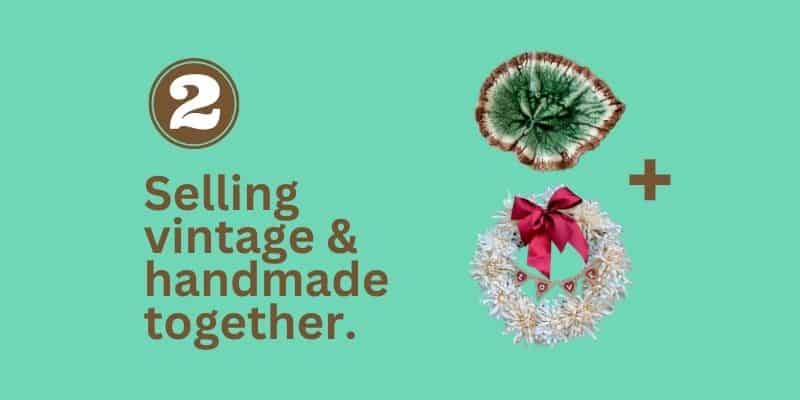
Many antique sellers (like me!) are both antique lovers AND crafters. So often we’re tempted to sell both from the same venue. But unfortunately I’ve not experienced a lot of success combining the two types of merchandise.
The reason for this is that buyers tend to be drawn to sellers based on specific niches, like MCM, vintage clothing, or handmade quilts. Vintage buyers are not necessarily lovers of handicrafts and vice versa.
Offering both types of merchandise can be confusing and disorienting for buyers.
If you’re trying to decide between selling vintage or handmade, I personally think it’s easier to break into a vintage niche than a craft niche.
For one thing, there are less vintage than craft sellers, and for another, vintage items tend to be more unique. So while you may find 1 million handmade concrete planters on offer, you may find only ten or twenty of a certain type of antique.
3. Not Listing Regularly
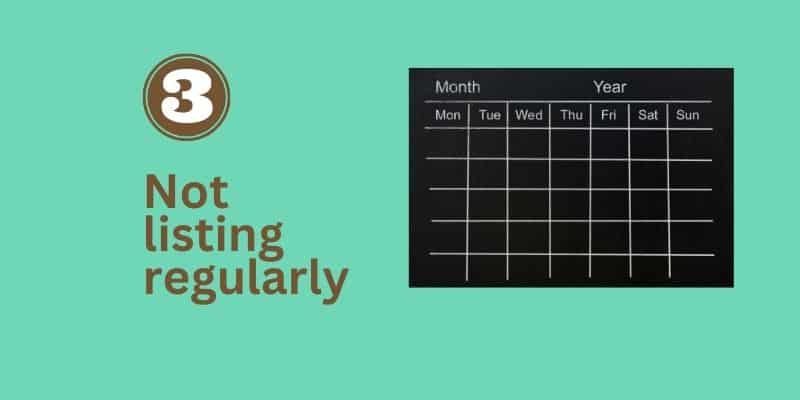
The elusive Etsy algorithm factors in a seller’s frequency of listing. Anyone who questions this only has to start listing regularly e.g., once per day or every other day, and they’ll notice visits to their shop and actual sales go up immediately.
Pro Tip
One of the “tricks” I use to meet this goal is by working in batches. On one day I’ll edit photos for five items; the next I’ll load them onto Etsy and save them in draft form; the final day I’ll write the listings and publish one. I then publish the remaining four, on the following four days.
4. Not Enough Listings
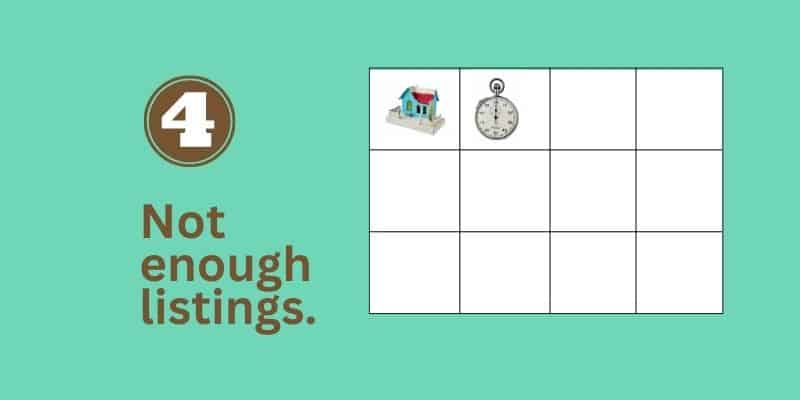
How would you feel if you walked into a gift shop and you saw empty spaces everywhere? You might think the owners don’t know how to run a business or that they’re going out of business.
That’s what it’s like when someone comes to your shop and sees only a handful of items for sale. It’s very important that your shop appear “full” with at least 24 items, preferably far more than that.
Pro Tip
Establish a simple habit for your biz by setting a listing goal for the week and then set a specific day and time to create your listings.
For example, you could decide to list five items/week. You could accomplish this by creating five listings every Monday morning and then posting one/day during the work week.
5. Descriptions are Inadequate
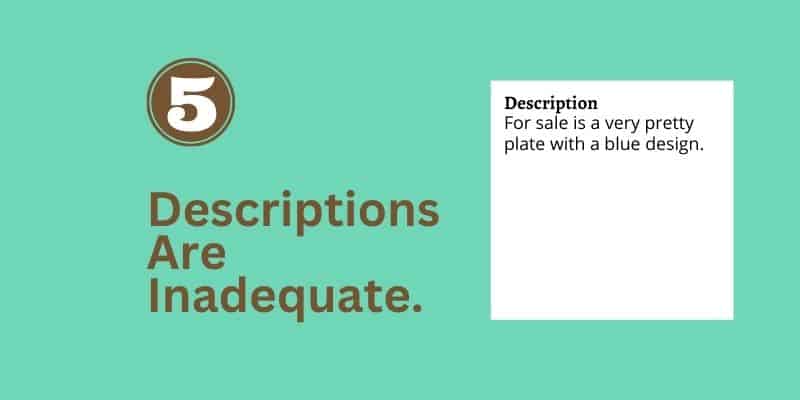
It’s super important that you take the time to craft an adequate (“stellar” is better) description of your item that includes “key words” (see SEO below).
Take some time to read the descriptions in shops that have 1000 or more sales. Chances are, they have some high quality write ups.
Pro Tip
Here are the essential elements of an excellent Etsy listing:
- What is it? Tell what the item is (include a small amount of history if relevant/interesting).
- Size. Include measurements and weight (if relevant).
- Condition. Describe its condition, including ALL flaws.
- The Why. Mention how it can be used and/or why they should buy it (beauty, scarcity, etc.).
6. Not Using SEO

If you don’t know what SEO (Search Engine Optimization) is, it’s time to learn! SEO refers to the way in which search engines, like Google and Etsy, find your merchandise.
There are steps you can take to ensure that both (Google & Etsy) offer your listings to potential buyers. This includes selecting the correct “key words” to describe your item and using them in your (1) listing titles, (2) listing descriptions, and (3) tags.
Pro Tip
Type the name of your item into the Etsy search bar. Underneath Etsy will serve you a list of similar words and phrases. This process will uncover some important key words for you.
In addition, take a look at listings for items similar to yours and take note of how those sellers describe it. This should also provide some helpful key words for you to use.
7. Photos Need Editing

The first point of contact that a potential buyer has with your merchandise is its photo. How important does that make the photo?? It’s absolutely crucial!
No your photos don’t have to be professional level, but the buyer should be able to identify the item and clearly see all the angles. Ideally, it should stand out in a screen filled with similar items.
This is one of the trickiest areas for online sellers and truth be told, many fail at it. Of the thirteen issues listed in this article, this is one of the most important to work on.
Pro Tip
Most photos need lightening and cropping. I wrote an article that should help tremendously: Product Photography: Taking Photos That Sell.
8. Photos Are Cluttered
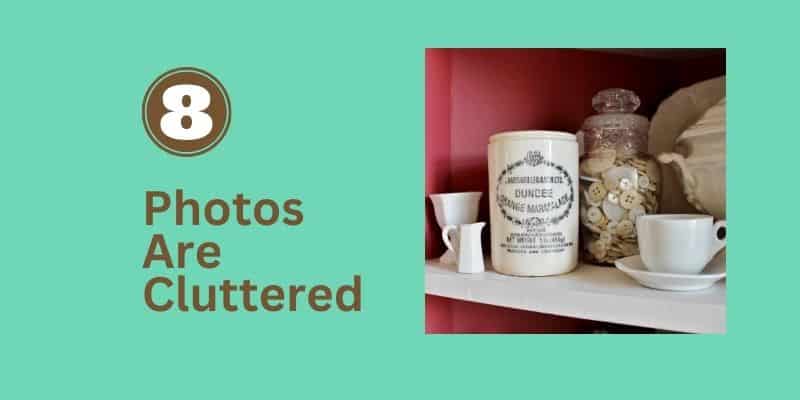
Lots of sellers like to add props to their Etsy photos. While it may make for interesting or attractive photos, it can look cluttered and lead to potential buyers wondering, “Which item is for sale?”
Personally, I want to laser focus in on the specific item itself, especially in the thumbnail, which appears small in searches.
Pro Tip
If you must include an artsy photo showing potential buyers how they could use or display the item you’re selling, don’t use it as your main photo.
9. Photos Are Not Uniform
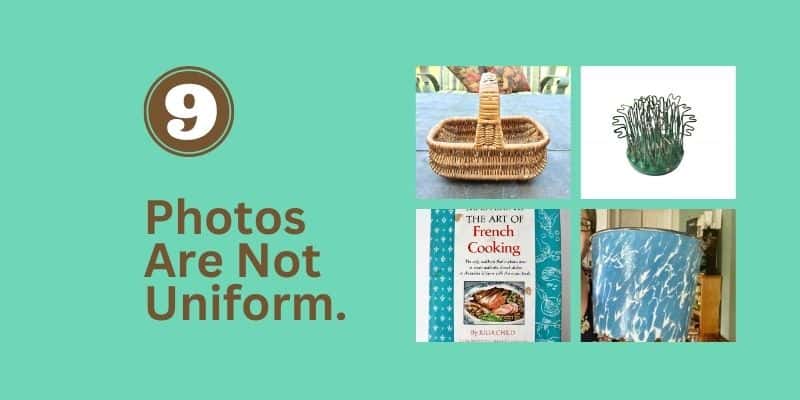
For those potential buyers who actually visit your shop, it’s important that your photos have a uniform look. In other words, similar backgrounds.
Mixing and matching various backgrounds and settings creates a hodgepodge look that doesn’t invite Etsy’s more sophisticated buyers to have a look around your shop.
In my personal opinion a plain white background really highlights your merchandise and allows it to stand out from most other listings. HERE are some background removal tools.
Pro Tip
Make sure you’re item is centered in at least one photo, showing the entire item. This will serve as your first photo and thumbnail. See the photo of the flower frog above (top right).
To do this, take at least one photo with lots of white space around it. A photo taken too close to the item results in thumbnails with your item bleeding off the edges. See the cook book photo above (bottom left).
10. Prices Are Too High
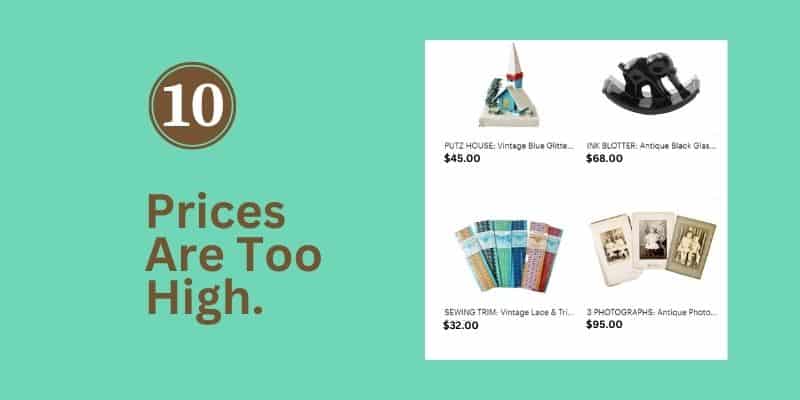
Pricing is tricky, isn’t it? Wouldn’t it be great if we had access to a secret list of “everything that sells well on Etsy” along with the price points??
Since that’s not likely to happen, we have to do our best to try and figure out how to correctly price our merchandise.
Check other Etsy listings for items similar to yours. Are your prices consistently higher than most others? This is a sign that your prices may be inflated.
Etsy is a competitive market, so it’s important to remain viable by pricing within the market range. Experiment with lowering the prices of several of your items and note whether that has an effect on your sales.
Pro Tip
Check out my article, 9 Free Ways to Price Your Antiques; I think you’ll find it helpful. In addition, you should pick up a copy of my Savvy Seller Price Guide (2023). It has over 300 pages of items that have sold over the past three years and how much they sold for. You can preorder the guide HERE.
11. Prices Are Too Low
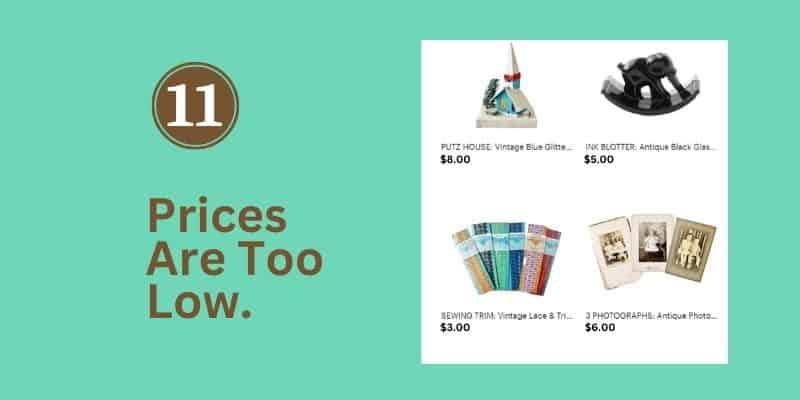
In the same way that pricing too high can reduce sales, pricing too low can as well. Intuitively, it may seem that offering items at prices lower than other sellers, would result in more sales.
In fact, the result may be just the opposite.
When potential buyers see items priced below their market value, it raises red flags. Is there something wrong with it that the seller’s not telling me? Is it a fake? A reproduction?
I have noticed over the years of selling on Etsy that as I’ve raised my prices, in line with other sellers, I’ve made more sales(!).
12. Lack of Interest in Your Merchandise: Failing to Follow Trends
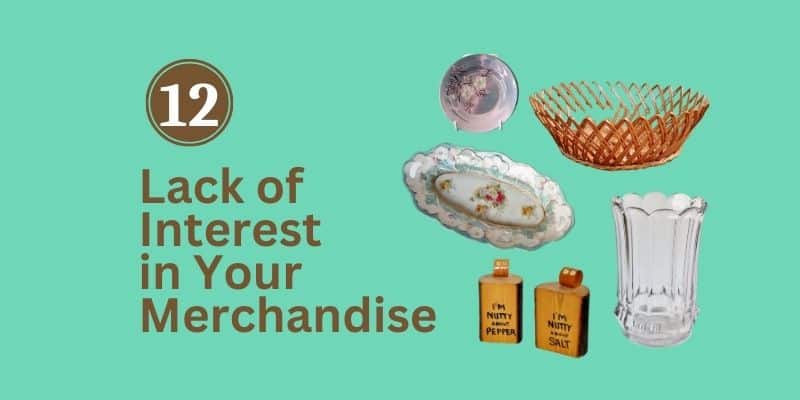
If you’re “doing all the right things” and you’re not making any sales, it’s possible that there’s simply no market for some of your merchandise. In other words, you may have made some wrong choices.
This happens when we buy items we think are beautiful but in reality they’ve gone out of style. Clear glass is a good example of this. You’ll find more examples of poor sellers in my article, 41 Antiques Resellers Should Avoid.
As best you can, it’s important to stay aware of trends in the vintage and antique market. We can do this by reading articles online, talking with other sellers, and keeping track of what’s selling well in our own businesses.
UPDATE: Check out this article to learn more about items that are “hot” right now in our industry What I See Selling on Etsy: 10 Items to Sell in 2026.
Two ways to check the market for a specific vintage or antique item include, reviewing similar item listings on:
- Ebay: Take note of how many items similar to yours are listed for sale on eBay and then check eBay sold listings to see how many have actually sold. If listing numbers are high but actual sales are low, that’s an indicator that the item is not popular. Furthermore, if sales values are low, that’s a bad sign too.
- Etsy: Note whether sellers of similar items have a high number of sales (1000+) under their belts. If so, I’d trust their judgment that the item is saleable. If however, most of the listings come from sellers with few sales, then I’d say pass on that item.
13. Your Shop Isn’t Personalized
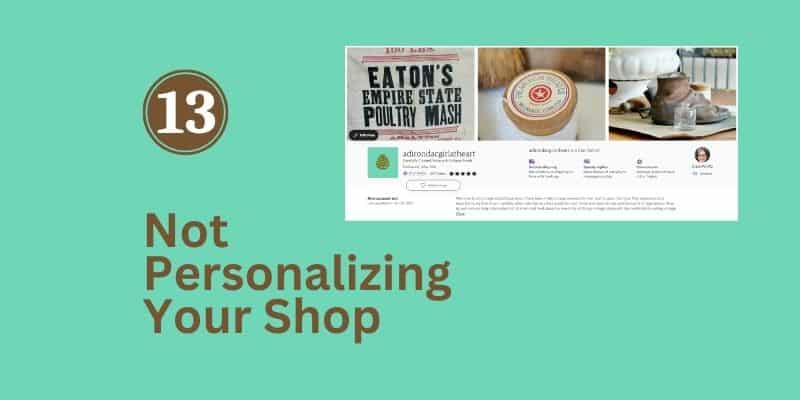
Portrait
Adding a photograph of yourself to your shop personalizes it and allows buyers to connect with you in an important way. Etsy shoppers LOVE to connect with store owners and your portrait allows them to see the person behind the shop.
Will adding your photo immediately result in increased sales? Probably not. But in connection with other adjustments it will create an online space that is inviting to potential buyers, and that’s seriously valuable.
—>>To add a portrait, click “Settings” then click “About your shop” and add your portrait.
Icon (logo) & Banner
Creating an attractive and unique logo and header for your shop goes a long way toward establishing a welcoming environment for your buyers.
If you have a specific niche, jewelry or MCM, for example, then your icon and header should tie in with it. This helps to imprint your shop on the minds of your buyers, causing you to come to mind whenever they want to shop for items like yours.
In my course, Savvy Antique Seller: Etsy Edition, I take students step-by-step through the process of creating a logo and banner using Canva, a free graphics toolbox.
––>>>To add a shop icon, click “Settings” and then “Info and appearance.”
—>>>To add a banner, scroll down on the left side bar until you see the orange “E,” click on the pencil next to it, add your image.
Shop Description
Adding a well-written shop description is one of the simpler changes you can make to your Etsy shop. Start with a blank piece of paper and “brain dump” any ideas you have about your shop and what it has to offer.
Take a look at some of the descriptions other shop owners have and jot down words or phrases that appeal to you. Use an online thesaurus to come up with some jazzy lingo. Now write your winning shop description.
Other Etsy Articles I Think You’ll Enjoy

Final Thoughts
I hope this article provided some clear steps on how to increase Etsy sales by making your shop more competitive.
You may find that making one change, editing your photos for example, produces some good results. In most cases, however, it requires several incremental improvements in a number of areas before positive change is achieved.
Don’t give up! Don’t get overwhelmed. Slow and steady wins the race. Make one change at a time and pat yourself on the back for working hard at your antique biz.
Keep in mind if you want personal help to more quickly improve your shop’s ability to bring in a good income, I offer Etsy shop audits and coaching. Sometimes change is easier when you have a friend to stand by your side 🙂
Thanks for stopping by–
If you enjoyed this post, subscribe today
and get a FREE copy of my eBook:

Bye for now,

I’d love it if you’d pin me for later!


Wonderful article Diana! I am a long time Etsy seller and you are so right about consistently listing–even one item a day makes a difference. It also helps to join an Etsy Team where members mutually visit each others shops and favor items. Plus the support of other sellers is invaluable when you have questions that need answering.
The other thing I will mention is that I have over 2000 sales and do sell both vintage and handmade jewelry. They are clearly separated in my store categories and I have some buyers who buy both at the same time.
Renaming the photos is new to me! I am going to get started on that today. I think something key to becoming a successful seller whatever platform you use is continuing to learn and improve what you are doing. Being willing to change and grow is essential.
I’m glad the article rang true for you (mostly!), Candy. Thanks for the mention of Etsy Teams. I belonged to something like that quite a long time ago and didn’t find it super helpful for me, but times, they are a’changin’!
Also good to hear about your success selling both vintage and handmade jewelry. If sellers want to sell both, they should definitely experiment. I’ve not had similar success, though I’ve tried in multiple ways. An exception has been my handmade watch bracelets and to a lesser extent, charm bracelets made with religious medallions.
Very helpful article. #3 is my issue and why I put my Etsy store on vaction 2-1/2 years ago and haven’t opened it back up. I like your idea of working in batches and will have to try that once I get around to reopening it. I have a few boxes of items that will never sell in my booths for what I see them selling for on Etsy so this hint may just kick start me into action.
On line selling is something that I want to do but, BUT…I am clueless and the unknown stops me in my tracks. your article on Etsy sales was packed with concise information thanks for taking the time and effort to share your experience. also read your piece about button collecting and I have a question ❓ were buttons ever made from ivory?
I’m glad you found the article helpful Vivian! I have a course that helps people get started selling online (Savvy Antique Seller). You can find it here: https://adirondackgirlatheart.com/savvy-antique-seller/ Yes, buttons were sometimes made out of ivory.
I recommend Remove-bg.ai to everyone I know. It’s a brilliant solution for background removal – quick, precise, and impressive!”