
9 FREE Ways to Price Antiques
One of the most frequent questions I get from fellow collectors and vintage sellers is how to value their vintage and antiques. Some items don’t pose too much difficulty, but others can be almost impossible! Today I’m going to share with you all my “secret” ways to price antiques.

1. How to Use eBay as a Way to Price Your Antiques

I wrote an entire article explaining in detail how to use eBay to help you find the value of your antiques. Check it out to get all the info you’ll need.
Sometimes the sold prices you see on eBay are lower than what you can get on other platforms, sometimes they’re higher. Confusing? Unfortunately, that’s just how the vintage selling “game” works, so as dealers we have to test the market.
Generally, I recommend starting high and then coming down in your prices. That said, if you paid a dollar for a desirable item and you think it’s worth $75-85, why not price it at $75 (or even $60-65) for a quick and satisfying flip?
Advanced Tip:
Use the Picclick website to search eBay faster and easier. This mini-search engine shows up to 56 listings (with photos) per page! You can adjust the settings and reduce the number (so you can see the items better) by using a toggle on the upper right hand side of the page.
You can also search sold items only by clicking the gray “Filter all listings” button on the left. Then click “Sold.”
2. How to Use Etsy as a Way to Price Your Antiques

While Etsy doesn’t offer a way to search for sold listings of specific items, it nonetheless does provide SOME information about SOME sold items.
I explain how to find this information in this article: Find Sold Prices on Etsy in 3 Simple Steps.
3. Use My FREE Price Guides to Price Your Antiques

Did you know I have ten FREE price guides made up of items I’ve sold over the past seven years? You can access them anytime you want by clicking on “Price Guides” in the navigation bar at the top of my blog. Easy Peasy.
In addition, I have five other guides (more to come!) in my Member Library: Fenton glass, cameras, flower frogs, Yellowware, and Little Golden Books. When you subscribe to my newsletter, you get immediate access to the Library and thus, to the price guides. Subscribe right here:

4. Join Facebook Groups to Get Help Valuing Antiques
Facebook groups are a great place to gain information about vintage and antiques. You can find general groups as well as very specific niche groups. For example, I’m in one that’s all about Sarah Coventry jewelry.
If you haven’t joined my Facebook group (Your Vintage Headquarters) yet, what are you waiting for?? It’s filled with all kinds of vintage lovers and sellers (on a variety of platforms) who love to share their knowledge with each other about items that member’s post. They’ll help with identification and pricing.
5. Talk with Other Vintage Sellers
There are two parts to this answer. The first part (1) is for vintage sellers and the second part (2) is for vintage collecters.
(1) VINTAGE SELLERS: One of the mistakes I made early on in my business was being afraid to talk with other dealers, including the owner of my shop. I felt extremely insecure about my antique knowledge and didn’t want to make a fool out of myself.
Oh my goodness! The depth of knowledge I missed out on those initial years! What finally happened is that I made such a discovery of antiques being thrown away in my neighborhood, that I couldn’t move forward without getting some help.
As a result, I discovered that other dealers LOVE looking at, holding, examining, and talking about antiques–anytime, any place. My fellow dealers were so kind and generous with their time and knowledge. I learned a great deal from them and will always be grateful.
The moral of the story: Always make friends with the dealers (and the owner) of your shop; it will pay off in dividends of all kinds over the years, not just help with pricing.
If you don’t have an antique booth, then you’ll want to network with other online sellers in Facebook groups specific to your platform.
(2) VINTAGE COLLECTORS: If you are a vintage and antique collector, then you won’t have access to a cadre of “vintage sellers” to answer your questions. But the owners and managers of many antique shops are usually very happy to help anyone who calls or comes into their shop, if they can.
Here’s how I suggest you approach things: call the shop and explain to whomever answers that you have an antique that you would like to learn more about and could you bring it in to discuss it with someone? Very likely they will say yes. Ask who your speaking with and could you bring it in right now and show it to him/her?
If that person isn’t able to help you as much as you’d hoped, chances are s/he knows someone who can, and they may be willing to connect the two of you. In the process, you’ve made a good contact who may be able to help you out again in the future.
Expert Tip: If you do establish a relationship with one or more dealer/owners, do be sure to gift them a bottle of wine (or the equivalent) at some point in your relationship as a thank you 🙂
6. Use My “What’s Selling” Blog Posts

Every month for the past four years, I’ve written “income reports” that detail exactly what I sold in that month and from which platform. This information is GOLD you guys!
With a few clicks of your mouse, you can see everything that I sold from my antique booth in 2020 or 2019 or 2018. Or everything that I sold on Etsy for the month of June 2019. Or what I sold on Facebook Marketplace. It’s all there:
- Photos of almost every item,
- What I paid for each, and
- What each sold for.
Check them all out HERE.
7. Watch My FREE Videos
Last February I created a vintage and antique channel on YouTube and started to regularly post videos of my vintage finds, along with videos of specific antiques, like Pyrex, milk glass, and Native American baskets.
All my videos contain pricing information so be sure to check them out. My channel is still in the beginning stages so I could really use your subscriptions, comments, and likes whenever you get the chance–thanks so much!
8. Go to the Library

Most libraries have excellent vintage and antique resources, so you should absolutely make a visit to your local library to see what they have to offer. If you struggle to find what you’re looking for, go to the information desk and they will be happy to help you out.
They may also be able to connect you with eBook resources that you can access easily in the comfort of your own home.
9. Go to the Bookstore
I’ve told this story before: When my sweet husband and I were first married and resources were tight, one of our favorite “date nights” was going to our local bookstore, grabbing a coffee, and settling to in to read/skim a pile of antique guide books and periodicals (or newspapers in my husband’s case).
I always brought a notebook with me and took notes on information I gathered about recent vintage finds that I had no previous background in. It felt like I’d taken a college course in art history by the end of the night and I LOVED it!
Handy Tip: Use Thriftbooks to buy your price guides and save loads of money!
There you have my 9 FREE resources for pricing your vintage and antiques. Before I sign off and call it a day though, I want to mention a few of my paid products because they will give your vintage business a noticeable boost.
Use My Digital Products to Help Price Merchandise
You can find my digital products for sale on Etsy. Go to the left hand list of categories, scroll to the end, and click on DIGITAL PRODUCTS and you’ll find those recommended below:
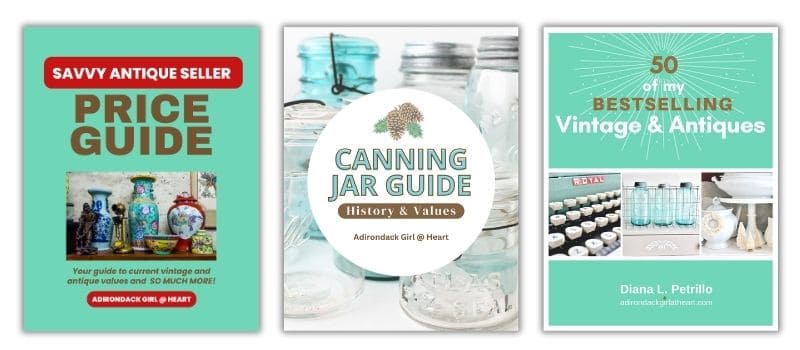
- Savvy Antique Seller Price Guide: Examine five full years of vintage and antique sales on four platforms: antique booths, Etsy, eBay, and Facebook Marketplace. Enjoy full-color photos, descriptions, dates, marks, and values on 400 pages of content.
- Canning Jar Guide: History & Values: Take the deepest dive into understanding the history and values of canning jars (or “fruit jars” as collectors refer to them) in over 130 pages of material with a good look at many of the brands you’re likely to run into while out vintage shopping.
- 50 of My Bestselling Vintage & Antiques): Get 50 categories of items that I sell regularly, with an example of each and the price it sold for. Four pages geared mainly toward antique booths.
My resources not only help with pricing but they will give you an edge when it comes to buying the “good stuff,” that is, the stuff that sells. That’s what we all want to know right??
Thanks for stopping by!
If you enjoyed your visit today, subscribe and get your FREE printable
(in the Member Library under Business Resources):
9 FREE Resources to Help Price Vintage & Antiques

Bye for now,

I’d SO appreciate a pin!

Lots of great information! So much more now to help with pricing. How did sellers do this 50 years ago ???
Right?? We’re so lucky to have all these resources 🙂 Thanks for visiting and taking the time to leave a comment, Patty <3 <3
This time, I had no problem opening this post. Go figure. Lotsa good info here; pleased that I am already doing a lot of this!