
Blue Willow China Collecting Guide [History & Values]
Please be patient while this post is being updated! Thank you-
Are you a lover of blue and white home decor? If so then you’re going to enjoy today’s post all about collecting vintage blue willow china, one of the most popular china patterns in the world.
Potteries in England, Japan, America, and elsewhere have produced this fascinating design for centuries. In fact, it’s still in production!

This post contains affiliate links for materials related to this blog post. I may receive a small compensation whenever you click on such a link and make any sort of a purchase, for which I thank you.
Table of Contents
Blue Willow History
Blue Willow Story
Elements of the Story Found in the Pattern
Willow Colors, Shades, & Borders
English Blue Willow
Japanese Blue Willow
American Blue Willow
Unmarked Blue Willow
Blue Willow Toy Tea Set Pieces
What is Blue Willow Worth?
Where to Find Blue Willow China?
Fun Blue Willow Facts
Other Articles You’ll Enjoy
History of Blue Willow China
Trade between Europe and China opened up in the 16th century through the efforts of explorers like Marco Polo. The English in particular fell in love with the beautiful Chinese blue and white porcelain, which they imported by the ton.
English potters struggled for years to develop pottery with the same look and feel in an effort to produce it at a lower cost. When they finally did in the 18th century, much of that early hand painted decoration mimicked Asian designs.
One of those designs, “Blue Willow,” was developed by potters in the Caughley Pottery Works. However, the standard pattern that we know and love today was produced by the Spode pottery in the 1790’s. Ultimately, both used the transferware process.
Related Articles:
The popularity of the Blue Willow design has stood the test of time. Thousands upon thousands of pieces of china have been produced through the years. It would be a rare flea market or antique shop that you couldn’t find a piece of it tucked away somewhere.
According to Mary Frank Gaston in Blue Willow an Identification and Value Guide, through the years “Blue Willow items have been sold through catalog ordering companies, variety stores and even given as premiums with certain products” (17).
Churchill China and Royal China, for example, produced pieces for the purpose of grocery store premiums, thus putting this beloved pattern into the hands of many new admirers.
The Blue Willow Story
When it comes to the quaint Blue Willow story, Gaston also explains that “the Blue Willow legends weren’t created until after the pattern had become popular” (9).
Credit for the development of the story goes to writers at Minton Pottery of England. Though somewhat based on The Green Willow, a Japanese fairy tale, the story was merely a marketing ploy. Many versions abound.
Here’s my take on the story:
Once upon a time, Koong-se a young woman of great beauty fell in love with Chang, her father’s accountant. Enraged when he discovers their love, her father banishes the obviously lower class young man and constructs a wall to enforce their separation.
Daily the girl walks to the property’s edge and stands beneath the willow tree, gazing out across the sea and dreaming of her love. She despairs when she learns her father plans to marry her to a Duke.
But on the evening before her wedding, she escapes with her one true love; they race across a bridge on the property and flee on the Duke’s own ship!
Sadly, their union isn’t meant to last. The Duke tracks them to an island where they’ve built a beautiful life, and he slays Chang, leaving Koong-se bereft. She dies of a broken heart.
The gods take pity on the pair and turn them into doves, allowing them to fly together forever.
Elements of the Story Found in the Pattern
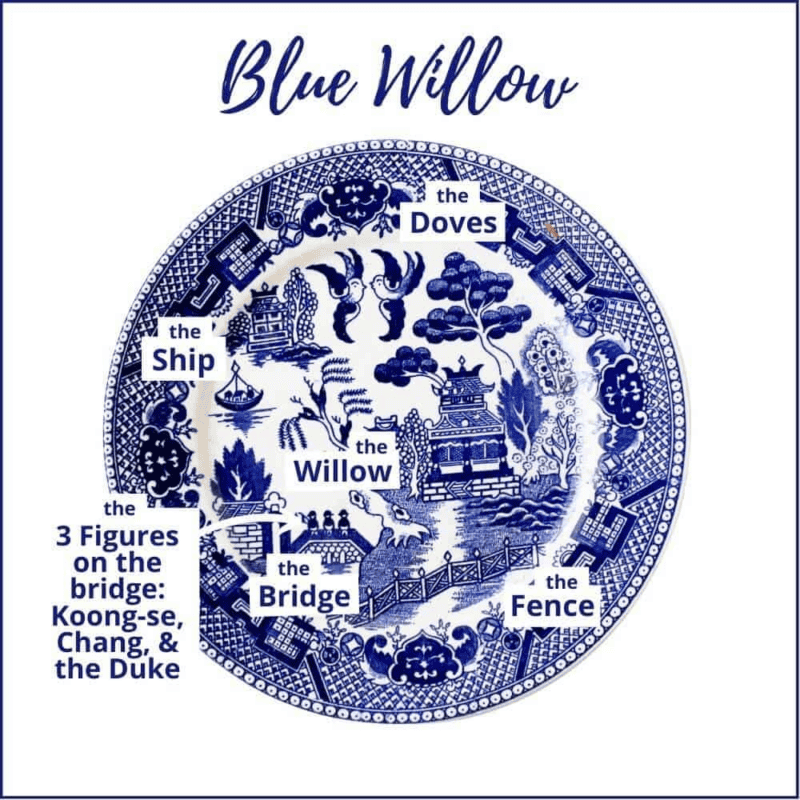
Until I started writing this post, I had never looked that closely at the Blue Willow design. At first I couldn’t quite make out all the relevant “parts.” But I think I have them figured out and thought I’d share them with you.
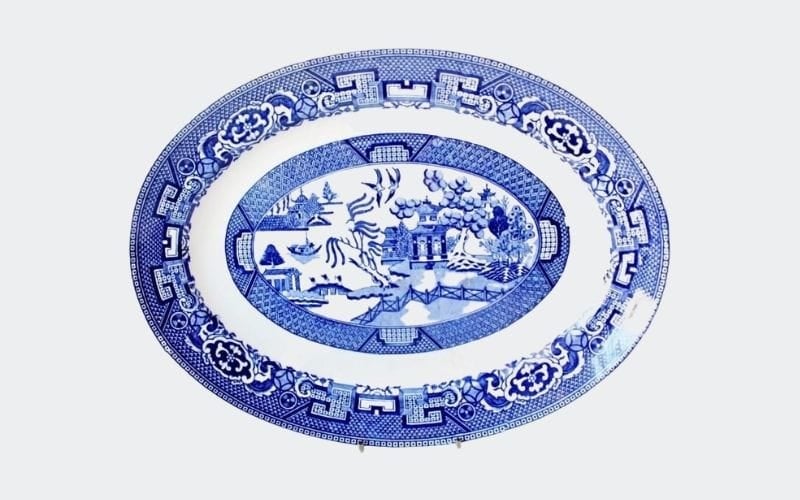
This unmarked platter displays the “official” Blue Willow pattern with an outer decorative border as well as an inner decorative border.
You’ll notice that it includes a willow with four sets of fronds (three strands in each), as opposed to the willow tree on the plate in my diagram above, which has only three sets of fronds. Identifying and understanding Blue Willow can get very detailed!
Smaller Blue Willow Platter
Unmarked
c. last half 20th century
Value: $12-20
Willow Colors, Shades, & Borders
Colors
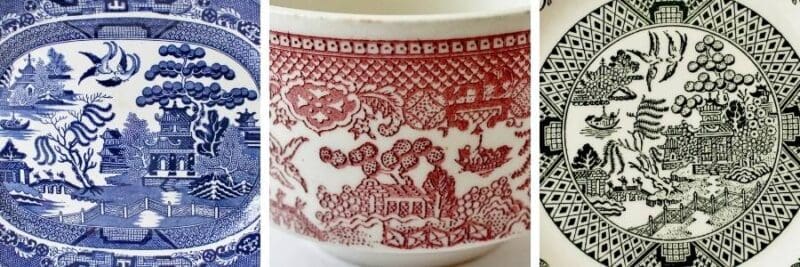
The willow pattern comes in more than just blue! As seen above, you can find it in red/pink and green as well. In addition, you can look for black and multi-colored.
Shades
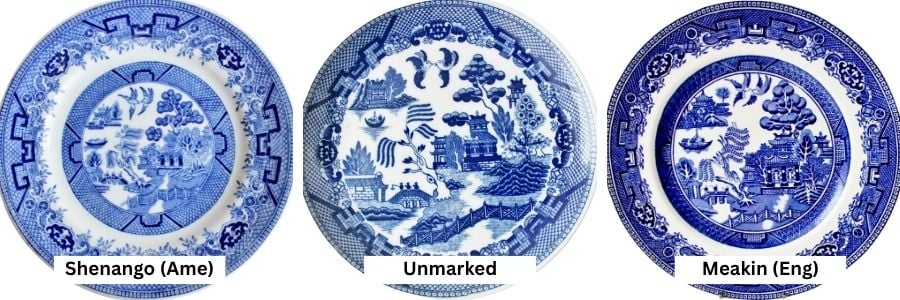
And as you can see above, Blue Willow comes in a variety of shades from light blue to dark or indigo blue.
The first, lighter example is a Shenango China dinner plate, made in the U.S. The center slightly darker plate is unmarked and the third plate hales from England–made by the Alfred Meakin pottery.
Borders
Information regarding the various Blue Willow borders is based on information provided in Blue Willow an Identification and Value Guide (12).
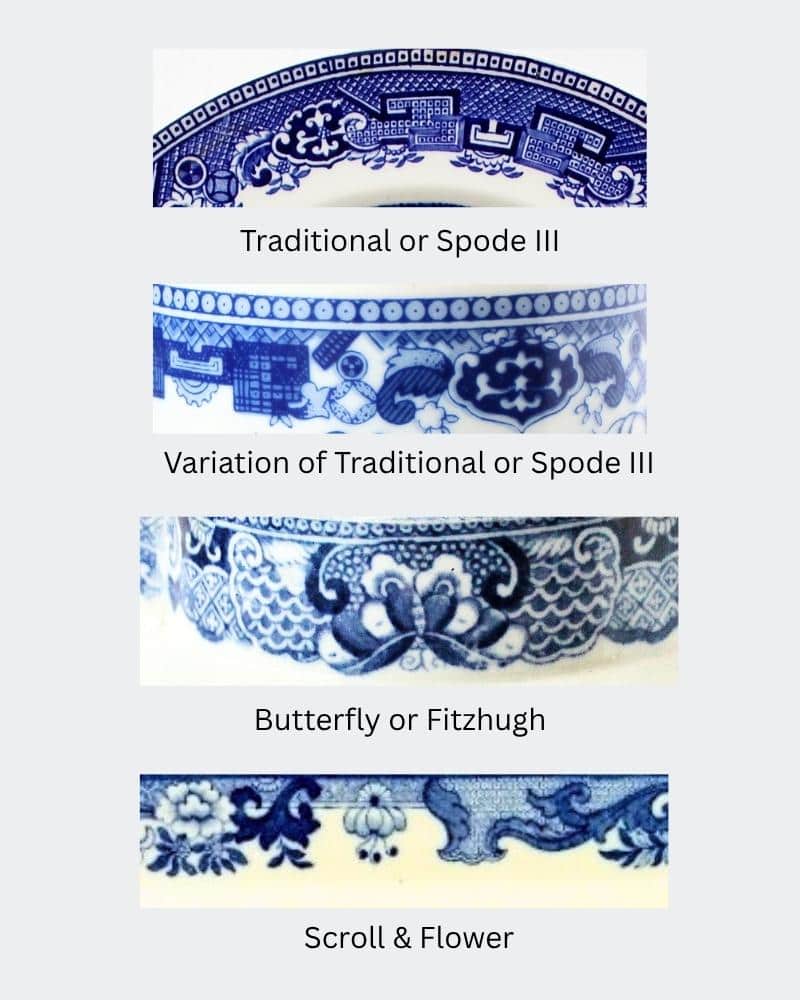
The large variety of border designs have been given their own names for identification. Above you see:
- Traditional or Spode III
- Variation of the Traditional
- Butterfly or Fitzhugh
- Scroll & Flower
Additional known borders include:
- Bow Knot: Has “2-layer wedding cakes” with diagonals shooting out from each side of the base
- Dagger or Fleurs-de-lis: Narrow ridges starting on the outer edge, aimed toward the center
- Floral: Flowers separated by white space
- Pictorial: Images taken from the Blue Willow design itself
- Simple Line: One or two thin lines
- Borderless: No border
English Blue Willow
Ridgway
Edward John Ridgway established his pottery, which produced earthen and stonewares, in 1866 in Stoke-on-Trent. His sons John and Edward joined him in 1873, The Potteries.
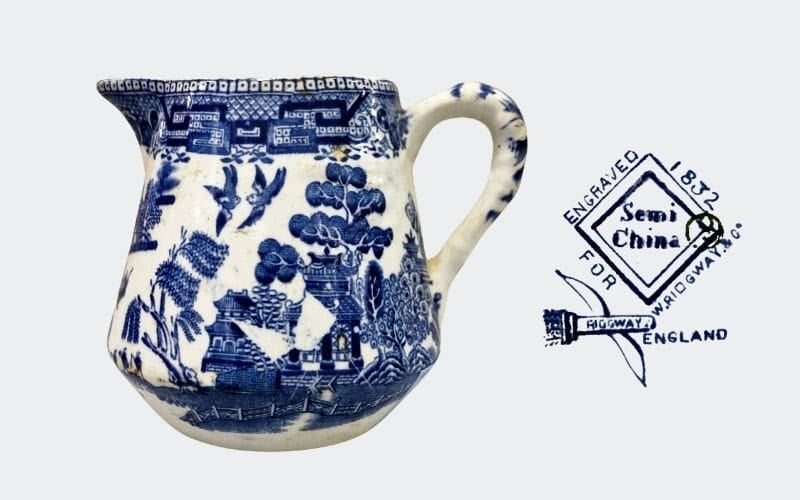
Creamer
Ridgway Pottery
c. 1890-1910
Value: $18-22
Allertons LTD
Charles Allerton began producing china in Stoke-on-Trent in 1831 along with two other men. In 1859, those men left and Allerton’s sons joined the company. Production ceased during WWII, The Potteries.
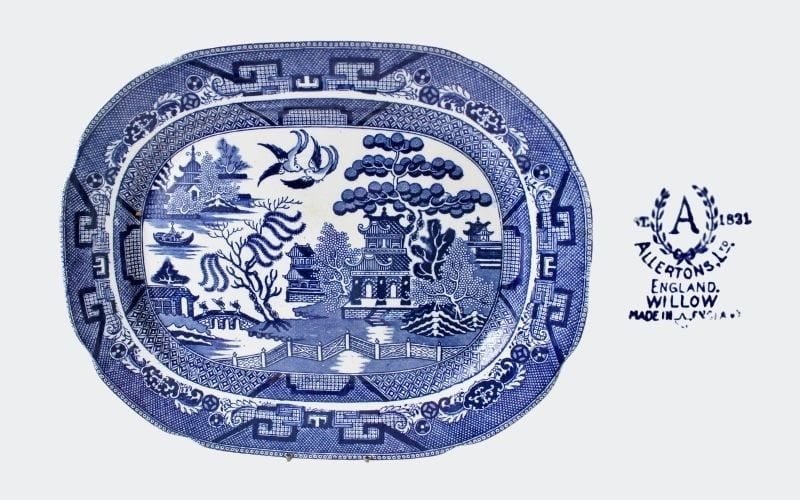
Platter
Allertons, Ltd. Stoke-on-Trent
c. 1929-1942
Value: $40-50
Mason’s Ironstone China
When one asks, “Who invented ironstone?” Invariably the response is Charles Mason who filed the patent for it in 1813; however, William Turner and Josiah Spode beat him to the actual invention of the stuff.
Mason was in business in Stoke-on-Trent from before 1813 to 1854, producing both earthenware and ironstone, The Potteries.
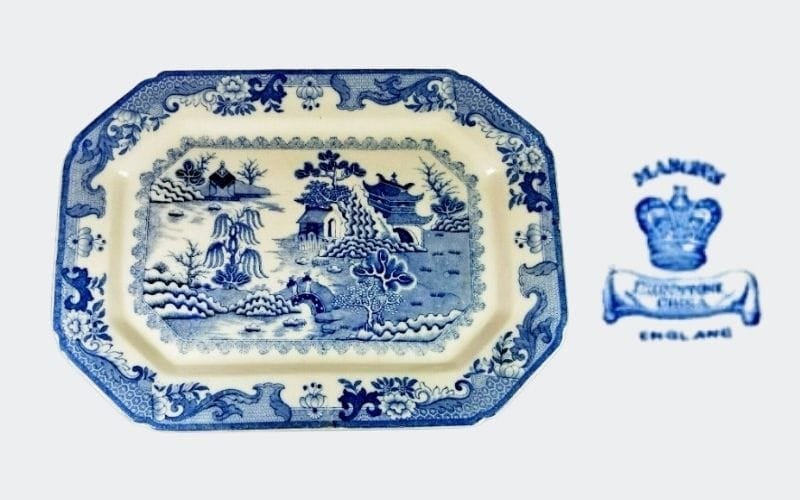
Platter
Mason’s Ironstone China
c. Mid-1800’s
Value: $90-100
Related Articles:
Alfred Meakin
Alfred Meakin began his solo pottery business in 1873 in Stoke-on-Trent, manufacturing both earthenware and ironstone. The company produced pottery under various owners, using the Meakin name, until 1976, The Potteries.
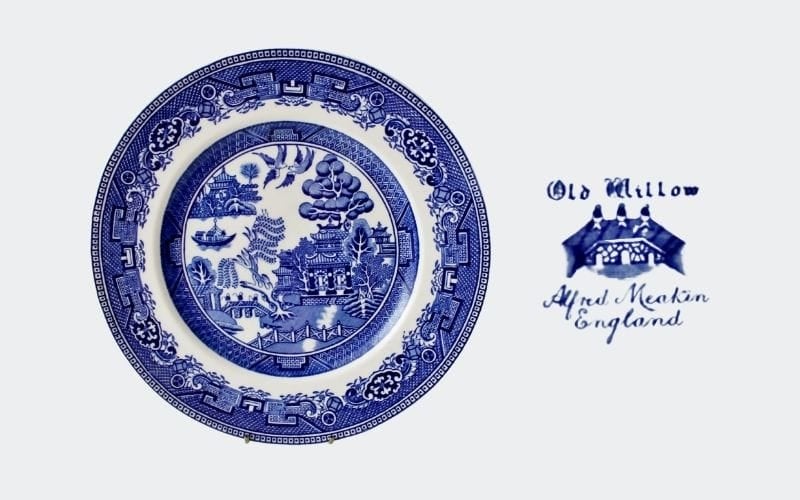
Dinner Plate
Alfred Meakin, Stoke-on-Trent
c. 1930’s
Value: $20-25
Unclear Mark, England
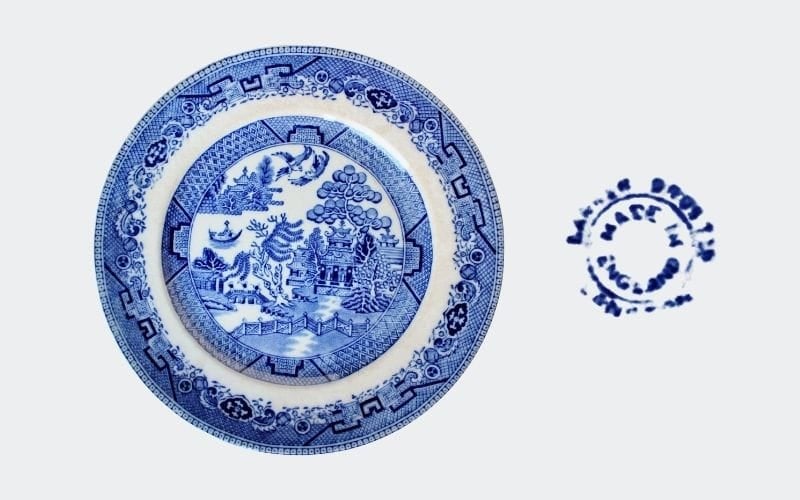
Dinner Plate
Made in England, by who? when?
Value: $10-15
Churchill
Blue Willow pieces by Churchill were produced for grocery store giveaways. I remember my local Price Chopper giving it away back in the day. At the time, I didn’t succumb to its siren song since I already had a set of china at the time.
This common marketing strategy would entice shoppers to return week after week in order to assemble an entire set. The Grand Union, for example, gave away the popular “Liberty Blue” dishware shortly after the Bicentennial.
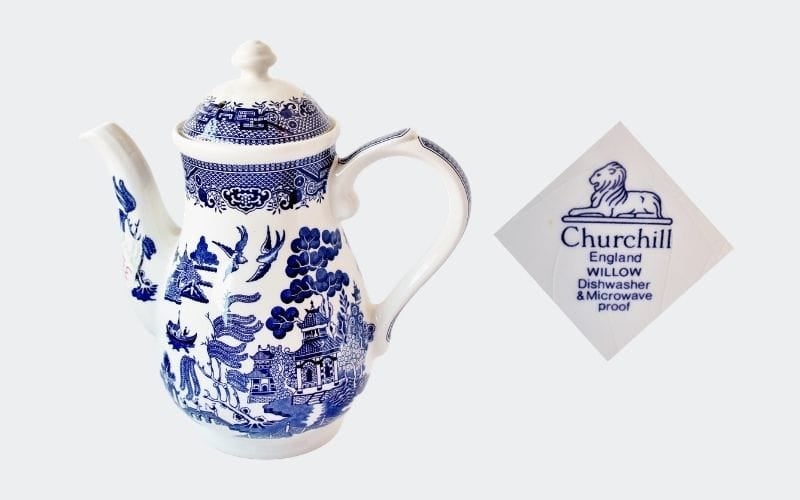
Teacup & Saucer
Churchhill China
c. 1990’s
Value: $25-35
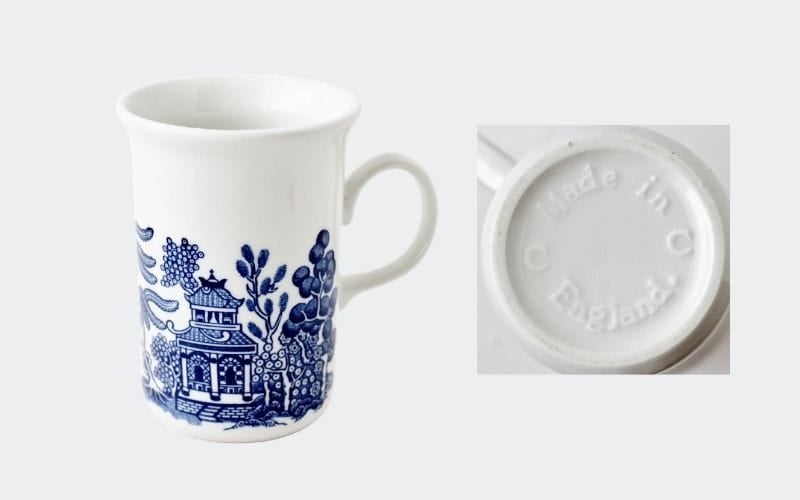
Mug
Signed: CC for Churchhill China
c. 1990’s
Value: $4-5
Japanese Blue Willow
Around about the 1920’s, the Japanese began producing their version of Blue Willow china. Sometimes the coloring appears much more heavily saturated than on most American pieces, as well as some English. Look for marks like Nippon, Made in Japan, Japan, and Occupied Japan.
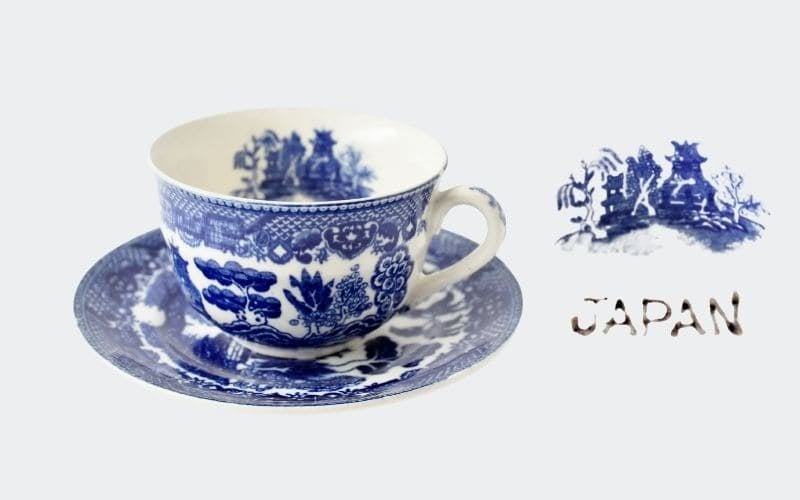
Teacup & Saucer
Japan
c. 1950’s
Value: $15-20
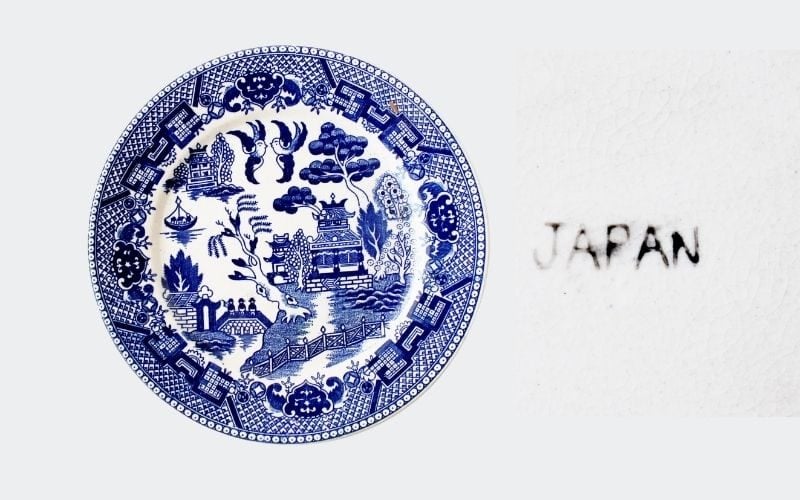
Dinner Plate
Japan
c. 1950’s
Value: $12-18
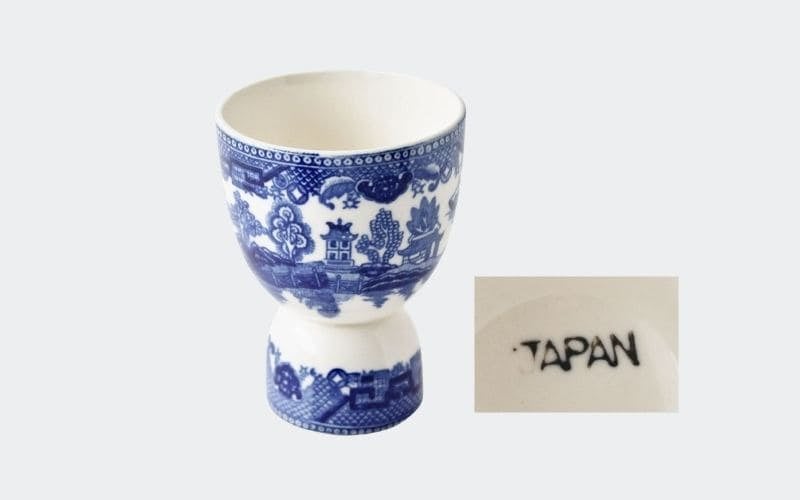
Egg Cup
Japan
c. 1950’s
Value: $15-20
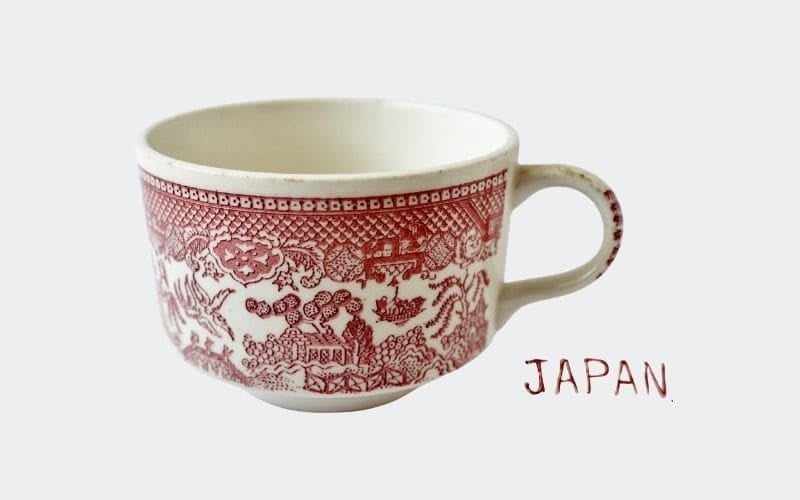
Cup
Japan
c. 1950’s
Value: $5-6
See also: Blue Willow Toy Tea Set Pieces (made in Japan)
American Blue Willow
Buffalo China
The Larkin Soap Company founded Buffalo Pottery in 1901 to produce pottery they could use as premium give-aways. (The name changed to Buffalo China in 1956.)
Buffalo Pottery is credited with being the first American company to produce a version of the Blue Willow in 1905 or 1907. From this date forward, multiple other American potteries produced Blue Willow dishware.
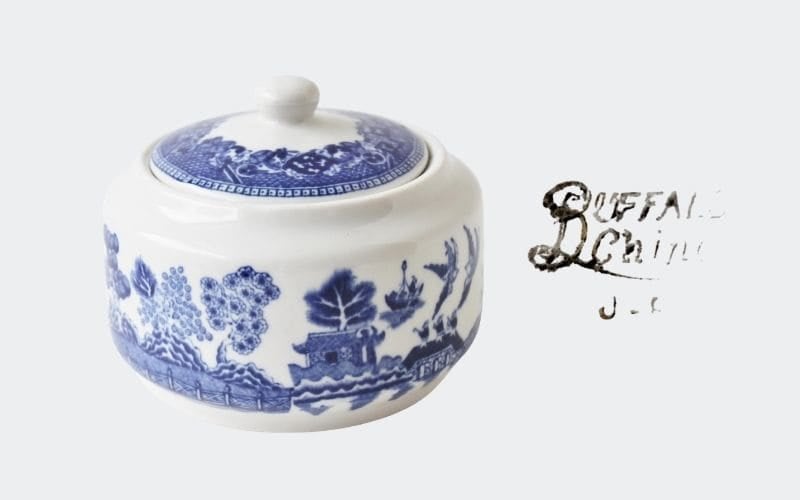
Sugar Bowl
Buffalo China
c. 1950’s
Value: $10-12
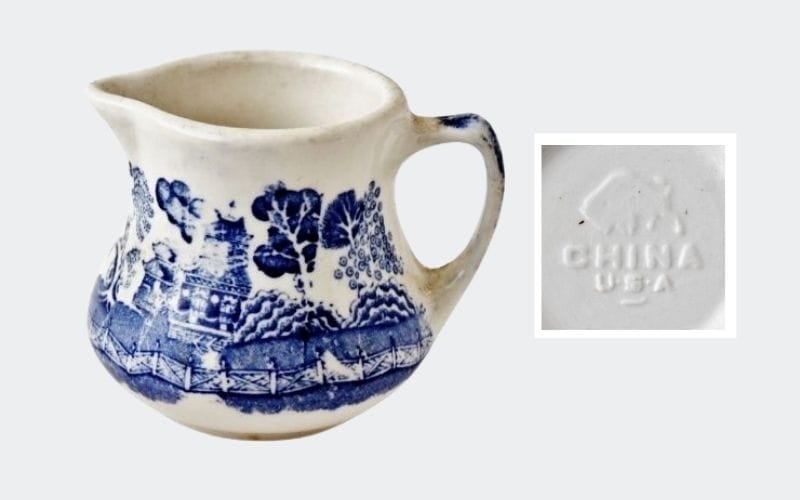
Small Creamer
Buffalo China
c. 1950-1980’s
Value: $8-10
Royal China
The Royal China Company out of Ohio produced a set of Blue Willow china that grocery stores gave away in the 1940’s, long before Churchill China ever got into the act.
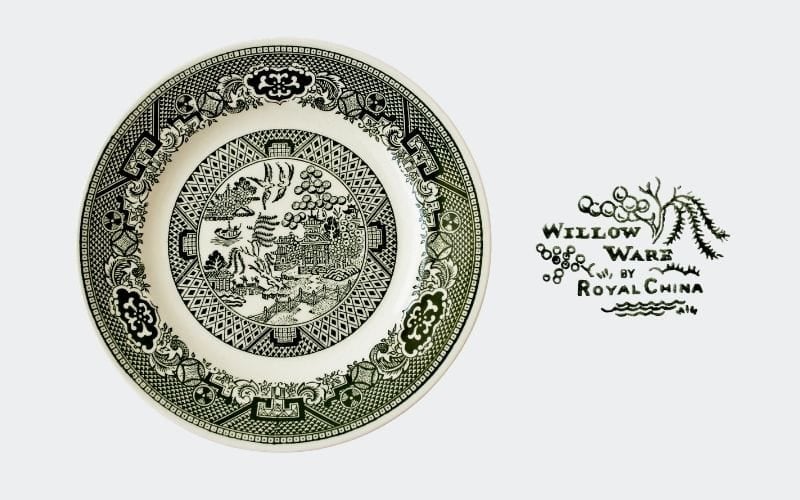
Salad Plate
Royal China “Willow Ware”
c. 1950’s
Value: $8-10
Shenango China
In business for 90 years [1901-1991] Shenango China of New Castle, PA produced a significant amount of heavy-duty restaurantware in the Blue Willow pattern from the 1920’s to the 1950’s.
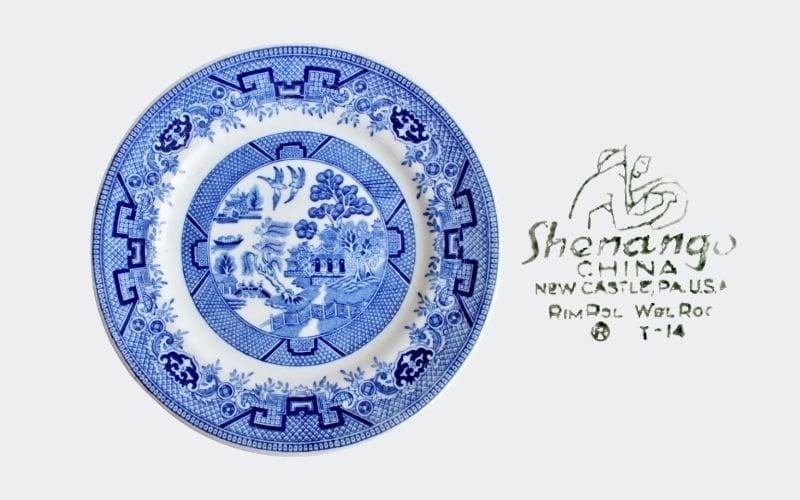
Dinner Plate
Shenango China, T-14
c. 1956
Value: $15-18
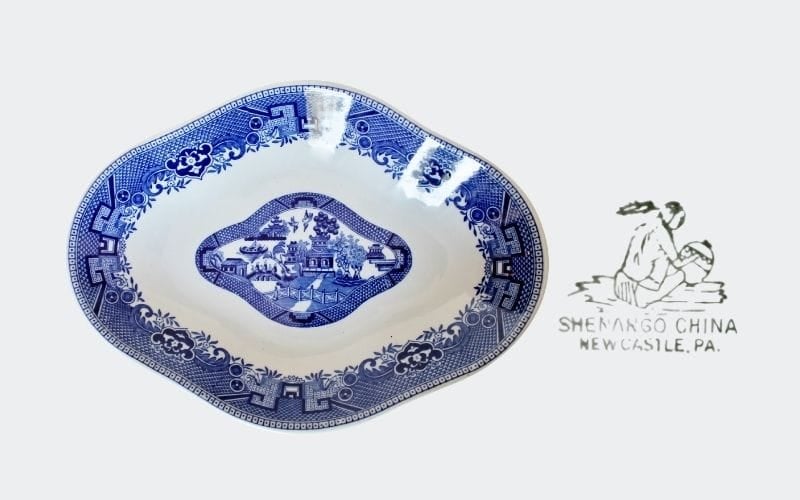
Small Serving Dish
Shenango China
c. 1950’s
Value: $12-15
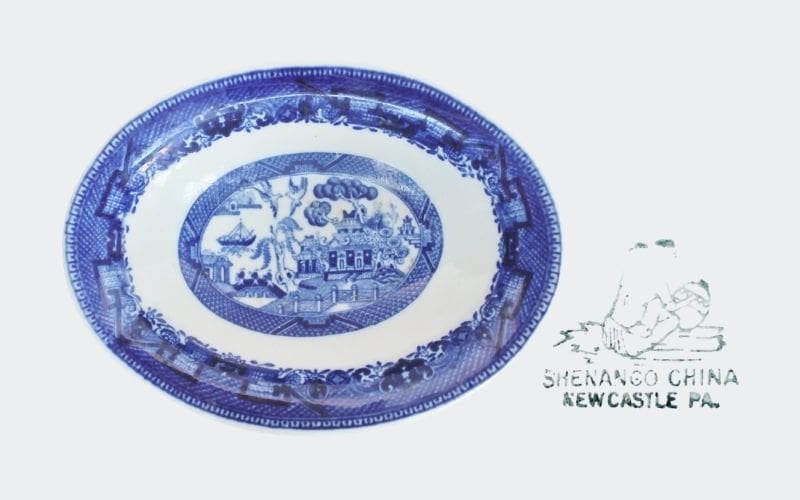
Soap Dish
Shenango China
c. 1950’s
Value: $12-15
Unmarked Blue Willow
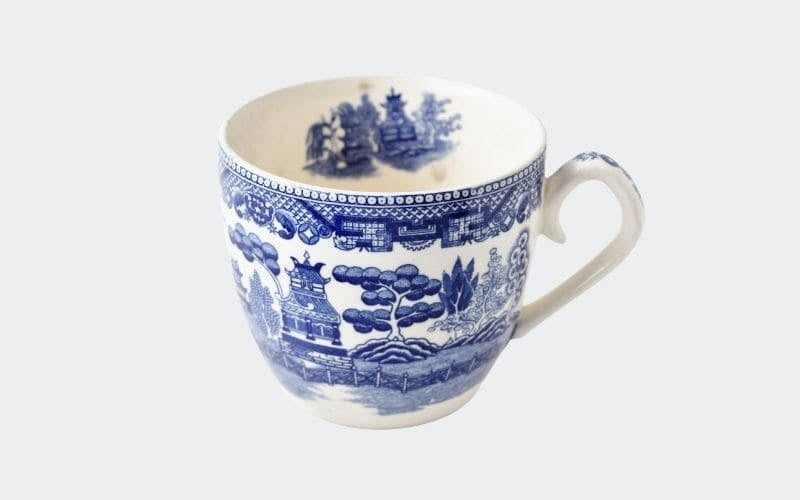
Large Cup (20 oz.)
c. Last half 20th century
Value: $20-25
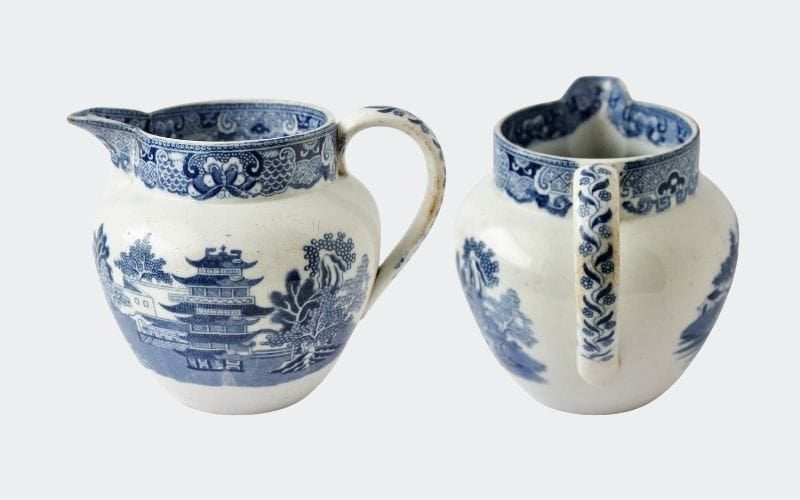
Pitcher
c. 1st half 20th century
Value: $25-30
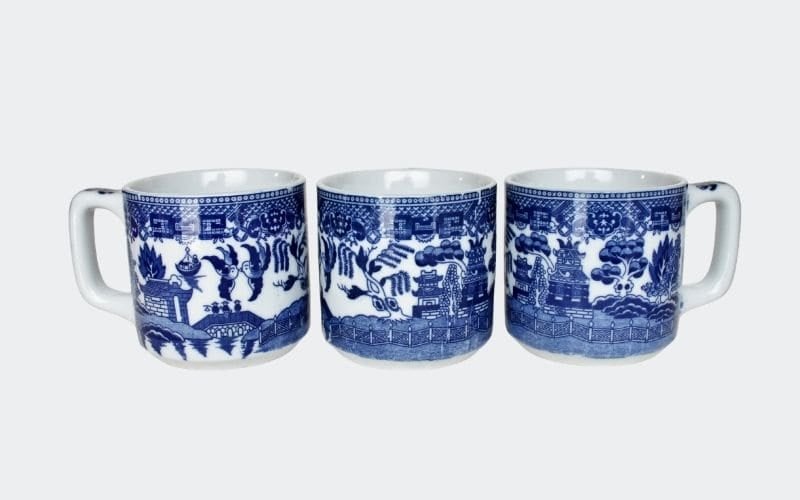
Mugs
c. Mid-20th century
Value: $15-18 each
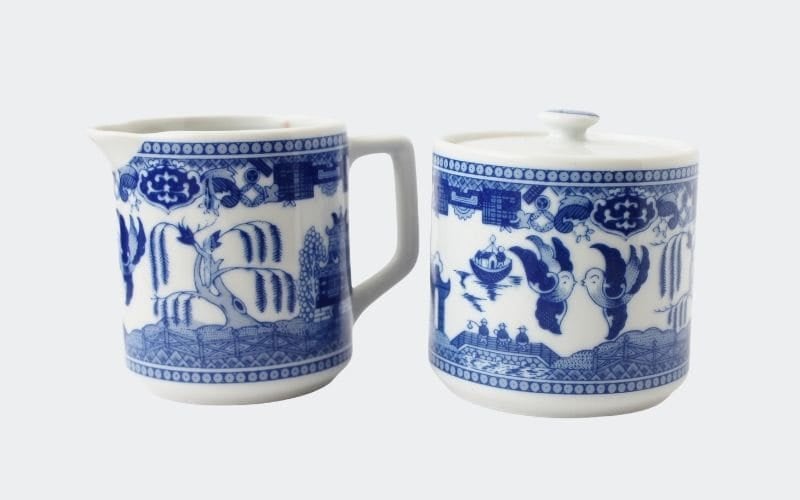
Cream & Sugar
c. Mid-20th century
Value: $10-18
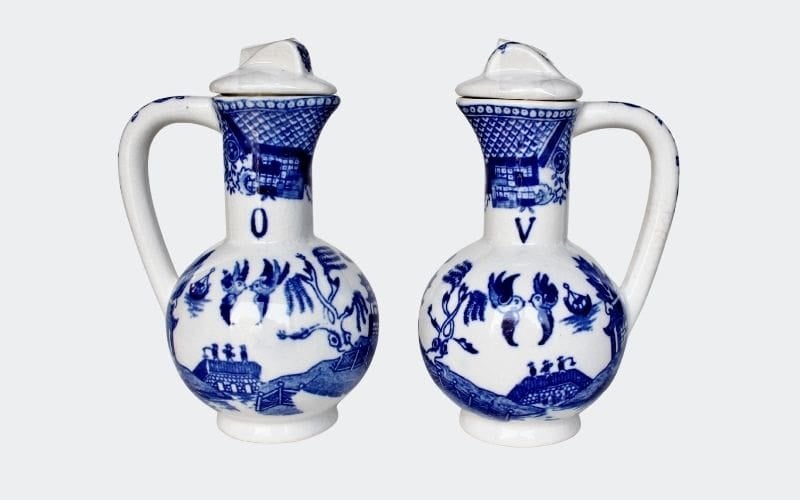
Oil & Vinegar Cruets
c. Mid-20th century
Value: $20-30
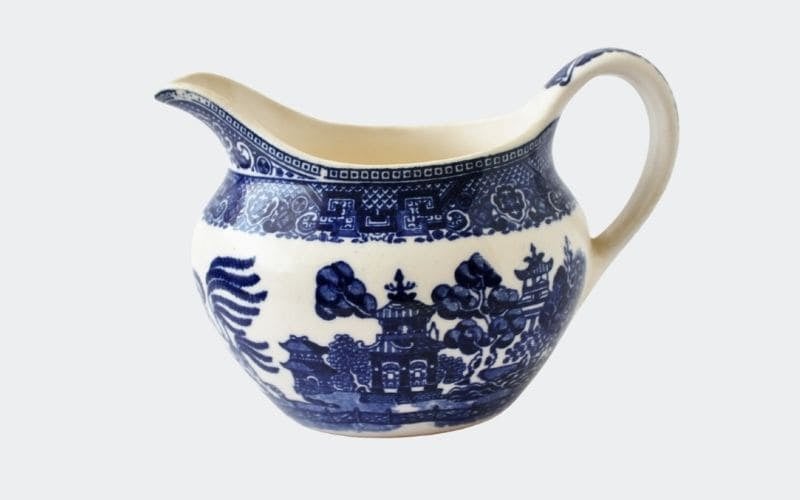
Sauce Boat
c. 1st half 20th century
Value: $18-22
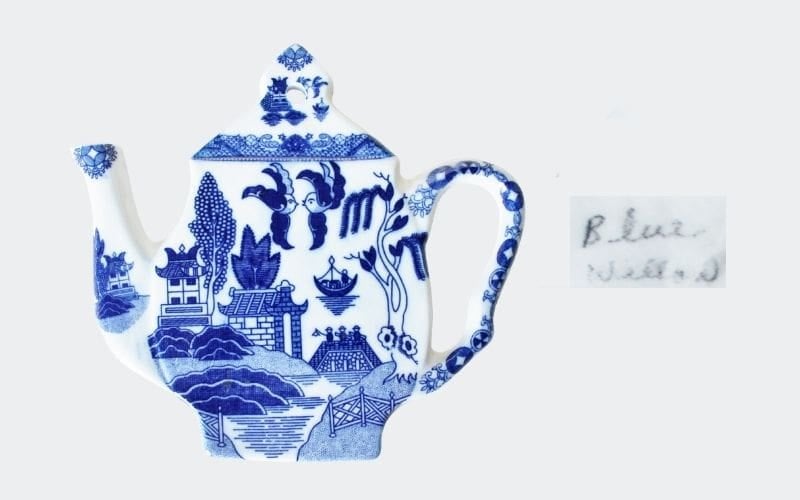
Teapot-Shaped China Trivet
Signed: Blue Willow
c. 1980-2010’s
Value: $15-20
Blue Willow Toy Tea Set Pieces
These toy Blue Willow pieces date to the first half of the 20th century.
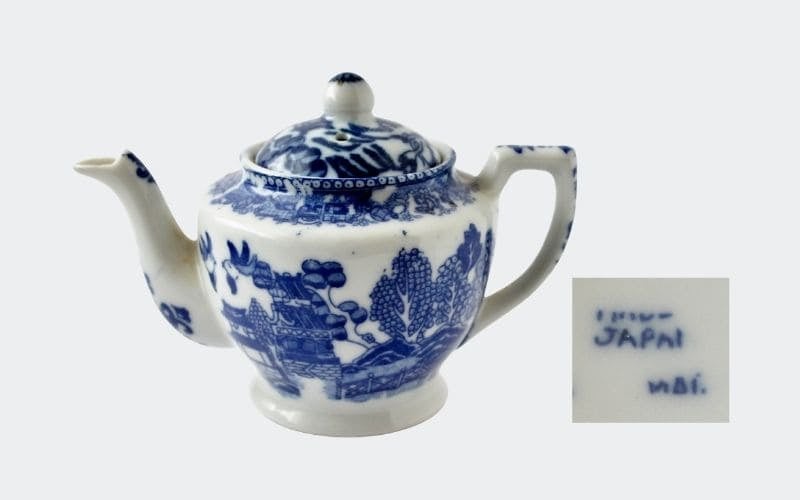
Teapot
Made in Japan
Value: $10-15
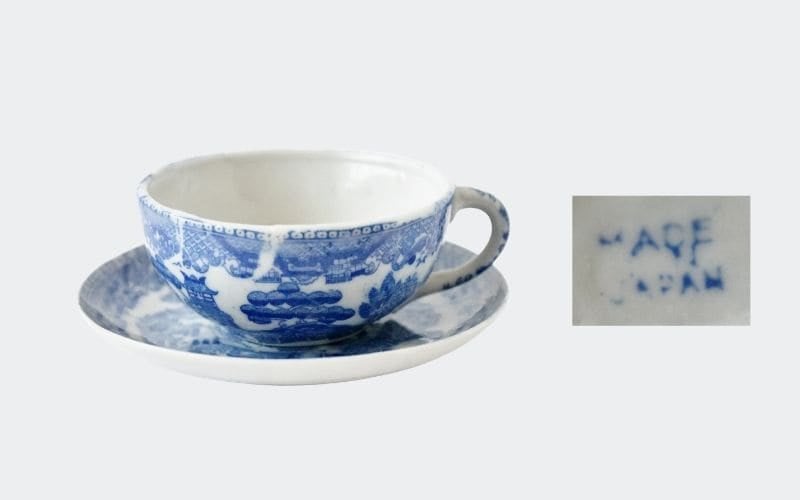
Teacup & Saucer
Made in Japan
Value: $10-15
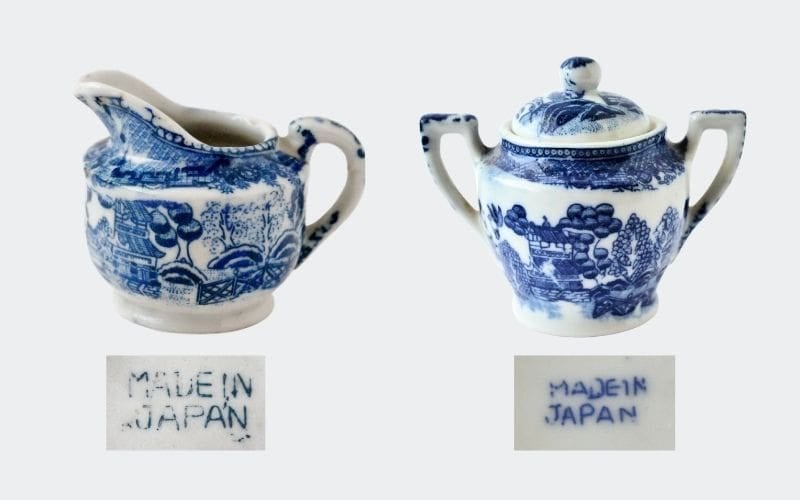
Cream & Sugar
Made in Japan
Value: $15-20 (for the set)
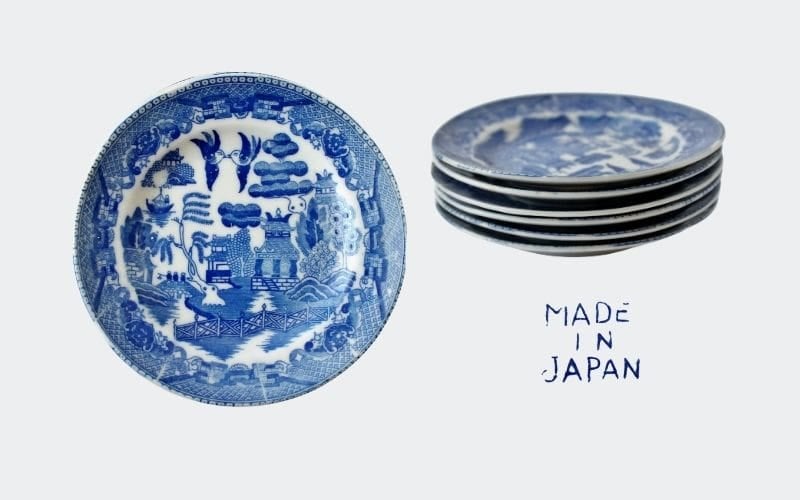
Dessert Plates
Made in Japan
Value: $15-20 (for the set)
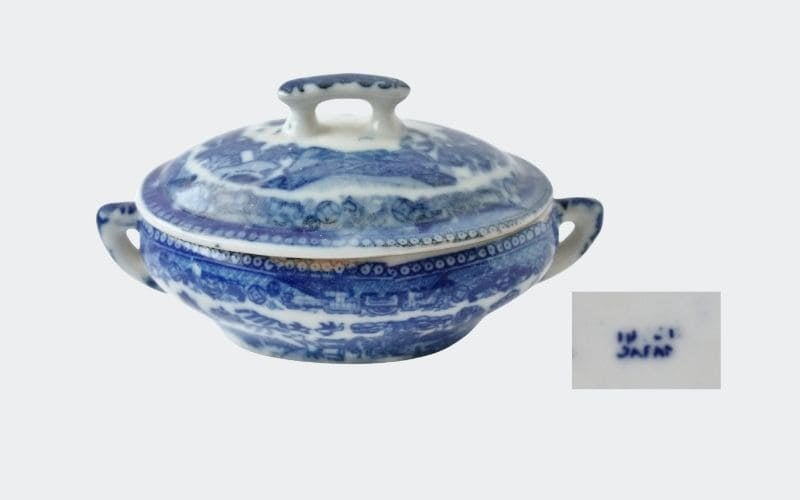
Serving Dish
Made in Japan
Value: $12-18
What Is Blue Willow Worth?
Prices for Blue Willow china varies from high to low ($10 to $1000+), with older English pieces bringing the highest values and newer American or Japanese pieces bringing the lowest. This means that these lower value pieces have no real value if damaged in any way.
As with much of the china on the market, serving pieces tend to bring the highest prices, including soup tureens, large platters, and pitchers.
The antique Mason’s platter above is a good example of a valuable English piece; it sold on eBay in 2021 for $75, even with a small rim chip. (Thanks to my friends at WorthPoint for providing this great research info.)
One caveat regarding Japanese pieces bringing lower prices would be unique pieces, like spice sets and canisters, that only Japanese companies produced, so keep your eye out for them.
Where to Find Blue Willow China?
So much Blue Willow china has been produced over the years that you can literally find it everywhere. For reselling purposes, I look for it at flea markets, garage sales, and thrift stores. For example, I found the little restaurantware creamer (above) at Salvation Army for just .79.
You may also have luck locating people trying to sell whole sets of Blue Willow on Facebook Marketplace since selling locally avoids high shipping costs. And church sales provide another opportunity to scout out some good pieces.
Collectors should shop estate sales and auctions for older, higher quality pieces. And don’t forget to look online regularly on both eBay and Etsy, keeping in mind that prices for Blue Willow tend to be a bit lower, from my experience, on eBay.
Fun Facts About Blue Willow China

- Blue Plate Special: The “blue plate special” advertised by diners across the country derives its name from the Blue Willow grill plates used on trains and in restaurants back in the 1920’s. (See photo above, also curtesy of WorthPoint. This English grill plate sold last month on eBay for $15.)
- Not Just China! Blue Willow’s popularity has run so high through the years, you can find it on all sorts of home goods, not just china: spice jars, tin canisters, trays, salad servers, tiles, towels, wall paper, toasters, pots and pans, tea kettles, and glassware.
- Colors: Willow comes in colors other than blue! You can find it in red (pink), green, mulberry (purple), multi, and even black.
- Nickname: Passionate Blue Willow collectors call themselves “Willowers.” They gather in Hyanisport, MA for their annual conference.
Other Articles You’ll Enjoy


Final Thoughts
I hope you enjoyed reading about this fascinating collectible. Let me know in the comments if you’re a Blue Willow lover (or have converted to one), and if so why??
Thank so much for stopping by!
I hope you’ll SUBSCRIBE and never miss a post.
Get a FREE copy of my mini eBook when you do,
10 Vintage Items Often Overlooked & Undervalued at Garage Sales:

Bye for now,
I’d love it if you’d pin me!


Sources:
“Blue Willow Legend Turn Dinnerware Into Hot Collectible”
Blue Willow, Mary Frank Gaston (available for research at WorthPoint)

Hi, Diana–
I have a fairly large collection of blue and white, but very few pieces of blue willow–don’t know why. I remember as a child in the 40’s seeing blue willow dishes, possibly one of my aunt’s, and falling in love with it. Maybe that’s why so many years later I started collecting blue and white. I have a lot of Chinese and Japanese pieces as well as some American and assorted other. It has not been easy to evaluate most of them, even the pretty unusual ones. Thanks for this article about blue willow–I hope you will talk about other blue and white also.
Hi Jo! Sounds like you have a great collection. If you ever have any questions about specific pieces, be sure to ask them in my FB group, Your Vintage Headquarters 🙂
How do i join your facebook
Hi Diana,
I just uncovered numerous pieces of blue willow from my great grandmother or older. how do i join your FB group?
thank you,
Lori
Lori, you can join it HERE. Enjoy!
I have a collection of a Blue Willow set I’d like to sell but I don’t know who to contact for that. I know I have valuable pieces on the research I’ve done. Any info would be great in who I can contact that won’t low ball me? Thank you
I have a video that talks about ways to sell your collectibles if you’re not an antique dealer. It should help. Also, there may be a Facebook group that specializes in Blue Willow that allows members to sell to each other. You might want to check that out. Best of luck Teresa!
I have blue willow cups plates dessert plates etc made in Japan is it worth anything ? It was my moms she passed in April
So sorry to hear about the loss of your mother, Brenda. Your Japan-marked plates likely have some value!
Thanks for this very informative post! I’m going to look more closely at my Blue Willow pieces, especially how many sets of fronds are on the trees. :o) I have modern and older Churchill, some Buffalo pieces, and some Japanese Blue Willow. I love it all!
Sounds like you have quite a collection Tammie! Glad you enjoyed the post 🙂
Hi Dianna, I have a complete set of Blue Willow, some say Johnson Brothers on the back and others have English statements, most of the pieces say Johnson Brothers. I think it is a service for 12 and is about 50 years old all the pieces are in very fine shape. There are serving pieces and tea pots, water, pitchers, glasses and much more. I don’t know how to price these pieces. Can you help me?
Hi Dianna! Unfortunately I can’t speak to pricing, but feel free to join my Facebook group, Your Vintage Headquarters, and post some photos. It’s a great way to get feedback on merchandise when you’re stumped. I do encourage you to do some basic research like search eBay’s sold listings: https://adirondackgirlatheart.com/search-ebay-sold-listings/ Best of luck 🙂
Thanks for the info. I have inherited old willow. 1832 ridgeway and Y&S Japan. Trying to figure out insurance for shipping. Very informative.
Thank you for this interesting article. I have my grandmother’s blue willow dishes and my set of child’s blue willow from when I was a child. I have become a little obsessed with it and have quite a collection of the child’s blue willow!
Sounds like a wonderful collection Vicki! I’d love to see photos if you ever get the chance 🙂
Thank you for all of your research for us! I have several different BW plates in with my blue and white plates on my kitchen soffit! I do so enjoy the blue and white! I’d love a child’s teaset and have stupidly passed by several due to the price. Al’s late sister-in-law who died from Covid last year collected BW and I always tried to find her something interesting with BW on it–including a McCoy milk can cooky jar!
You’re welcome Kathy! There’s just something about blue and white that’s SO appealing 🙂
So sorry to hear about the loss of Al’s sister-in-law. Covid has certainly wreaked havoc across the world. Sounds like you all had a good relationship and that’s a blessing.
Diana, thanx so much for all the research you have done for us; we appreciate it. My “good” china is the blue and white Royal Mail–had to shop at an unfamiliar grocery store all summer in the mid 70’s to collect it all! People sell the brown and white more often; I still search for extra pieces. Love my b & w china pieces!
I had to look that up Kathy as I’m not familiar with “Royal Mail”. What a pretty pattern. I’ll be on the lookout for it now!
Thanks for the informative article on BW. I’ve had quite a few pieces that I have sold in my booths and shop over the years. I think mine were all Japan. I kept a nice pair of S&P shakers. But I remember having a BW metal tea set when I was little and our playhouse was the old chicken coop. Of course, all of that disappeared over time but I found another metal set just like I had that a vendor friend had for sale, , so we made a trade!! I just need a place to display all my treasures! Downsizing has its down side!
This was so interesting to read! I also have Blue Willow from my Grandmother and am curious to look and see where it was made. Thanks for another fun article, Diana. So glad I “found” you (and you probably didn’t even know you’d been “missing!” 😀)
Ha ha!! I love being found Jane 🙂 🙂 I’m so glad you enjoyed the article and love that Blue Willow has a special place in your heart because of your grandmother. I was very close to my grandmother so I know how dear it must be–
Great article…I now love Blue Willow more than I did before. Thank you for your detailed information–You are the best.
You’re so welcome Cathy!! Thanks for your encouraging note–it made my day 🙂
Loved the article. I can’t even imagine what the world would be like today without copyright laws.
I did notice that you didn’t mention, in your article, anything about the numbered Willow Ware. I have piece with the green Willow Ware by Royal China stamp on the back with the number 56D under the water waves. Can you tell me anything about that number. The piece also looks hand painted because there are imperfections in the designs.
I’m not familiar with the numbered examples you describe Bradley. Feel free to post photos in my Facebook group, Your Vintage Headquarters, to see if others may have some info about them.
Hi Diana!
I have various pieces of blue willow. A great many of mine say Johnson Brothers and have a bear? Symbol over it. Is there any value to them?
Loved finding out about you and your blogs!
Hi Jeni! I’m not familiar with that mark. There is a Johnson Brothers mark from the 1980’s with a bull, could your bear be a bull? I recommend posting some photos of your pieces in my Facebook group, Your Vintage Headquarters, so I and others can see exactly what you’re talking about and hopefully help out 🙂
Finally I understand! You are amazing. Thank you. Quick question, what if its marked with Asian letters only?
China and other Asian countries have produced china in the blue willow pattern. So those pieces likely do come from somewhere in Asia 🙂
Hi.
I have a question regarding pink/red willow ware that is unmarked. What is the earliest date it is known to have been produced? Is this prior to the time when it was required by law to have a back stamp? It is very heavy and has some crazing. Ironstone, no doubt. Any ideas about it?
Thank you.
Geri
The transferware process was developed in about 1750, the blue willow pattern in 1790, and ironstone in about 1800. I’m not sure that anyone could tell you when the pink/red willow ware was first produced, but your piece probably gives hints as to its age that a qualified appraiser could use to determine its age.
Most quality potters have routinely marked their wares as that would be a selling point. The laws regarding what the mark had to contain, e.g., country of origin, have changed throughout the years. Here’s a good article about that: http://www.thepotteries.org/mark/general.htm
Hope that helps Geri!
Just a question about authenticity, we bought a set recently from a seller, they have no mark on the bottom, however they look vintage, and some plates have a few small spots of blue that are definitely out of the design, like a little speck of paint that’s not supposed to be there. I’m sure we overpaid…should’ve done our research. Some plates are a tad darker as well, the paint looks slightly thicker. They are glazed well, no cracks or anything.
Is there somewhere I could send a picture to see if they can be identified?
Hi Diana, thank you for the information you have provided. I love the Willow pattern and I did not have the full story of the lovers until now. I have a huge set of Churchhill and other brands.
As a child, I would sit at my Nana’s table where she kept a single willow plate, which she gave to me as an engagement gift.
Nana and Pop sponsored a family after WWII. They wanted to give them a thank you gift, so Nan asked for a plate that survived the war. That’s how she came to have the willow plate, and it was the beginning of my collection.
I’m glad you enjoyed the blue willow background story Wanda 🙂 Thank you so much for sharing YOUR beautiful story with us; it really touched my heart <3 <3
I read one time that blue willow is the most popular china pattern ever manufactured. Have you ever heard that?
Yes I’ve read that too Barbara. Not sure if it’s true or not…
I have a very dark blue willow plate. The stamp is hard to read on the back. It was made in England, and the previous owner said it was Circa 1903 to 1905. I was curious to know what the back stamp actually reads.
You could take it to an antique shop and see if the owner might be able to help you out. There may also be a blue willow facebook group that you could join. You could then post a photo there and ask for help. Good luck Marianne!
I have been designing and selling antique and collectible China tiers for twelve years. Willow Ware has always been my best seller. My customers are drawn to the classic blue and white but mostly for the nostalgia value. So I love sharing the story behind the design to “ seal the deal “ ! Once I had a lady in my booth in tears as she shared her family story with historical Willow Ware. I believe it will be popular forever. Thank you for promoting an affordable passion.
Blue Willow has woven its way into your life, hasn’t it Maureen? Thanks for sharing your stories with us 🙂
When I think of Blue Willow I think of my mom. She grew up poor, so too her having it was luxury. I have her collection and just put it in my china cabinet.
I came across this post looking for answers and got more than expected.
Thanks for sharing your knowledge.
What a precious family heirloom Sadie. So glad you enjoyed the post 🙂
Hi! I enjoyed this article, very informative. I also like the story of the Blue Willow! I had never heard that before. I have a question about a piece I own. It is a blue with a turquoise background pedestal bowl. It is 10.5 inches wide and bowl is 4.5 inches deep. It has handles on either side. I have not seen a similar piece anywhere. Is this a defect or a rare piece? Thank you so much for any help I can get.
I’m glad you enjoyed the article Denise! Unfortunately, I’m not familiar with the piece you describe but Blue Willow can be found in almost any shape and size you can think of–it was that popular. Could be a rare piece. I have an article that explains how to research your treasures called “9 Free Ways to Price Your Vintage & Antiques.” I think that will help you with your pedestal bowl.
I was handed down my grandmother’s blue willow from the 1930s but know nothing about it. It has a big A and says Allertons England Willow. It’s a very large set and I really don’t know what to do with it or if it has any value. I loved reading the story behind the details on the China.
The best way to learn the value of your plates would be to search the sold listing on eBay. Here’s an article I wrote about how to do that: https://adirondackgirlatheart.com/search-ebay-sold-listings/ Best of luck!
I just came across this. So informative. Thank you so much for posting. I am a lover of all things Blue and white, Blue Willow, Delft, English Transferware, etc. I have acquired quite a bit over the years. From inherited pieces, estate sales, antiqued stores and even a few Delft from Holland when I traveled there. It is all over my house. Lol. Thanks again for sharing.
You’re so welcome Templa!! I’m really glad you enjoyed the article. I’m big fan of Blue willow too 🙂
I got a 6″ blue willow plate and I`m trying to figure out when and where it was made. It`s got a thin gold line around the outer edge and a thin gold line about an inch down from the outer edge. No marking on the back except 2 small blue dots. So many subtle differences between almost identical images.
Blue Willow was made by SO many different companies in SO many different countries it makes research a real challenge, right? There are a few BW guidebooks out there. Here’s an Amazon link (where I am eligible to receive a commission) to one that should help: https://amzn.to/3yDA5V4
Thank you so much for such a great article. I’m a huge history buff and amateur archeologist. I love finding old spots and having a dig. And a few days ago I found an amazing spot with lots of old bottles, glass dishes and heaps of (so far) broken China. And thank you to you, you have helped me work out some of the beautiful pieces we have found so far. A lot having be blue willow. We haven’t got it all just yet but I’m definitely excited and busting to get back to my new fav place and hopefully find the rest.
Thank you again.
You’re welcome Ngaire! I’m an old digger from way back so I can relate to your excitement at making new discoveries and then researching them. So glad I could help 🙂
I have an entire set new in box I want to sell. What’s my best bet to sell it quickly, piece by piece or as a set? Does that change the value? My set has creamer and sugar, several platters, serving bowls, coffee pot and soup tourine included, as well as plates and bowls, etc.
Great article and informative! Thank you!!
Sheila M
Hi Diane,
I acquired a set of Blue Willow dishes from my mother. They are the Japanese ones. They appear to have been double transferred. I cannot find anything online regarding these dishes or any dishes ever having their patterns being double stamped/transferred. Could you tell me please how I can find out if they are worth anything? Thank you.
Hi Carole–I have an article entitled 9 Free Ways to Price Your Antiques that should help. You can find it here: https://adirondackgirlatheart.com/9-free-ways-to-price-antiques/ Best of luck!
I have always loved blue Willow dishes. One of my earliest memories is of my grandfather drinking his tea out of a blue Willow cup. It was a bit larger than the other cups in their set and he always used it.
I have my grandparent’s dishes and another set that belonged to my friend’s grandparents. I used to keep them in the china cabinet but recently started using them as our every day dishes so that I can enjoy them at every meal.
Thank you for the great article and all the history
Such sweet treasures from your family Sandra! I love that you’re using them rather than keeping them stored away 🙂
Hello,
My wife and I live in an old house. Outside bits and pieces of old chinaware comes to the surface of the earth very frequently. Some if it is Blue Willow style, but we have no idea what the age would be, and we have not been able to place the maker of any of it. One piece we have includes a partial maker’s mark on the bottom. Despite many efforts I have not been able to find it anywhere online.
I would love to include a picture of it to see if anyone has a clue about it.
My recommendation is to search for and join a Facebook group that focuses on Blue Willow and/or dinnerware/china. “Experts” in the group will likely be able to help you. Good luck!
Love my blue willow and use daily except 2 I have had a long time think demetaise so thin when you hold up to light there is a lady’s face image on bottom cannot be seen other wise I think they may be very old
I love that you use most of your collection on the regular Colleen! Your demitasse cups sound lovely 🙂
40 years ago, I bought a modern set of Booths Real Old Willow (6 place settings) & that started my Old Willow collecting -I now have 14 place settings plus most of the incidentals like 5 platters in different sizes. I also have Willow pieces by other potteries & other BW patterns.
In the early 1970s the Booths Pottery in England was sold to Royal Doulton, who discontinued their Willow pattern. Cue uproar, because there were so many British collectors! Booths Real Old Willow pattern is being made again but under the Royal Doulton banner.
Willow patterns were made by most potteries – some thicker pieces were for the kitchen & finer gold trimmed pieces were for the middle class dining tables. Thanks for the article
What a wonderful collection you have Sue! Thanks for sharing your Blue Willow knowledge with us 🙂
Hello, thank you for the informative piece. I was surprised you didn’t mention Spode Blue Willow. I bought a large set in the early 90s that turned out to be quite a boon for our little family. I found a set selling in the classifieds. They were beautiful, and very inexpensive so I bought them on the spot not knowing one thing about them except that I admired Blue Willow and it was the prettiest set of it I had ever seen in my life hands down. They had a gold edge, and the tea cups were delicate with the most exquisitely shaped handle with words from “Auld Lang Syne” on the cups, teapot, sugar and creamer, but not on the other pieces. I remember the young woman who sold them to me told me they had been her grandmother’s china but didn’t fit her lifestyle because,”I don’t have tea parties” as if that huge set of dinnerware had no other use. She also pointed out that many of them were marked “Made for Tiffany & Co” as well as the Copeland Spode mark. I had grown up eating off Johnson’s Blue Willow at my grandmothers house. She only used it for Sunday dinners in the dining room. I was so happy to own a set myself complete with serving pieces, and consommé bowls. I got home and unwrapped them one by one and dreamed of the tablescapes I would make, the dinners I would serve and how they would look in my china cabinets.
Then I did something I couldn’t resist doing. My mother had been selling china to Replacements Unlimited so I called them. The young woman who took my call was very sweet and said she didn’t want to get my hopes up till she saw for herself that they were Spode Blue willow because many patterns look like Blue Willow. I assured her I knew blue willow when I saw it, but I dutifully photocopied a dinner plate front and back as she requested, and sent her the image. The same young lady called me back and she was so excited to tell me what I already knew, they were Blue Willow Spode. I don’t remember the exact amount but it was quite a chunk of change. We had a new house and a baby on the way so couldn’t afford to say no. So I packed them up (box in a box) and sent them off. My husband was the sole breadwinner but yet he more than willing to let me spend all the money as mine but he shared everything with me so I helped him buy an expensive electric piano he really deserved with half the money and I can’t even remember what I spent with mine. I was pregnant with my second, and I think I spent it on her nursery.
I have never regretted selling it and I love porcelain and collect dinnerware. It was too dear for me to truly enjoy. I have a complete set of Herend (golden edge), and Noritake Valhalla which is my bridal china which I still love and not many women can make that claim. My mother and mother in law gifted me those sets. I also collect Mottahedeh Tobacco leaf, Arte Italica Bella Bianca and many others as well as my Fire King Jadeite, Jeanite Delphite, and Peach lusterware. The Tobacco leaf and Herend frighten me enough, the Blue Willow would have terrified me. I am sure there might be more expensive examples of Blue Willow but that Spode set had to top the list and to tell the truth they didn’t even seem to care that it said, “Tiffany & Co” or not and not all pieces did. They also weren’t nearly as picky with scratches as they were with other sets I sold since. Anyway Spode Blue Willow sells for a pretty penny.
Hello Diana, I have a rare Gaudy willow pattern plate. Yes I know the plate with gold, brown and red and other colours is not rare BUT I have the cup and saucer too. I understand the only other cup of this pattern and as in good shape (no crazing) is in a museum! I am a keen collector of rare and very old willow pattern.
My oldest is a set of four 1830 cups and saucers. All my collection, except one serving dish is fine bone china. I also have an excellent tea pot that set me back…but was worth it…a tea pot stand from 1890 and two milk jugs–one Alfred Meaken and one Booths.
My collection has began to turn to old Ashcroft Plates that have some crazing but with age I guess it comes to that. I am proud of my serving bowls with handles.
I am glad you love love Willow too. Oh and by the way the story is believed to have been originated by Thomas Minton for Thomas Turner’s Caughley factory in Shropshire around 1780. Minton then moved to the Spode factory, Staffordshire, in 1784. Yes, it is based on a Japanese story “Green Willow,” westernised by a fellow Brit (of which I am one).
With my greatest respect, Christopher (N.B I have a title but I don’t use it). So do keep in contact.
Christopher
Oh my, sounds like you have quite an amazing (and important) collection Christopher! Thanks for sharing your experience and insights with us –
Thank you so much for such an informative article. I bought a collection of mixed Blue Willow pieces at a thrift store many years ago for $20 and just love using it. My favorite pieces are by Allerton’s and I’ve since learned that Laura Ingalls Wilder loved her Allerton’s Blue Willow and bequeathed it to her daughter, Rose. I have Ridgeway and Buffalo pieces, too. And there are two children’s pieces, including a plate, among the china.
Sounds like a lovely collection Sandra! And what a neat connection to Laura Ingalls Wilder 🙂