
This Week’s Vintage Finds #65
Hi everyone! Today’s vintage finds all came from two local thrifts–a Salvation Army and a Goodwill. It’s been brutally cold outside, so we’ve been spending lots of time staying warm inside.

First up–some ironstone. Wildly popular in home decorating for years, it’s simplicity and lovely lines contribute to it’s appeal. But can every piece of white or off-white china be called “ironstone?” Not necessarily. In fact, in the picture above, not every piece is truly ironstone. Can you tell which pieces are and which aren’t?
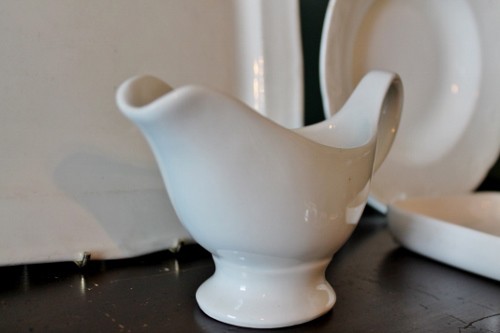
First patented in 1813 by Charle’s Mason in Stafforshire, England, ironstone is made of porous earthenware, coated with a fired-on glaze that makes it both impermeable to liquids and difficult to break. It is heavier than other ceramic wares and often has a bluish tinge.
It was initially developed as a frugal alternative to the more expensive porcelain. This little gravy boat, ($1.99 at Goodwill), is completely unmarked, but it has the weight and color of ironstone. My feeling is that it is American ironstone, that is, glazed earthenware pottery made in the US beginning around 1850. American potteries often left their pieces unmarked since they were trying to pass them off as English. It is worth about $15.00.
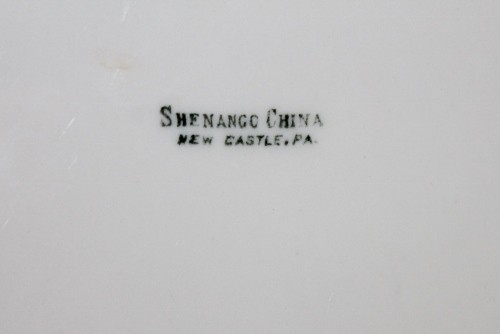
The rectangular platter on the left, bears an early (1905) Shenango China, New Castle, PA mark, indicating that it is a piece of American ironstone. But this company, along with others like Syracuse China, are well-known for their restaurant wares, which share some of ironstone’s qualities, like durability and weight.
What separates restaurant china from ironstone? In my experience it is primarily the shapes. Restaurant wares usually display simpler, cleaner lines, while ironstone often has small decorative knobs and bulges, like finials on tureen lids and leafy shoulders on gravy boats.
Restaurant pieces also tend to be a purer white and the surface ages differently than ironstone. This type of knowledge comes from a familiarity that comes from handling both types. This little platter is worth about $20.
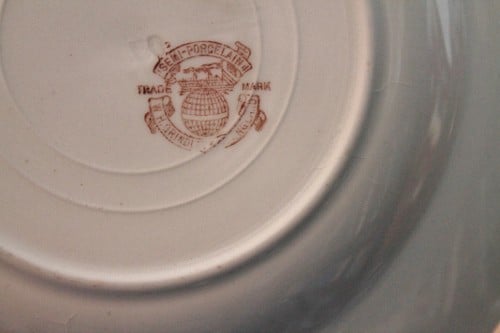
This piece of ironstone, produced by W. H. Grindley & Co. of England, dates from 1880-1891. The term “semi-porcelain” refers to earthenware that has been highly glazed to imitate porcelain.
My experience is that pieces marked “semi-porcelain” are often lighter than those without this mark, and are a creamier white–with no bluish tinge. To me, it’s not really ironstone, but since I’m still trying to fill up my corner cupboard, I bought it (for 99 cents) to fill an empty spot until I upgrade to a better quality piece.
UPDATE: Just read an article on the blog, Janvier Road, about ironstone, and in it the author explains that semi-porcelain is just another way of saying ironstone. I also learned that this mark dates to the time period 1891-1914.
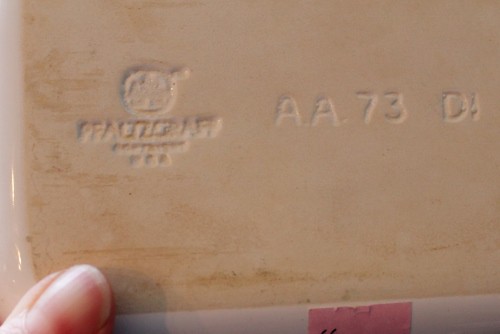
The retangular dish (front, right) is a newer, Pfaltzgraft dish I bought for 50 cents (at half-off) that I plan to use to make a pedestal stand.
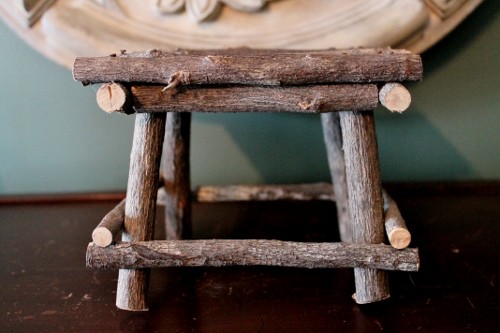
This little twig stand will be added to my “Adirondack” collection, priced at probably $10.00.
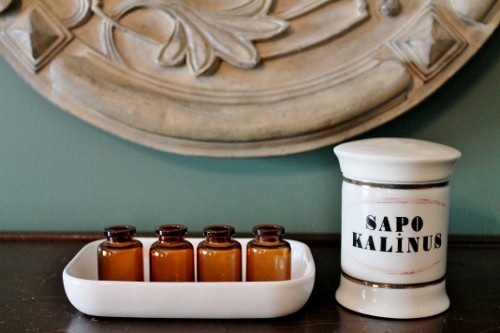
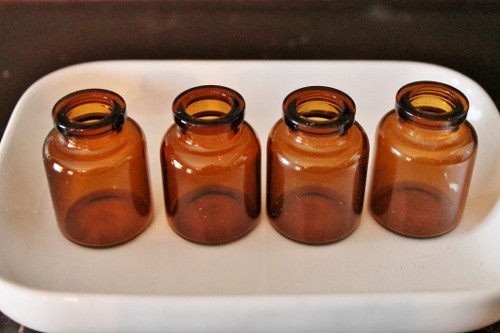
I purchased the small amber bottles for 50 cents (again, at half-off), and the Sapo Kalinus jar (German for “potash soap”), I bought on sale at Marshall’s for just 79 cents.
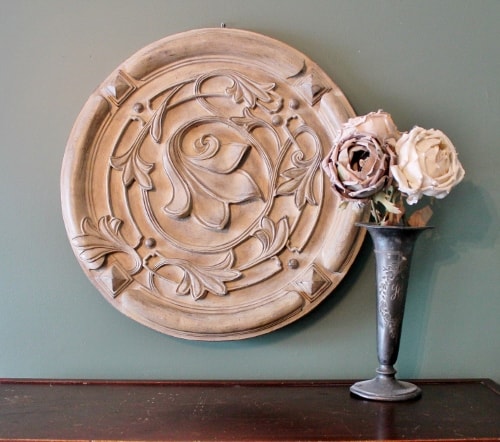
I uncovered this medallion in a shopping cart at Salvation Army as a staff person was unloading. Looks like wood, doesn’t it? It’s one of those heavy, molded plastic pieces that are common at Home Goods and store like that. I snagged it for $4.00 and plan to hang it somewhere in my house.
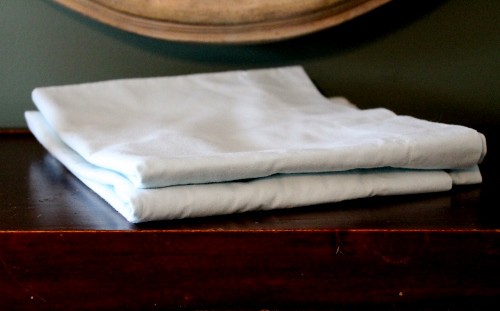
Two, vintage 100% cotton pillow cases in light blue, for my sweet daughter. Just $2.99 for the pair.
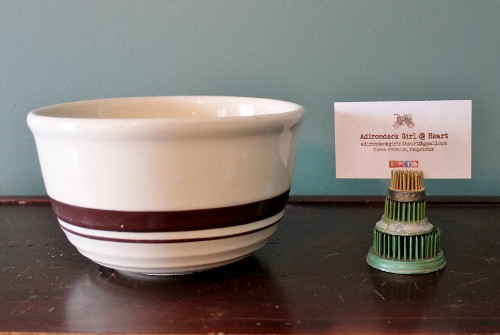
This McCoy mixing bowl took me kind of by surprise at the Salvation Army. It surprised me that a piece of McCoy was on the shelf to begin with and that it was priced pretty low ($2.99). It’s worth about $15-20.
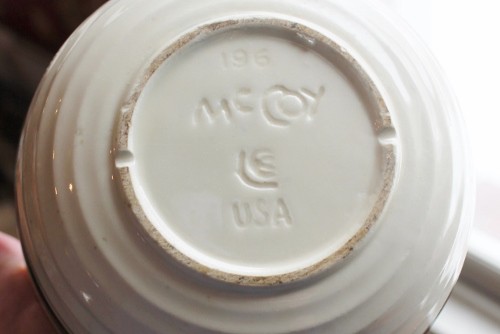
This mark dates to 1974 or later. We can tell that by the LCC mark, which stands for Lancaster Colony Corporation–the company that bought out McCoy in 1974. McCoy began production in 1910, and is still being produced under the name, “The McCoy Pottery Collection” by Nelson McCoy and his wife, Billie.
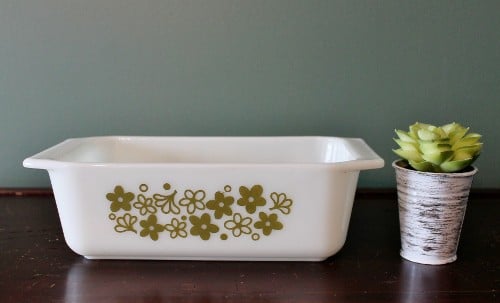
All this talk about Pyrex on popular vintage blogs has led me to view it with completely new eyes. I picked up this loaf pan for $1.99 (it’s a keeper); I believe it’s valued at about $8-10. I think the pattern is “Green Floral.” Note: I found the little succulent at The Christmas Tree Shop this week for just $1.29.


Wonderful finds this week, Diana. Love the little Amber bottles.
You had some great finds, Diana…love the little bottles and soap jar especially…so pretty!
What great information! I love learning about this! I love finding things at thrift stores and then trying to figure out if it was truly a "find" or not. A couple of weeks ago I was at Goodwill and I spotted a set of three Iris Herringbone footed tumblers.I have a collection of Iris Herringbone that I adore and I'm always on the look out for it, but it's not something I've ever found at Goodwill. These were priced at $3.54 for the set! My Iris Herringbone loving heart skipped a beat! They aren't expensive, usually priced between $8 to $10 each, but to get them for a little over a dollar each was an awesome find. They are now properly displayed along side other pieces.
Thanks for all the info on ironstone. I will look with a sharper eye from now on. Great finds for you this week!
Love those pottery/ironstone pieces, Diana, and the look of those little amber bottles on that dish – !! Like you, I generally go by instinct on what my gut tells me is ironstone when it's not easily detectable. After all, it's about going for what you love first, and pedigree comes second, right? I really like the old, mottled brown, is that okay to eat off of kind of ironstone, lol. Love that little stool you found, too. Btw, when I click on that video, it took me back to my blogger home page.
Rita
ps Thanks for the wonderful feedback on my jadeite.
Great finds! You're lucky to have found a Spring Blossom loaf pan! I collect that pattern and it's one of my missing pieces!
I always like finding anything that is Pyrex.
Great finds and thanks for the info on Ironstone! I would love to see a new photo of your growing collection!
Diana, I love the iron stone!! Awesome finds!
Love your treasures – especially the ironstone and that medallions is so pretty!!
I have that little gravy boat! Love all the info on the differences. I usually use the "if it quacks" technique :>)
Wow, what great finds. Beautiful!
The ironstone is very pretty, and thanks for all the great info. That floral medallion has an art nouveau look to me. I love it!
Love the ironstone! I can never find anything at the local thrift stores or Salvation Army like I used to. I now go to more Estate sales and auctions but they are a bit more spendy.
Have a great week!
I love the medallion and I used to have a whole set of pyrex like your pattern!
Great post as always Diana, filled with wonderful tidbits of vintage information!
Hi Diana, I remember asking how you knew it was ironstone on my blog a while back. Don't often find much of it here, but I think I have a few pieces. I did think that the rectangular platter was a newer piece, but still pretty. I love the brown bottles. I have a small casserole with that pattern from my wedding. Thanks for sharing with SYC. Again, thanks for the sweet vintage blog of the week feature!
hugs,
Jann
You sure found some wonderful treasures, and great bargains too. Thanks for sharing your knowledge about Ironstone and thanks for linking up at Vintage Inspiration Party.
Reading thrifting blogs has made me value Pyrex more too – not enough to keep it but enough to pick it up when I see it!