
Your 1st Antique Booth: 10 Steps to Get Started
If you’ve ever wandered through an antique mall and thought, “I could do this!” you’re not alone. Hundreds of people across the country have taken the leap and turned their love of vintage into a fun and rewarding side business.
While it’s not quite as easy as throwing a bunch of merchandise into an empty space, it’s not as hard or complicated as you might think. There’s a bit of strategy involved and I’m happy to share ten steps to get you started.
If you’re a vintage lover and you’re looking to make a bit of extra cash, opening a booth might be the perfect fit for you. This article contains the advice you need to get started!

My Story: How I Started Selling in an Antique Booth
A dear friend lured me into the antiques business back in 1994. She took me to three antique shows and I sold a few boxes of antiques that I had acquired through a death in the family.
I was hooked.
After acquiring my sales tax ID, I began to sell via antique shows on my own for the next few months. And then I got pregnant. After doing one show while pregnant, I realized that I was in a new phase of life that would NOT accommodate antique shows.
As a result, I contacted the only antique mall within 20 minutes of my home and spoke with the owner. “Did they have any spaces available?”
She said no, but she would put me on her waiting list. A few months later, when I was quite pregnant(!), she called to say she had a large, open shelving unit available for $50/month, plus 10% commission on my sales. Did I want it? Yes!
And that’s how I got my start in the business.

Fast forward fifteen years, and I moved to a new antique mall, Gristmill Antiques, and that’s where I still am today. I’ve moved booths twice and am in my “forever booth” doing very well.
Here’s a recent video of my current space.
Now that I’ve been selling successfully from an antique booth for almost 30 years, I want to pass on some of the lessons I’ve learned. The ten steps shared below will help anyone thinking about opening a booth to get started on the right foot and to make money quickly.
The 10 Steps
1. Research Local Antique Malls
2. Talk With Owners/Managers
3. Be Prepared to Answer Questions
4. Evaluate the Rent and Commission Charges
5. Should You Work in Your Mall? Yes!
6. Make Sure You’re Legal: Research Legal Requirements
7. Determine What Antiques Should You Be Selling
8. Make Sure You Can you 3-4 Times Your Rent With Your Goods?
9. Have Enough Antiques to Get Started
10. Know How to Set Up Your Booth
(1) Research Local Antique Malls
If you’re considering selling vintage via an antique booth, I recommend visiting every antique mall (called “dealer shops” in my neck of the woods) in your area.
What exactly is an antique mall? Antique malls have separate booths or areas, each rented to a different dealer. You’ll find one central check-out for buyers to make purchases, negating the necessity of your being there.
Visit the malls to see which one offers the best fit for you and your stock. For example, if a shop has a strong focus on Mid-Century Modern and you sell primarily farmhouse-style goods, they aren’t a good fit for you, right?
As with real estate, you want to seriously consider the location of the mall. Ideally you want to open a booth in a shop that gets good traffic. Are they on a main road, in the center of town, out in the boondocks?
During your visit, look for dealers restocking their booths. Take the opportunity to talk with them about their experience renting in that mall. Some questions to ask:
- How do you like being in the mall?
- How are your sales?
- Have you experienced seasonal fluctuations?
- Would you recommend the shop to other dealers?
- What kinds of vintage and antiques do best in the mall?
(2) Talk with the Owner/Manager
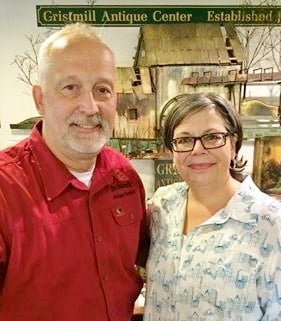
This is the first owner of the Gristmill Antique Center (and me!) back in 2017.
He has since sold the shop to new owners who manage it wisely with all kinds of innovations and improvements to the property.
While visiting various antique malls in your area, approach the checkout when there’s a quiet moment and ask, does the shop have any openings for new dealers?
At that point whoever’s manning the front desk will reveal themselves to be the owner/manager or cashier. If it’s a manager or cashier, they may tell you you need to speak with the owner. If so, get the owner’s name and the days s/he works.
Whenever you get the chance to speak with the owner ask him/her:
- What space, if any is available?
- If they only have a locked case, I would explain that you’re not interested in a case (see reasons below).
- If there’s a space, ask what the rent is and whether there’s a commission and how much. How often is the rent raised?
- Ask how long the “lease” is for (should be month to month).
- Do you have to put in hours working at the shop? If so how many and what’s the pay/value (discounted rent or cash?).
- How much advertising do they do?
Of course you want to know how business is doing in the shop, but unfortunately, whether business is good or bad, the owner is going to put things in the most positive light possible. Your best bet is to try and get some inside scoop from other dealers renting space in the shop.
It’s also why I highly recommend going to the shop a few times to get a feel for the vibe and to [hopefully] talk to other dealers.
Other considerations: First floor booths are typically better than 2nd or 3rd floor. In my area, air conditioning is a must. No one likes to shop in 90° heat and humidity.
In addition, I personally prefer a booth with a window and plenty of wall space (for hanging artwork). Unfortunately, you may be forced to take a sub-optimal booth and wait your “turn” for a better one.
(3) Be Prepared to Answer Questions
Very likely the owner of a shop will have a few questions for you. They may include:
- How long have you been selling vintage?
- Have you ever had an antique booth before? If so, how was your business?
- What kinds of antiques do you sell? Can you send photos?
To answer the last question, it’s a good idea to have some photos of some of the antiques you plan to sell on your phone. Even better if you have photos of your merchandise on display, as you would in a booth to give the impression that you know what you’re doing.
(4) Evaluate the Rent & Commission Charges
When first starting out, I recommend beginning small if you can. Learning how much stock you need to buy, the time it takes to clean and price it, and the time it takes to maintain a space are all part of the learning curve you need to give yourself time to experience.
By small I mean, open shelving, if available, with rent from $50-75, depending upon the exact size. Some places don’t charge commission, others charge upwards of 15%. However, 5-10% is more the norm.
In addition, some shops charge 3% for any purchases of your merchandise made with a credit card (to cover credit card company fees).
I don’t recommend renting a glass case with locked doors unless you have a massive amount of smalls, like jewelry, that are highly desirable and worth $10/item and up. Most such cases cost $150-200/month, which is a rather large investment for a beginner.
If you’re brand new to selling vintage and antiques and the rent charged at a particular mall near you is super high, you might want to pass on that one. Most malls tend to charge $10-20/square foot, so a space that’s ten feet by ten feet would run $100 to $200, which is reasonable.
Most antique malls require you sign a vendor agreement of some sort that indicates the amount of rent, rent due date, etc. Usually the agreement is valid on a monthly basis, which is preferred, but sometimes vendors must agree to a 6 month or even a 12 month commitment.
(5) Should You Work in Your Mall? Yes!
If you have the opportunity to work a day every now and again in your shop, I highly recommend it, especially if you are just starting out buying and selling vintage.
Working usually reduces your rent, which is nice, and it teaches you SO much about the business. You’ll learn what buyers are interested in, which will help you with your own buying. In addition, you’ll likely notice what people are NOT buying.
You’ll have great learning conversations with both customers and other dealers, whether they’re working along side you, shopping, or fluffing their own booths. And finally, during down times you’ll have the chance to reorganize and add to your own booth. It’s a win, win, win opportunity.
(6) Make Sure You’re Legal
Laws regarding retail sales vary from state to state, so you will have to research your questions online and/or speak with an accountant or lawyer. Common issues for discussion include sales tax collection and “Doing Business As” (DBA) documentation.
A sales tax number is required in New York when you sell from any venue, be it an antique shop/show/mall, craft show, vintage market, or gift shop. You are required to collect and remit sales tax unless someone is collecting it on your behalf, as with most antique malls. [Note: Even in the latter case, you will need your own sales tax number.]
In New York, you must apply for and receive a “sales tax number,” which then allows you to sell in the state. You do not need a DBA (as of July 2026).
(7) Determine What Antiques You Should Be Selling
To make money selling vintage and antiques from a booth in a mall, I recommend you undertake two things:
A. Establish an Identifiable Niche or Style
In general, booths that are most successful have an identifiable look based on a decorating style, antique era, or category of antique. For example, my booth focuses primarily on farmhouse or primitive style vintage and antiques. Other styles, eras, or categories include:
- MCM
- Shabby chic
- Art Deco
- Toys
- Glassware
- Art
- Victorian
- Retro
B. Have Plenty of Stock Valued at Between $1 and $100
Antique sellers often say that smalls ($1-$10 items) pay the rent. While this is true, it’s just as true that in order to make a decent profit, you must have some larger ticket items and plenty of those in between.
You want to fill your booth with a good mix of both low, mid, and high-priced items. These ratios are useful for guiding your purchasing:
- $1-$10: 50% of your stock
- $10-$30: 30% of your stock
- $30-100: 20% of your stock
Resources for Learning What to Buy:
YouTube Channel: One way to determine some good sellers from antique booths is to watch my YouTube videos where I show and tell vintage and antiques that I’ve recently purchased. I share what each item cost, what it’s worth, and [usually] where to sell it.
Facebook Group: Consider joining my private Facebook group, Your Vintage Headquarters, where you can ask questions, share your recent finds, and answer other’s questions as you’re able.
Digital Download: Another resource that I have is my eBook: 50 of My Bestselling Vintage & Antiques. Almost every single one of the items I list is a bestseller from my antique booth.
Where to Buy Stock: Check out this article that reveals 15 proven places to buy vintage and antiques.
(8) Make Sure You Can 3-4 Times Your Rent With Your Stock

My friend who started me in the business recommended early on that I should at a minimum aim to 3 times my rent. So if rent is $150/month, then aim to make gross sales of $450. That means at a bare minimum you would need at least $450 worth of stock in your booth, right? In actual fact, you should have about 10 times that, or approximately $4000 worth, or more.
For arguments sake, let’s say you sell $450 in any given month. After you deduct rent ($150) and a 10% commission ($45), that leaves you with $255. After you deduct your cost of goods sold (hypothetically $50), that leaves you with a profit of $205, which isn’t bad.
That’s about $2400 to $3000/year, or what I call pocket money. It allows you to go out into the “wild” and buy more vintage and antiques, keeping some and selling others.
How to make more than just pocket money? Diversify and sell on more than one platform, e.g., eBay, Etsy, Facebook Marketplace, antique shows, flea markets, etc.
(9) Have Enough Antiques to Get Started

For an 8″ x 8″ sized space, I would recommend at least 6-7 banana boxes filled with smalls and medium-sized goods, along with a few pieces of furniture, for example a farm table, corner cupboard, and some side tables, to start out. Have a number of crates to use as well to supplement.
You don’t want to spend $150/month on rent with a half-filled booth, right?!!
(10) Know How to Set Up Your Antique Booth

I’m a firm believer that it’s worth your time and effort to make your booth look good. Plenty of vintage sellers just throw new stock into their booths willy nilly, but those that have a somewhat organized and appealing look will tend to make more sales. Here are some tips:
Create a Cohesive Look
Most people enjoy shopping in attractive places, so make sure yours is. This is first accomplished by sticking to a style, era, or category, as described above.
This can also be done through color, as exemplified by some farmhouse-style dealers who keep their color palette to mostly whites, with black and maybe one other color as highlights. It can also be done by keeping like colors together, all your green items in one area, for example.
Arrange Items in Threes
It’s commonly understood that arranging smalls in combinations of three appeals to people visually. Our brain enjoys this composition. To achieve this you want to select three items of varying heights with some sort of visual connection, like color or style.
Arrange them with the tallest in the back and then the smallest and middle-sized items in the front. Some call this the “pyramid rule.” You could select three figurines, three Art Deco smalls, or three red pieces, for example.
Create a Focal Point
Wherever your eyes go first when shoppers first see your booth (from the most common direction) is where you want to create an outstanding focal point that will draw customers into your space.
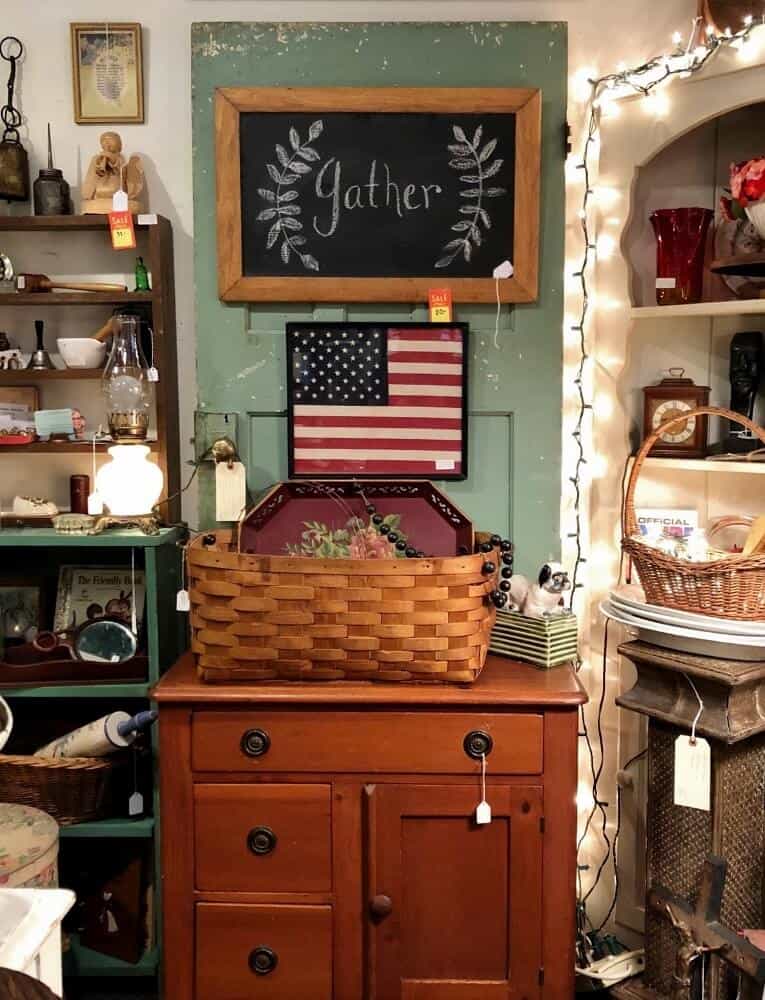
In the past I’ve achieved this by placing a large, shabby chic door against the wall, putting a small table in cabinet in front with a few items on top, and then hanging items, like a sign and/or flag on the door.
Focal point decor is meant to immediately attract buyers and lure them into your booth to see what other amazing items you have for sale.
Display Upwards
It’s important to take advantage of all the space you have available in your booth. This means you should stack pieces on top of each other to both look attractive and to maximize your rented area. And don’t forget to hang items from the ceiling if it’s low enough–think light fixtures and baskets.
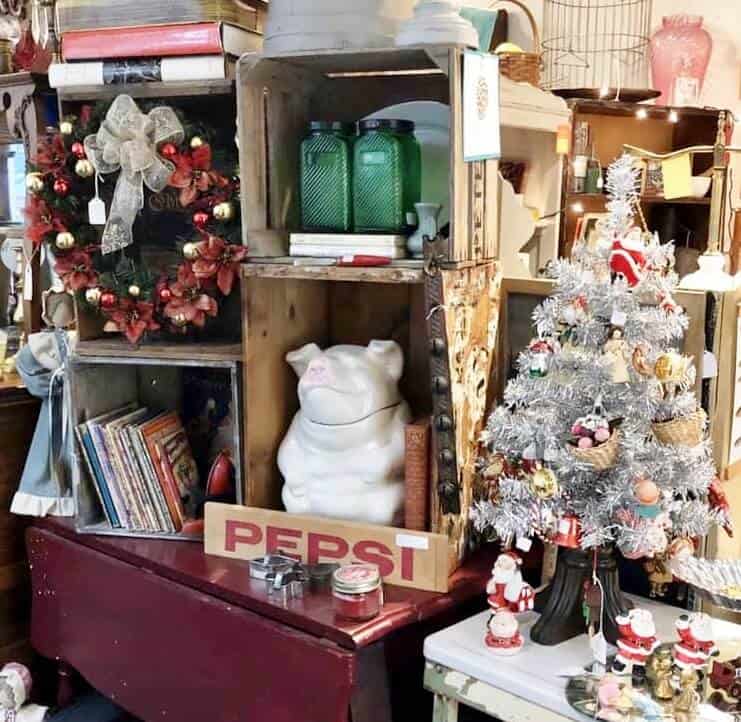
A booth with merchandise at every level, especially eye-level, makes a much better impression, so stack a side table atop a farm table, a couple of crates atop a commode, or a chair atop a cupboard, that sort of thing.
When you subscribe to my email newsletter, you get access to my Member Library. Inside you can find a “cheat sheet,” How to Style Your Antique Booth & Make More Money (under “Vintage Business Resources”).
Other Articles You’ll Enjoy


Final Thoughts
I hope you enjoyed learning more about renting space in an antique mall. If you rent an antique booth, I’d love to hear about your experience in the comments, and if you’re thinking about opening a booth but have more questions–ask away!
Get This Free e-Book When You Subscribe to My Weekly Newsletter:

Bye for now,

I’d love it if you’d pin this to your fave Pinterest board–thanks!


Whaat a great list of tips! Really enjoyed reading them!
Thank you Kathy! I hope they help others out there who are thinking about opening a booth or just getting started 🙂
Very helpful article! I’ve been toying with the thought of opening a booth for the last year or so, but didn’t really know the first steps to take (besides shopping that is). So these are some tremendous tips that you’ve shared. Thanks!
I’m so glad Paula! Let me know if you have any questions, I’d be happy to help if I can 🙂
I started out with a section of glass shelves in tiny Plains, GA, which is the home of President Carter. I did well because they have a tourist train dropping people off every week (he teaches Sunday School too). I also opened a booth in larger town in December and have yet to make more than $100 each month. My booth is neat and attractive but I can’t get a handle on what is selling the most. I don’t think there is any magic to know what people are looking for. I may sell a chair I painted and recovered the seat on, and it was so ugly to me…..then can’t sell a lovely East Lake table! This is the closest (and a good mall), however, it is 45 miles away so I can only get over there once a week at the most. One cool feature the mall has is a web site that allows me to check my sales! I try not to get obsessed and check it often but it is so tempting! Your article has encouraged me to keep plugging along; I enjoy my little business and I encourage anyone who wants to try a booth to go for it! and it is a hobby that ALMOST pays for itself!!
Hi Cecilia–congrats on opening up not one but two spaces! Vintage selling is definitely something that takes time to learn and it sounds like you’re making progress. Are you a member of my Facebook group (Your Vintage Headquarters) yet? It’s filled with vintage sellers who enjoy sharing their vintage finds and asking questions about the vintage “biz.”
Of course their are regional differences around the country, but you might want to check out a bunch of my “What’s Selling” posts (under “Vintage Selling” above) to get an idea of some of the things that are selling well for me. In addition I have a couple of eBooks, like 50 Vintage & Antiques That Sell, that might help you out as well. You can find them here: https://adirondackgirlatheart.com/adirondack-girl-heart-shop
Be sure to stay in touch!
Diana,
Great post with such valuable information! Thanks for sharing your expertise.
Thanks, Tanya, I’m so glad you enjoyed the post 🙂
Thank you for all the straightforward information that you generously share.
My biggest hang up is buying items that I luv and then failing to price them and take them to the store!
You’re so welcome! I’m glad you’re enjoying my posts. I hear you about wanting to keep the beautiful things you buy. I’ve come to a place where I’m basically more in love with the “green” than items themselves, LOL.
I am interested in starting a booth but I have no idea where to start. I asked a vendor about getting started and she said don’t! Too time consuming, too much work, etc. Very discouraging. Anyway. How do I do this? Should I just start shopping? How do I get deals so I can resale at a profit? So many questions…. Thank you, great article!
Hi Julie! I have a whole series of blog posts about selling vintage, how to get started, etc. You can find them all HERE. You should consider joining my private FB group (Your Vintage Headquarters) if you haven’t already. It’s filled with all kinds of vintage lovers and sellers who are always willing and able to answer any questions you might have. I also have resources available in my Digital Shop that will really be helpful for you. Good luck and be sure to stay in touch!
Thank you for these tips! I have been curious about setting up a consignment space for a long time, but find it quite intimidating…thanks so much for sharing this knowledge!
I so enjoyed all of your advice! lt’s been a long time goal for my husband and I, to have a booth at our local antique mall. We both are currently working full-time jobs, but have been slowly taking small steps to see our dream turn into reality.
I’m so glad you enjoyed the article Ann! Sounds like you have something to look forward to 🙂 Just as an FYI, I have a course that teaches how to get started selling on 4 platforms, including an antique booth. You can learn about it here: https://adirondackgirlatheart.com/savvy-antique-seller/
I agree with your thoughts about a well curated, attractive booth. That’s what I try to achieve. Surprisingly though, one of the top selling vendors in my mall has a booth that is only bookshelves, crammed with as much inventory as she can possibly stuff into it. It is not attractive to me, but she sells like crazy. When i’m trying to put more into my space, I call it “channeling my inner Pam”.