
Historic Mabee Farm: A Dutch Gem (Part II)
Early last week I posted about our tour of Mabee Farm (Part I) in the neighboring county of Schenectady. You all walked through the interior with me, and today I’m sharing the alluring grounds.
The museum transplanted a 1760 Dutch barn from Johnstown (NY), and you’ll also find a red “English” barn, along with several other outbuildings. Whether you visit in the spring or fall (the two seasons I’ve been lucky enough to visit), you’ll enjoy your time on the farm.
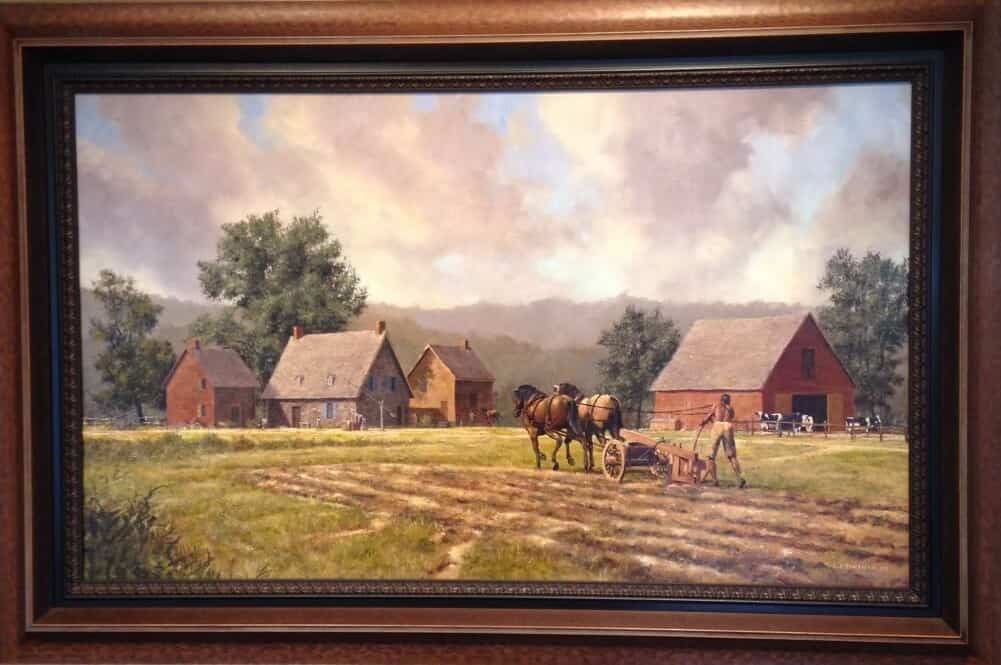
In the Visitor Interpretive Center you’ll encounter this painting by Len Tantillo. On the left you can see the house (in gray) and summer kitchen/servants quarters (in brown).
The tan addition to the house is the tavern and the larger, building on the right (in red) is presumably the original Dutch barn. Driving the plow with horses you see one of their slaves, Jack, in the foreground.

Here’s another look at the [side of the] main stone house with the Dutch style steep roof. Out of the picture stands an addition used for the family business–a tavern.

After the state acquired the property, they discovered this fabulous, original sign in the attic. It now hangs in the Frances Franchere Interpretive Center, also on the property.

The small building immediately adjacent to the farmhouse is thought to have been at times a summer kitchen and at other times a servant’s or slaves quarters.
Like the main house, it is made of stone and contains a Dutch-style, “jambless” fireplace. The unique Dutch hinges deserved a highlight, don’t you agree?

This sun dial is located in the family cemetery where several Maybees are buried. You can see both the Dutch and English barns in the distance.

Adjacent to the large Dutch barn, stands a cute little red corn crib.

The Dutch barn door is a masterpiece in its own right.

But it’s the red barns that attract us, isn’t it? This is a shot taken last fall.

And another.

To the rear of the property sit these two out-buildings.


Closer to the house is an outbuilding in pale blue.

And a double-outhouse, sitting on the bank of the Mohawk River.

Lest we forget it’s spring, a sun-shine yellow tulip.

It was truly a spectacular spring day–perfect for wandering the attractive grounds–learning more about New York’s Dutch history and seeing it with our own eyes.
Thanks for stopping by–
If you enjoyed this post, subscribe today
and get a FREE copy of my eBook:


)
Lucky to be able to explore the building as you did, Diana. It’s the old structures that I adore, and all the intricate details you’ve captured, like the hinges, and those blue diamond, wooden shingles!
Beautiful property and your photography is wonderful. Thanks for sharing.
I love visiting places like this. So steeped in history and charm. Great pics. I adore the diamond shaped blue siding shingles. So pretty..
Thank you, the pictures really place you in that time in history when your life depended on your crops and hung on the whims of Mother Nature.
Love this place and its amazing rustic look!
You outdid yourself with the spectacular photography in this post. The water faucet deserves an award.
I agree with Donna. Were you using a new lens? Thanks for the tour.
Oh, I love touring places like this. That sign is amazing! Thanks for sharing with SYC.
hugs,
Jann