
Historic Kingston: New York State’s First Capital
Hi everyone! My sweet husband and I did some thrifting south of us, near Kingston and decided to head into the city to see some of the historical sites. Many of you know that I live in Albany, the capital of New York State, but what many of you may not realize is that the city of Kingston bears the honor of having been NY’s first capital, despite the fact that both NYC and Albany had larger populations. New York’s Constitutional Convention began meeting in NYC in 1776, but they were forced out when the British invaded in early 1777. The members of the convention chose Kingston (the third largest city) over Albany because they expected the British to invade Albany at any moment. [Ultimately the British failed in this endeavor when the Patriots forced their surrender in Saratoga.]
 Kingston’s time as capital, however, was short-lived. Within the year, the British had burned the entire city and the state government found itself, again, on the run. This time to the city of Poughkeepsie, though it did return briefly to Kingston for short periods in the 1780’s, until Albany took on the role as state capital permanently in 1797.
 But prior to the British conflagration of Kingston, the Convention had the opportunity to adopt a constitution, elected a governor (George Clinton), and established a legislature. The state Senate met in the building you see here, a Dutch Colonial style, stone home belonging to merchant Abraham Van Gaasbeek and dating to 1676. [You may remember that the Dutch settled NY in the early 1600’s. In 1664, the England took it from them and New Netherlands became New York.]
 The Senate House sits in one corner of the Kingston Stockade District, a National Register of Historic Places site. A famous name from the New York Constitutional Convention: John Jay, also a member of the (US) Continental Congress, America’s first Chief Justice, and later Governor of New York.

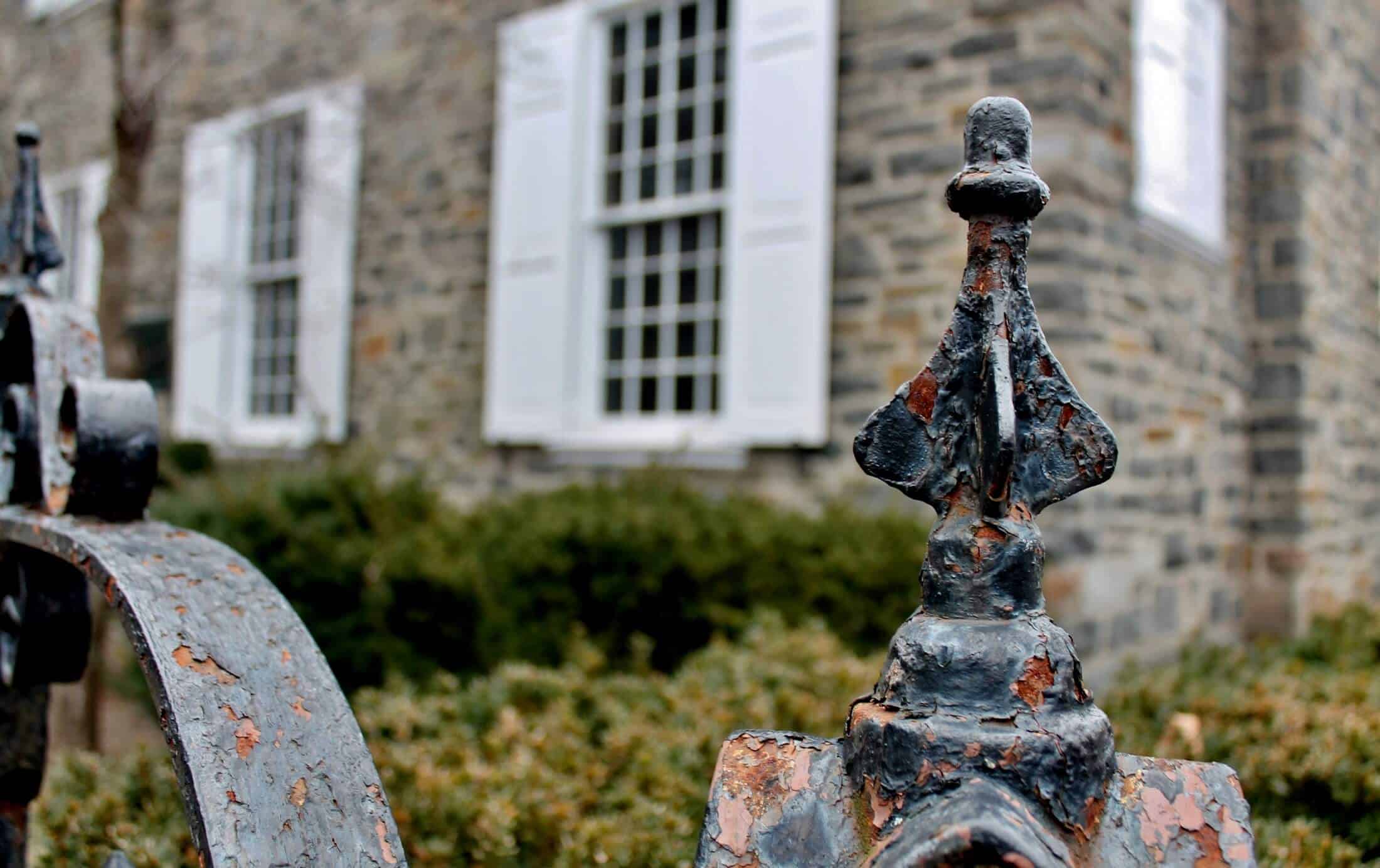 Adjacent to the Senate House, the county built the Senate Museum in 1927.
 It’s an impressive building in its own right, built in the Georgian Revival style.

 Down the street and around the corner, we found the Old Dutch Church (also within the Kingston Stockade District), built in 1852 in the Renaissance Revival style. Its congregation dates back to 1659.
 On this shiveringly cold day in January, we did not find the headstone of George Clinton (NY’s first Governor), whom we read was buried in the Old Dutch Church graveyard. But we found the writing and various shapes of the old headstones fascinating.
 This beautifully tinted stone remembers “Nelly the wife of Tunis who was born the 12th of August 1771, died the 3rd of October 1822, aged 51 years and a few days. Blessed are the dead that die in the Lord.”
 I found this copper-topped headstone lovely (in its way); I’ve never seen one like it.
 Saying goodbye to the Old Dutch Church, we meandered about until we discovered some of the stone homes within the stockade district that date to the pre-Revolutionary period. In 1663, the Dutch stationed Sergeant Matthew Person in Kingston. He chose to remain, even after the English had seized control of New Amsterdam (NY). and built this home on the corner of John and Crown Streets. Occupied by members of the Persons family until 1920, the county now owns the building, which houses the 4-H Club, Cornell Cooperative Ext., and the Agricultural Dept.
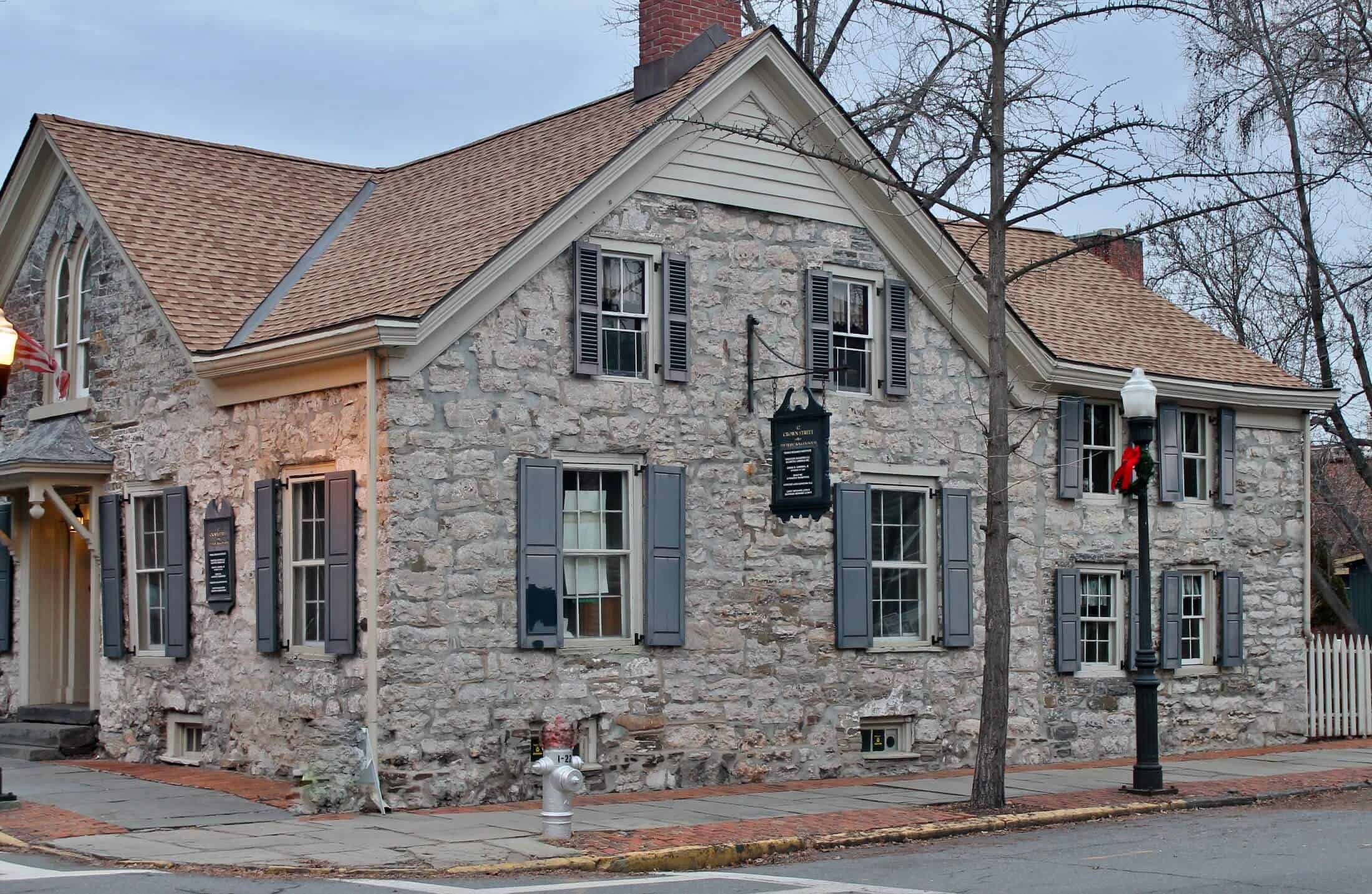 Said to be haunted, the Franz P. Roggen House also sits on the corner of John and Crown Streets. After the British burned Kingston, locals used beams from the house to build a gallows. Apparently, those same beams were used to reconstruct the home, now owned by a securities firm. Kind of spooky.
The narrow streets and Colonial-era homes remind me of the Schenectady Stockade, which I’ve posted about before. I have a soft spot in my heart for Kingston because my first job out of law school was for Assemblyman Maurice Hinchey (later Congressman), and he ran his district office out of Kingston. I became quite familiar with the city over the five years that I worked for him, travelling there from Albany for various meetings. It’s a lovely city, well worth a visit, particularly if you love old things and American history.
Thanks so much for stopping by!
If you enjoyed your visit, I hope you follow me by email.
Sign up and never miss a post.
Let’s connect!
Facebook
Pinterest
Instagram
Instagram Shop
Twitter
Bye for now,

Check for slashed prices on select merchandise, up to 50%!

Our vintage link party opens Thursday at 8 am–

Pin Me!


I love old stone buildings and unusual headstones. What a treat to see them.
So glad you enjoyed the post, Fonda 🙂 Thanks for dropping by–
Impressive history. Excellent photo details captured!
Thanks Rita! Glad you enjoyed the post 🙂
Thanks for sharing, I enjoyed the photos and history.
I’m so glad–thanks for stopping by 🙂
Fascinating! Love the old stone buildings and the tombstones lettering. Always interesting to see how they expressed themselves.
Yes, we really enjoyed pottering around the graveyard–lol!
Thanks for sharing your photos. Years ago, I used to do gravestone rubbings when I lived in New Haven, Connecticut. I have never seen nor heard of a gravestone topped with copper. Do you have any idea why it was done? I am surprised that it hasn’t had more of an effect on the stone itself. I think gravestones in the East are suffering from acid rain and other problems in the environment, which is sad since these stones survived for so long.
I can only guess that it was done for decorative reasons, but that’s a great question, Susan. I have a few grave rubbings that an uncle took of some family headstones, and I’ve always been intrigued by the idea.
You know I love it when you take me somewhere I’ve never been. Your photos capture it all so beautifully. In New York I’ve been to NYC but I would love to see more of your area of the state.
And I love that you love it, Sharon 🙂 So glad you enjoyed the post!
Lovely pictures! Your tours always make me want to travel more. I know so little about New York history, thank you for sharing this!
Thanks Anita! So sweet of you to say 🙂
I am from Gloversville and I have so enjoyed reading your blog… ( live in Ohio now nd miss my homestate!)
So lovely to hear form an upstate New Yorker, Jean! I love NY, too–so glad you enjoy my blog 🙂
I always love visiting historic places. I was surprised to see the graveyard so close to the entryway! FindAGrave.com loves for people to send photos of gravestones, provide info of what they say, and where they are located. They are trying to record them all for posterity and also for genealogy research. Great site!
It’s common in my area to find gravestones near the entryway of the really old churches. Though the Old Dutch Church building dates to 1852, the site itself dates to 1659. I’ve come across FindAGrave when doing genealogy work–quite a job they’ve undertaken and so helpful. Thanks for the visit, Rose 🙂
Thank you for this interesting post on the history of Kingston. My maternal great great great grandmother ‘s brother was named after George Clinton Winship.
Marilyn
You’re so welcome, Marilyn, and what a neat connection to NY!!
Yet another wonderful post! These are among my favorite post of yours. So full of amazing history and so well written. The photography is beautiful as well. You really have an eye for taking stunning pictures. Thanks for sharing.
Very interesting, Diana. I enjoyed the history lessons and your photos. That aged brick and peeling paint along with the old, old headstones are certainly testaments to the days of yore. So picturesque. Thanks for taking all of us on your travels!