
Introducing Elizabeth Cady Stanton: A NYS Suffragette
Have you ever heard of Elizabeth Cady Stanton (1815-1902)? She and her friend Susan B. Anthony are two of America’s foremost woman’s rights activists.
On a bright sunny day in April, my sweet husband and I visited her birthplace in Johnstown (NY), just 50 minutes west of Albany (NY).

Table of Contents
Johnstown History
Sir William Johnson’s Grave
Elizabeth Cady Stanton’s Birthplace
Johnstown History
Before we jump into the tour, let me set the stage. Sir William Johnson founded Johnstown in 1762. He grew the infrastruction of the town by constructing a grocery store, saw and flour mills, a courthouse, and a school.
A year later, he built Johnson Hall, where he lived until his death in 1774. While his lasting legacy is the relationship he built with the Mohawks (in fact he married two Native American women), he nevertheless owned upwards of 60 slaves who cleared and farmed his vast property.
Juxtapose this against Cady Stanton who married prominent abolitionist, Henry Brewster Stanton. Remarkably, on their honeymoon in 1840, they attended the World Anti-Slavery Convention in London, England (Wikipedia).
Sir William Johnson Grave

Johnson is buried in Johnstown next to the St. John’s Episcopal Church.
Elizabeth Cady Stanton’s Background
Born in 1815 in Johnstown, New York, Elizabeth Cady Stanton is best known for her efforts to secure a woman’s right to vote. Together, she and her good friend Susan B. Anthony organized the first women’s rights conference in 1848. It was held in Seneca Falls (NY).
I found it interesting to note that she attended nearby Emma Willard School (for girls) in Troy (NY)–a beautiful campus where dear friends of ours held their wedding reception. This met her desire for college given that no colleges at that time (1830) accepted female students.
Related Articles
Walk in the Footsteps of Elizabeth Cady Stanton
The Elizabeth Cady Stanton Hometown Assoc. put together a short walking tour of sites that help tell her story. It includes a short but interesting audio that you can listen to on your phone.
You can also pick up hard copies of the tour from the information kiosk in town on the corner of Main and Market Streets. It’s on the edge of “Johnson Park.”
Elizabeth Cady Stanton’s Birthplace
51 West Main Street (Rt. 7)

The first few stops, which include her birthplace, childhood home, and school have not survived into the 21st century.
But as you can see above, an historical sign marks her birthplace (now a bank). Born in 1815, she died in 1902, just eighteen years before women gained the right to vote.
One of eleven children born to Margaret [Livingston] Canton, none of her six brothers survived to adulthood. Her sister Tryphena is credited with raising the younger girls due to her mother’s depression over the loss of her sons.
We skipped the site of her home and school since they are no longer standing.
First Presbyterian Church
South Market Street

Elizabeth was both baptized and married (1840) in First Presbyterian Church, however, the building you see above was built in 1865, well after both of those events.
She met her husband, Henry Brewster Stanton, at the home of her cousin Gerrit Smith–an abolitionist who lived in upstate New York. They omitted the word “obey” from their wedding vows and lived for three years in Elizabeth’s family home while Henry studied law under her father’s supervision.
St. John’s Episcopal Church
1 North Market Street

In her autobiography, 80 Years & More, Elizabeth tells of visiting St. John’s Episcopal Church with a household servant named Teabout. She sat in the back with him rather than up front with white parishioners.
Sir William Johnson had founded the church in 1760 but the original structure burned down in a catastrophic fire in1836. The current building replaced it in 1837 and is now listed on the National Registry of Historic Places.

We were so pleased to find that the front door was unlocked.

Upon walking into the sanctuary, we found the peaceful quiet instantly soothing. My shoulders dropped and I took a deep cleansing breath.

We wandered a bit taking in all the beauty.

The stained glass windows glowed with sunlight shining through them.
The Tryon County Jail

Interestingly, we learned from the audio tour that Elizabeth and a friend, the daughter of the county Sherrif, would visit prisoners with gifts of cake and candy. Through this process, she developed great sympathy for the men.
Jame’s Burke Inn

The Jame’s Burke Inn is the home of the Daughter’s of the American Revolution (DAR), to which Elizabeth belonged.

Not much is known about her involvement.
Mrs. Henry’s Boarding Home

Susan B. Anthony rented a room in Mrs. Henry’s boarding home while working with Elizabeth on the third volume of the History of Women’s Sufferage during the summer of 1884.

This plaque outside the house commemorates their work.

Tryon County Courthouse

The Tryon County Courthouse, stands near the center of town. Elizabeth’s father, Daniel Cady, tried cases there. We learned that he handled cases in this very building with Aaron Burr, Alexander Hamilton, and even Abraham Lincoln(!).
Elizabeth and her friends followed the trials of the various prisoners whom they developed friendships with at the jailhouse.
In 1824 she and Susan B. Anthony held a rally to encourage women to vote in a local school board election. Women had just won the right to vote in these elections in New York State. The voting took place in the Tryon County Courthouse.
Colonial Cemetery
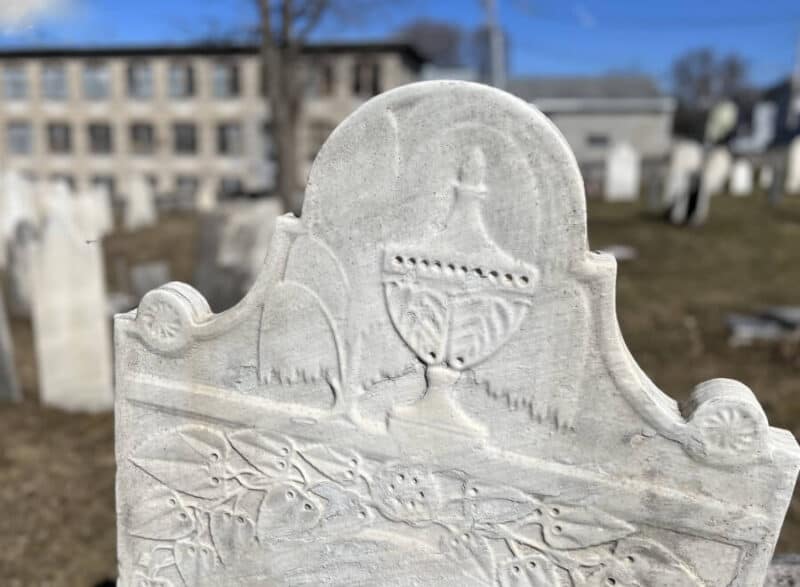
Elizabeth’s great-grandparents (the Livingston’s) and her brother Eliazer are buried in the Colonial Cemetery in town.
Elizabeth Cady Stanton Statue

The last stop on the tour, near the information kiosk in the William Johnson Park, tour-takers find the life-size statue of Elizabeth Cady Stanton sitting on a park bench. It was lovely to meet her.
The Mural

On the way out of town we waved goodbye to images of Elizabeth, Sir William Johnson, and Rose Knox, all represented on this large mural.
Conclusion
Elizabeth Cady Stanton stands as a fascinating character deeply involved in and greatly responsible for the women’s suffrage movement. Historians credit her speech, The Declaration of Sentiments, given in 1848 at the first Women’s Convention with galvanizing the movement across America.
In a day in an age when political candidates and pundits have advocated for the abolition of a woman’s legal right to vote (to be retained solely by the “male head of the household”), it’s important to remember why and how we acquired the right.
Similar Articles for Your Enjoyment


Bye for now,

Thanks for stopping by–
If you enjoyed this post, subscribe today
and get a FREE copy of my eBook:

I’d love it if you’d pin me for later!


Elizabeth Cady Stanton was also mother-in-law to L. Frank Baum, author of Wizard of Oz. One of the reasons he had a girl as his main characters ‘cause little girls could have exciting adventures, too!
Such an interesting fact Gail! Thanks for sharing it with us-