
How to Clean & Care for Antiques: Rusty Metal
Sometimes I assume that everyone knows what I know about vintage and antiques. I have to stop and remember that it has taken me a long time to get where I am (and believe me, I’ve got plenty more to learn).
I thought it might be helpful for some, especially those just starting out, to learn a how to care for the [less than perfect] items you might buy, whether for sale or for use in your home.
So, every now and again I’ll be writing a post about the various techniques I use to clean vintage and antiques, and otherwise prepare them for sale. Today I’ll pass on my easy steps for restoring and protecting rusty metal–going from sad and flaky to revitalized and protected.
Let’s take a look at how to clean and care for antiques: rusty metal specifically.

Table of Contents
Supplies for Cleaning & Caring for Rusty Metal
The Wire Brush Method
The Vinegar Method
Before & After Examples
Other Vintage & Antique Cleaning Methods
Supplies Needed to Clean & Care for Rusty Metal
This post contains affiliate links for research materials related to this blog post. This is both for your convenience as well as to support my blog, as I receive a small compensation whenever you click on such a link and make any sort of a purchase, for which I thank you.

Supplies
- Wire brush
- Steel Wool
- Mineral Oil
- Rags (alternatively, use my Wood Salve)
- Face mask
- White vinegar
- Old tooth brush
The Wire Brush Method
Step 1: Consider Wearing a Mask
I know we’re all sick of masks, but when cleaning rusty things with a wire brush, lots of tiny rust particles will be released into the air. You do not want to breath them in. Better safe than sorry.
Step 2: Remove Rust With a Wire Brush

The first real step to cleaning your rusty item (like the extremely rusty awl/ice pick above) is giving it a good scrubbing with a wire brush. You can do this dry, or wet under running water to keep the rust dust down.
WARNING: Do not use this technique on delicate, highly valuable antiques. You want to use other methods on those. Reserve the wire brush option for super cruddy items, like this awl, the value of which goes up once the rust is removed.

You can pick up wire brushes like these very cheaply at hardware stores or a Harbor Freight. Sometimes they come in packs of three. As you can tell, I’ve had my smaller one for a long time. The larger wire brush handles larger pieces well.

Just look at all the rust dust that remains after scrubbing a metal basket with a wire brush! As I mentioned, you can perform this step under water to avoid excess dust.

After being scrubbed, the awl looks quite a bit better already, doesn’t it? But while you can still see some bits of rust, the next step will take care of most of that.
Step 3: Clean With Steel Wool & Mineral Oil (or my Wood Salve!)

Scrub your piece with some steel wool and bit of mineral oil (or my all-natural wood salve) and the last of the rust will pretty much disappear. The oil improves the look of the piece and protects it from further rust at the same time.
If the item you’re working on doesn’t have too much rust to begin with, you can skip the wire brush step and jump right to the steel wool/mineral oil step.
Step 4: Buff the Piece
For the last step, rub the piece vigorously with a lint-free rag to remove excess oil. When you hold your piece in your hand, you don’t want it to feel greasy, just clean and satiny smooth.

Here’s the progression of the piece. Your steps:
- wire brush scrub
- steel wool and mineral oil scrub
- lint-free cloth rub down
The Vinegar Method
Some pieces are too small or too heavily rusted to really benefit from a wire brush scrub. For these, consider soaking in some white vinegar.
While vinegar nicely removes the rust, it often leaves behind dark spots where the rust was. For certain items, like tools, I’d rather leave a bit of tenacious rust than create those dark areas by applying vinegar.
For each item, you have to decide whether a bit of clingy rust or some dark spots is more desireable.
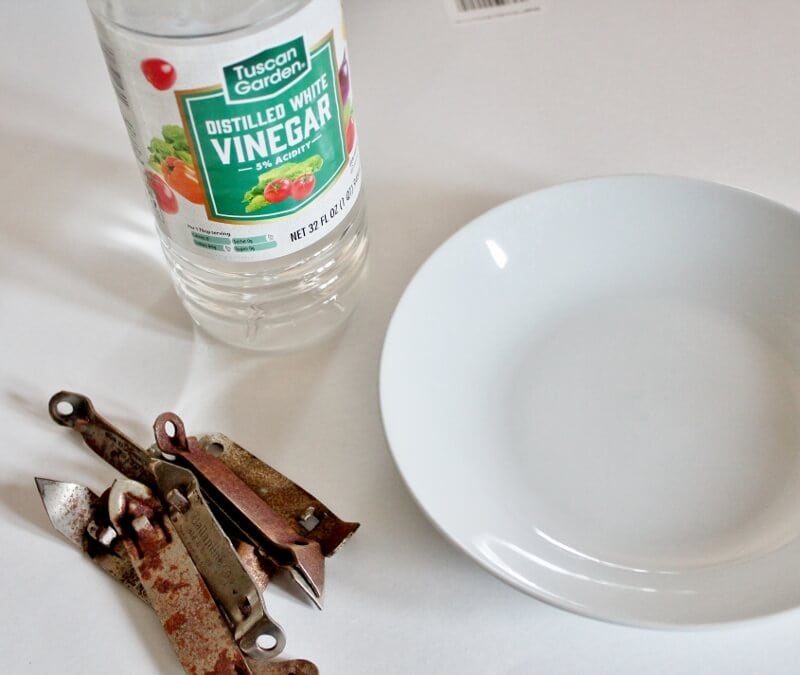
I picked up a bag full of rusty bottle openers at a flea market for a dollar. They had so much rust on them that I decided to give them a vinegar bath.
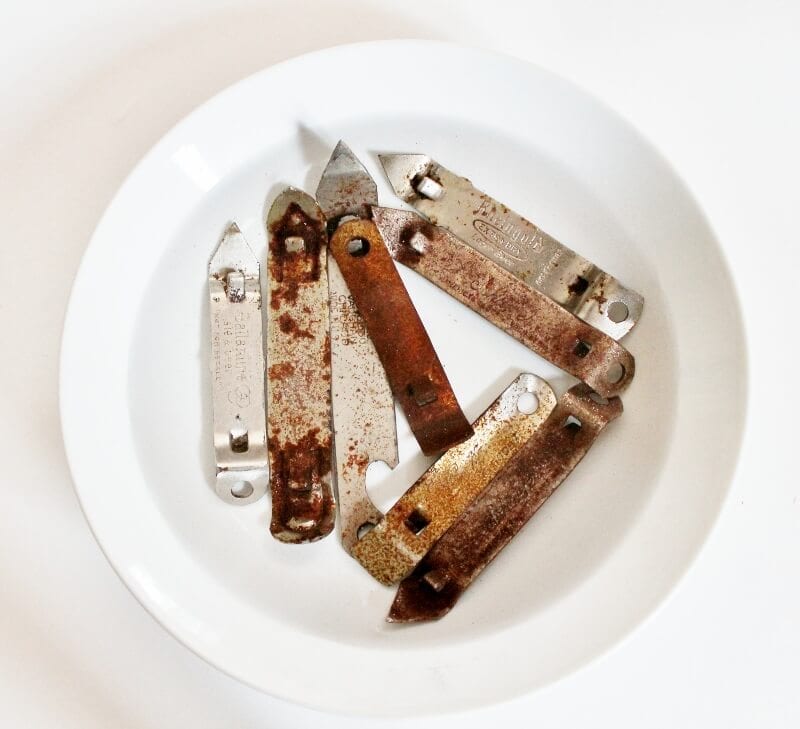
Here they are soaking in the vinegar.
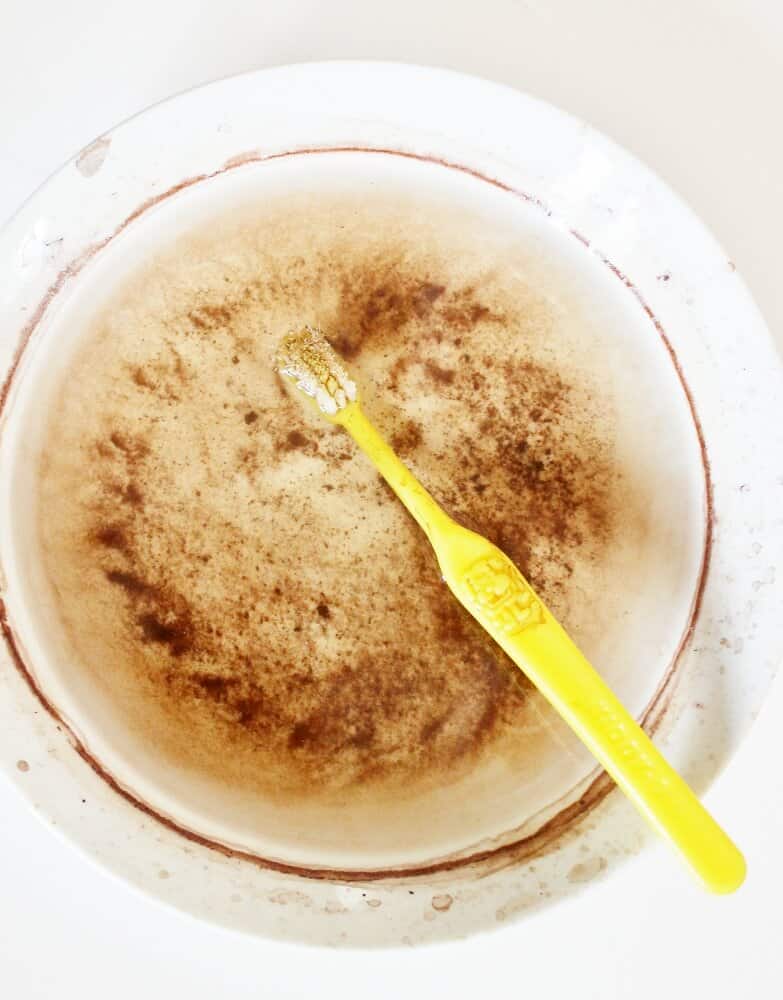
After a bit of a scrub with a toothbrush, this is the rust left behind.
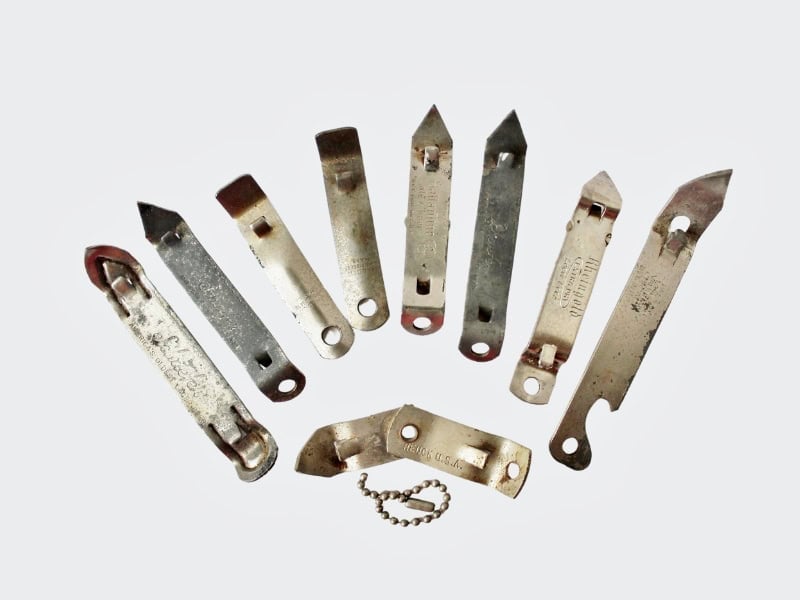
The vinegar method did the trick! The rust is gone and there are only a few dark spots left behind. Give your pieces a rub down and buffing with some mineral oil or wood salve to protect them from further rusting and to leave a satiny finish.
Calipers & Button Hook
Here’s another example of pieces soaked in vinegar with good results:
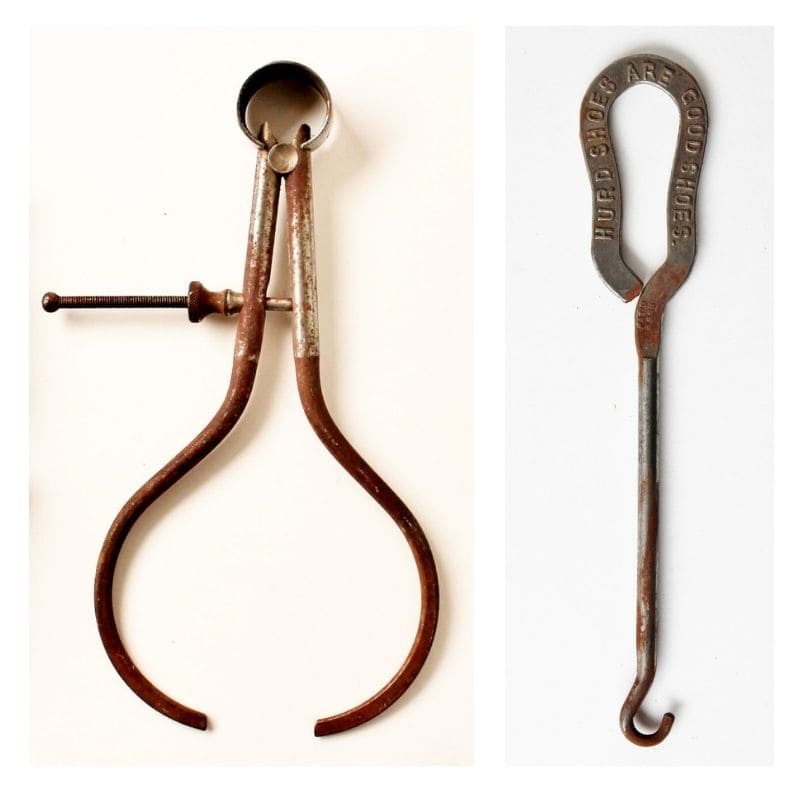
This is the before shot: rusty calipers and a rust button hook.
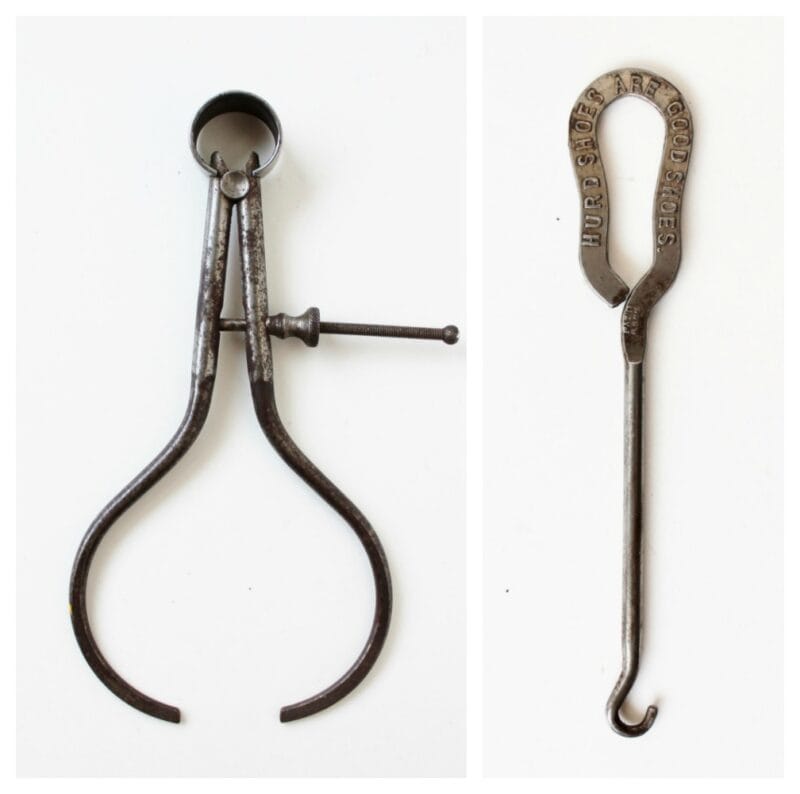
And the after. You definitely notice the darkening on the calipers, but that’s far better (in my opinion) than leaving some rust behind. Same with the button hook.
Related Articles
Metal Folding Ruler
And lastly, a metal folding ruler received the vinegar treatment:
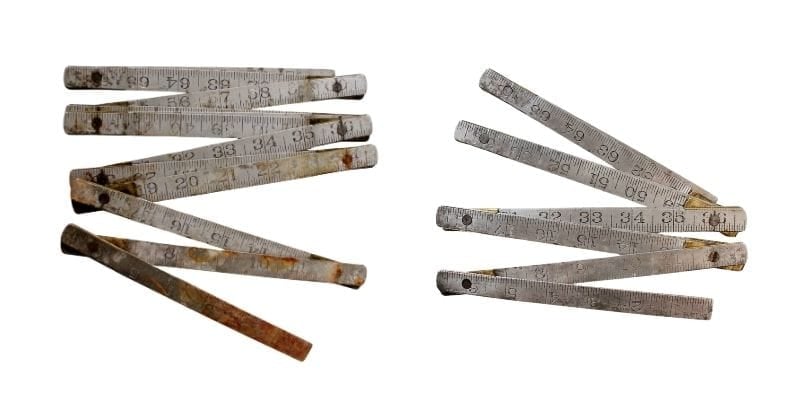
On the left you’ll notice some severe rusting on the lower part of the ruler, and then on the right, the good result from vinegar and mineral oil.
Related Article
Before & After Examples of the Wire Brush Method
Toy Cast Iron Sad Iron & Trivet
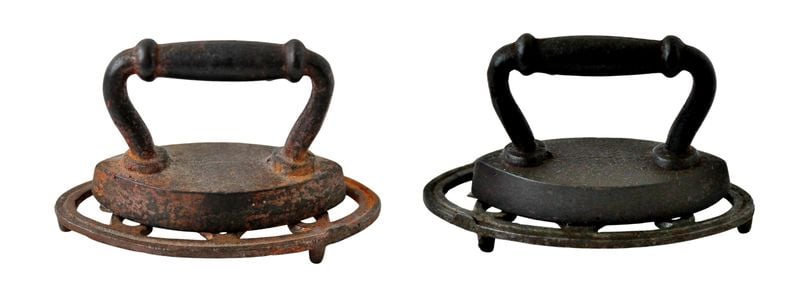
This sweet little sad iron and matching trivet had definitely seen better days. The wire brush method changed all that for the better.
Related Article
Wiss Tool
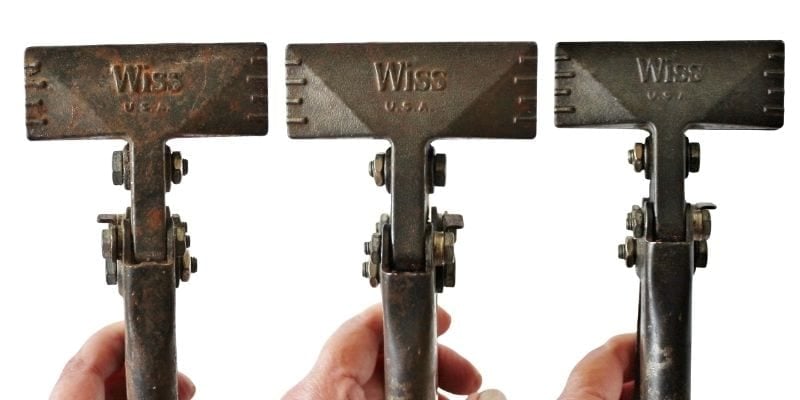
Wiss is a great name in scissors. I was unaware that they made tools like this metal clamp, which benefited a great deal from a wire brush and mineral oil spa treatement.
Related Article
Other Vintage & Antique Cleaning Methods
Final Thoughts
Next time you see a rusty something or other while out vintage shopping, don’t pass it up! Use the wire brush and/or the vinegar method to remove that rust and restore the “thing” to some (or all) of its former glory.
If you enjoyed your visit, I hope you’ll SUBSCRIBE and never miss a post.
Get a FREE copy of my mini eBook when you do,
10 Vintage Items Often Overlooked & Undervalued at Garage Sales:

Bye for now,

I’d love it if you’d pin for later 🙂


Very helpful, Diana! I have often wondered how this was done. Thank you!
Wow Diana what a great trick! I always brush my pieces down, but have never used mineral oil.
Thanks for the helpful tips. I am now following you on several social media sites so that I don’t miss a trick!
Big Texas Hugs,
Susan and Bentley
Thank you for sharing your expertise. It will come in handy.
Such great rusty stuff! You certainly got your money’s worth! Thanks for showing us how you beautify it all. xo Kathleen
I live this post. Thank you for the great information pining for future reference.
I love these pieces of junk, grin…(treasures to me also) The door plate is awesome!
Thank you for this post. I have an old rusty horse door knocker that I’ve been keeping around for years knowing there is beauty underneath but didn’t know how to get at it. Now going to get mineral oil and a wire brush.
Amazing! Perfect timing for this post for me as I had just purchased a box of rusty treasures and wasn’t sure how to make them pretty again! Thanks a boxload!
Great tips Diana ~ thanks for sharing them!
gosh I can think of dozens of things I use mineral oil on: butcher block, cutting boards, all kinds of hardware, even drawer edges run smoother with a rub down of mineral oil on the guider, my brass as a seal coat. Great tutorial, I hope everyone uses your techniques. Mineral oil is nature’s protector. Thanks, Sandi
This is a great post Diana! It’s amazing how good those old pieces look after you cleaned them all up!
Tania
Years ago an antique dealer friend told me that after he did the method you described he then dried them in the oven to bake the oil in. I did do that a few times and the pieces had gorgeous patina. Thanks for reminding me.
Yep, heat ’em up and “season” them like you would cast iron cookery.
Great tips. I love rusty but every now and then I need to clean up my rust a bit. Thanks for sharing.
Love your ideas for giving these rusty treasures the spa treatment. Thanks for sharing your tips and tricks at Talk of the Town.
Great tips, Diana! Thanks for linking up at Talk of the Town and for sharing the party – I’m sharing your link on Facebook, and pinning it to the Knickof of Time party board!
Thanks Diana …. very useful information. I have not used mineral oil, but will certainly try it.
Thanks for the tips and for sharing with SYC.
What a great read today….I love rusty old stuff and now I know what to do w them! Thanks for the info. Karan
When I studied archeaology, we learned that the rust is still there. Do you have any pieces that you’ve cleaned this way a few years ago? If you do, how are they looking? Do they need repeated cleanings to keep them looking as nice as they look when you have just cleaned them? I’d love to buy some old pieces to add to the collection for when i finally do get set up with e-bay, but don’t want to receive complaints later….thanks for your help…..i enjoy your antique/vintage hunting posts enormously…….
HI Diana! I came across an old copper tea kettle that has beautiful patina but it is dirty. How can i clean this without taking away the age of it?
Hi Cheryl! In my experience, the only way to clean a copper kettle without removing the patina would be with a damp rag, to remove dust on the surface. Depending upon how old it is, cleaning may increase its value, for example, if it’s a vintage rather than antique piece. Good luck!
Diana, I found your article and I’d like to find your email and send you a picture of an antique door that I bought from France to replace my pantry door. The hardware on it is old and rusty, and I would like to know how to clean it up and restore it to its former glory. I’d like to send you pictures of it
I bet your French door is beautiful Rebekah! Unfortunately, due to the high number of requests, I’m unable to help with specific questions such as yours. Perhaps a higher end antique dealer or shop owner could give you some suggestions-
I just purchased a 1956 Ford tonka truck. It’s really just dirty and rusty in spots, no big chunks. Wish I could show you a pic. Would you just suggest the steel wool and mineral oil to clean it? I want to keep the rustic look.
I don’t know what effect it would have on metal since it has perfumes, but I always clean paint off my hands with baby oil. it’s quite a bit less expensive than mineral oils and honestly I don’t see how it could harm metal pieces
Diana, thank you for these great suggestions. I have the opposite problem and that is, how do you preserve a decor piece that is very rusted but that is the look you want? It will be outside above a door and will be exposed to rain. How do I keep the rust from bleeding on to the wood behind it? Is that even possible to do? Thank you!
Hmmm. Not sure about this but you could try spraying it with polyurethane. I’d give it a whole bunch of coats and recoat it every year. Not sure that would work, but maybe it’s worth a try? Good luck Jill!