
How to Clean & Care for Vintage Pyrex
Do you love Pyrex? It’s hard not to love something that comes in such bright, beautiful colors and in such truly charming patterns.
I don’t personally sell much vintage Pyrex because I mainly focus on farmhouse-style vintage and antiques, but I do own several pieces that I absolutely love. Recently, I began investigating how to clean and care for vintage Pyrex.
My collection contains mostly aqua and pink pieces, but recently I bought a 1-quart white casserole in the “star” pattern because it was well-priced. I found it in pretty bad shape and therefore decided to try out some recommended cleaning methods and write a post about the results.
Keep in mind as you’re reading this post, cleaning Pyrex is not a straight-forward process! If you have a piece that’s in bad shape, you will likely need to take a few steps, rather than just one, to bring it back to its former glory (or close to it). It should make you stop and think twice about buying too many pieces in poor condition.
BTW, if you’re looking for a bit of help pricing your collection, be sure to check out my vintage Pyrex price guide.

Supplies I Suggest for Cleaning Vintage Pyrex
* This post contains affiliate links for products necessary to complete this project. This is both for your convenience as well as to support my blog, as I receive a small compensation whenever you click on such a link and make any sort of purchase, for which I thank you.
 I read numerous online articles and blog posts that attempt to explain how to clean vintage Pyrex. In this photo you see some of the products that various authors recommended.
I’ve circled the products that I found effective and X-ed out those that had little or no effect, and one that had a very bad effect. Notice I had to photo-shop some of the effective products into the picture, LOL. Here are the ones I recommend:
- Dish detergent (I like Ajax Grapefruit, but any brand will do.)
- A scrubby pad (I used Ceramabryte, cooktop cleaning pads)
- Barkeeper’s Friend powder
- Razor blade scraper and/or pin and/or toothpick
- Paste wax (I used Minwax)–this is a secret ingredient!
How to Wash Vintage Pyrex & Remove Light Grime
 The first rule for cleaning vintage Pyrex is to never, under any circumstances put your precious pieces in the dishwasher. Dish washing detergent will literally strip the sheen off your Pyrex and eventually wear away some of the color and the pattern.
Instead, you must wash it by hand, in hot soapy water, using gentle dish washing soap like Ajax. For normal everyday stuck on food, soaking in soapy water and washing with a sponge or nylon scrubby will return your piece to good order.
For pieces with stuck on grime, I recommend soaking multiple times before moving onto any stronger products. You might be surprised at how much can be removed through multiple soakings.
What didn’t work: I read a couple of times that soaking Pyrex in hot water with dish soap and Borax would remove just about anything. Nope. It had absolutely no effect on the hard-to-remove stuff baked onto my piece.
Pyrex with Baked on Grease & Grime
Now we get to the difficult question of how to remove that icky baked on gunk that you often see on vintage Pyrex. You’ve probably rejected a few pieces because of it.
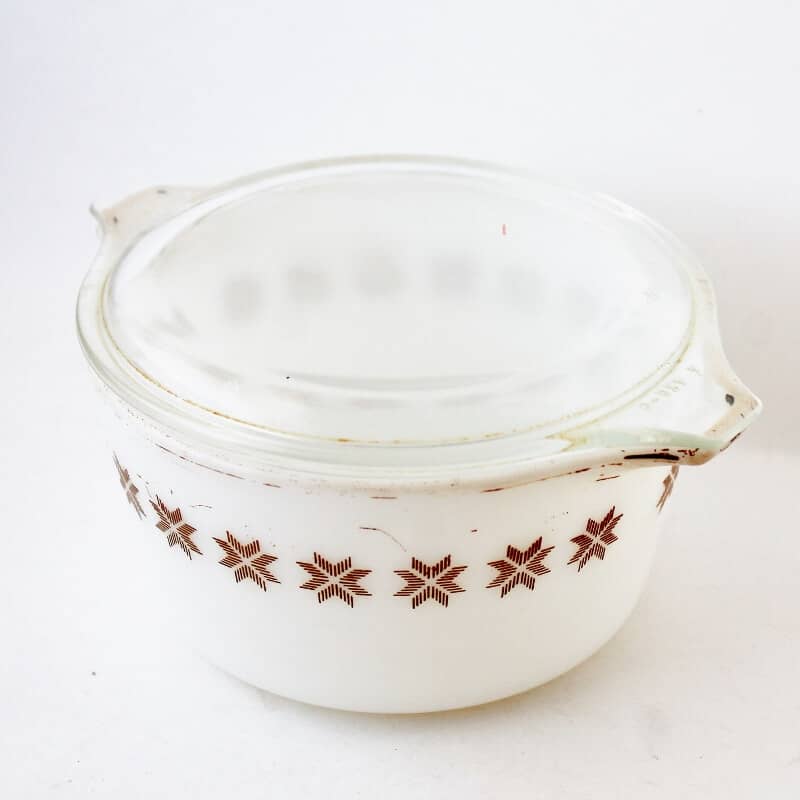 Here’s one-quart “Star” casserole I picked up at a garage sale for $3. It’s seen better days, right?
 The soaking in hot, soapy water method of cleaning only managed to clean the lid (the “lighter unwashed gunk”); it didn’t touch any of the baked on grease or grime on the casserole dish itself.
How to Remove Stubborn Baked on Grime from Clear & White Pyrex
 Barkeeper’s Friend
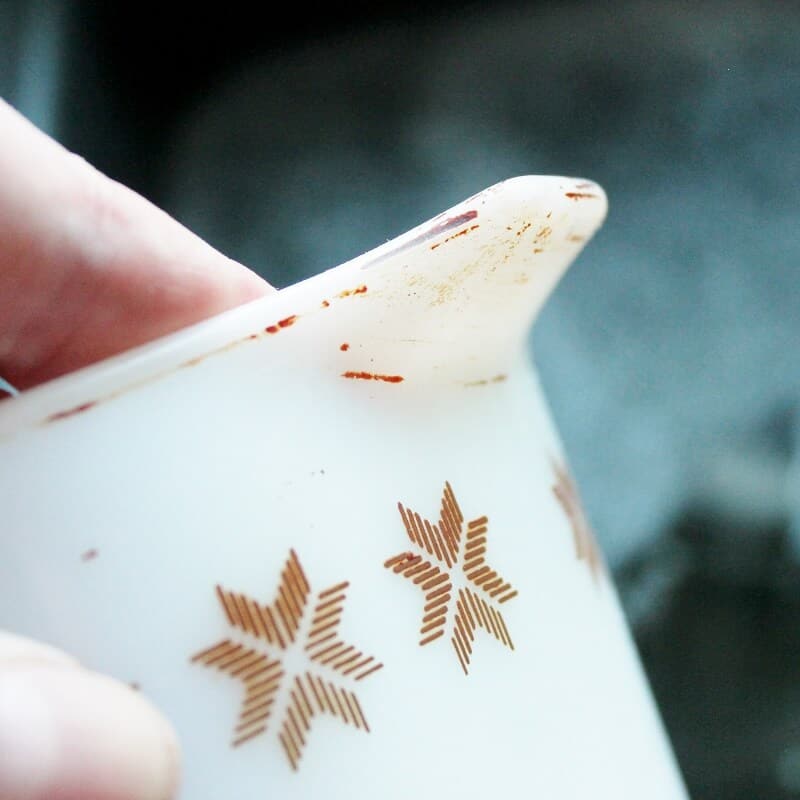
Almost universally, Barkeeper’s Friend (BKF) came recommended as a safe cleaning product for vintage Pyrex. I applied it with a sponge at first and tried to remove the grime from the handle and the casserole edge. I had very little success.
Next I applied BKF with a scrubby pad (I used Ceramabryte stovetop cleaning pads, though they look exactly the same as any other scrubby pad). Finally, much of the smaller, lighter specs of grime came off with a couple of good scrubbings.
NOTE: I avoid scrubbing over the pattern, though later I sprinkled some BKF on my finger and lightly scrubbed the grimy areas inside and around the star pattern, and it worked very well!
 Toothpick
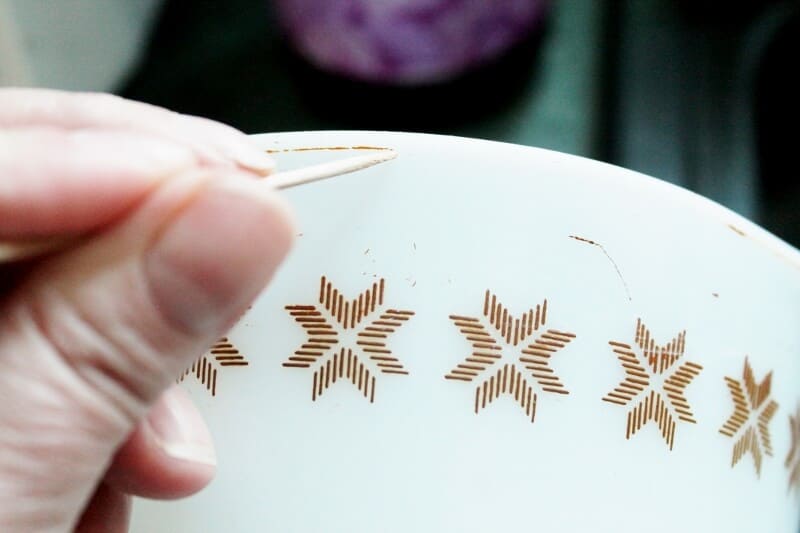
You can tell from this photo that scrubbing with BKF removed quite a lot of the baked on grime, but quite a few spots remained untouched.
What didn’t work: I had frequently read that toothpicks can remove grime from places like the rim line of Pyrex, but I didn’t actually have much success. Yes, it removed some, but actually very little. Since it’s a safe method, though, I do recommend giving it a try before moving onto more “dangerous” methods.
 Razor Blade
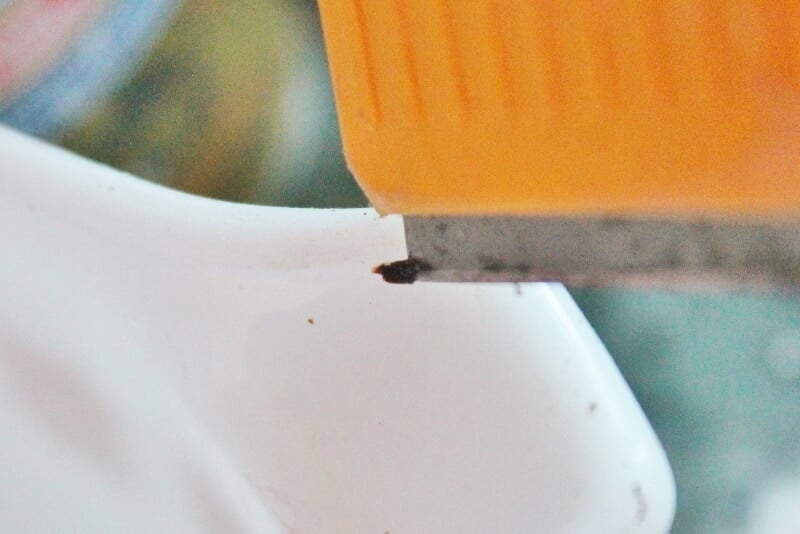
One of the biggest issues with this piece of Pyrex were the globs of gunk stuck to the handles, but my razor blade scraper (with a new blade) came to the rescue.
Since razor blades can scratch glass, I very carefully slid the sharp edge underneath each “blob” and gently lifted, and with very little pressure at all, the blobs simply popped off the glass(!). That was a nice surprise.
I also inserted the very tip of the blade into scratches and removed the grime that filled them. I’ve read that a pin can achieve the same result.
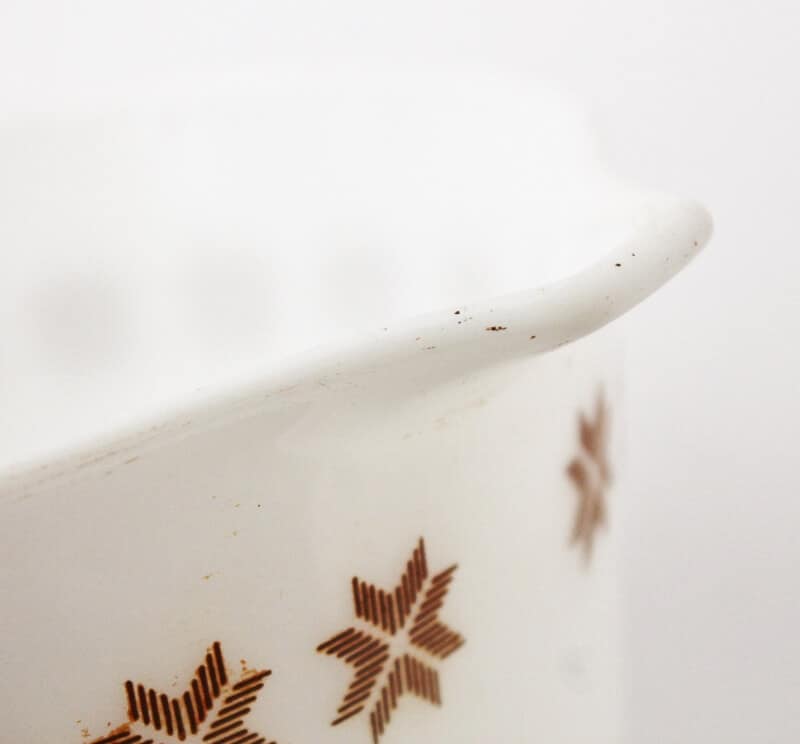
To removed smaller bits of stuck on gunk, I lightly scraped them off with the razor blade, by holding it at a narrow angle and gently scraping it under the gunk. Trust me when I say, scrubbing with BKF was simply not enough. I’d still be scrubbing and that stuff would still be clingy to the Pyrex.
End Result: A [Mostly] Clean Vintage Pyrex Casserole
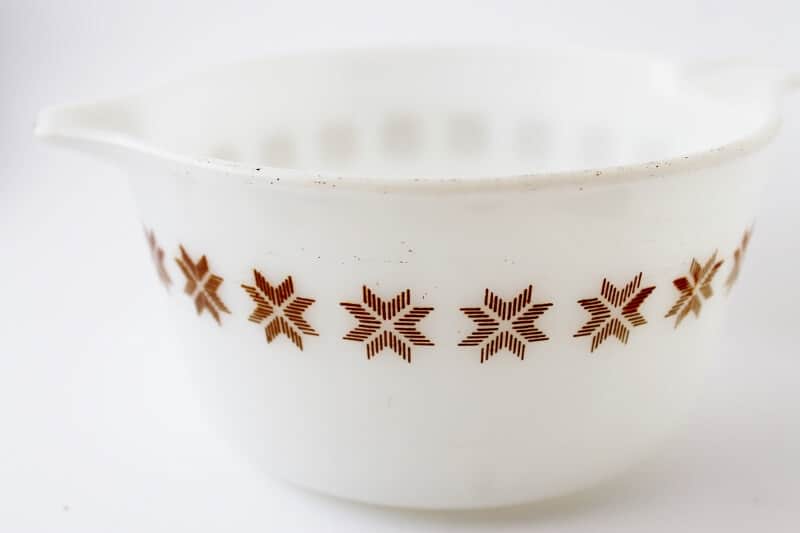 As you can see from this photo, my little casserole has not been completely restored to its glory days. But it’s looking pretty darn good, and in regular daylight, you hardly see or notice the tiny little spots of grime that remain in the myriad of light scratches that cover its surface. This cleaning project was by-and-large successful.
What the Corning Museum of Glass Recommended
Interestingly, the Corning Museum recommended just two cleaning methods: (1) soak the Pyrex in soapy water and (2) use lye to remove baked on grime. For the purposes of writing this post, I decided I did not want to deal with any product that required gloves, eye protection, and a mask in order to use, LOL.
In the comments to the Corning article, I read several other, less scary products that contain some lye: oven cleaner and Drano Kitchen Granules, for example. Again, a bit too strong for my taste, though the reported results sound good. Perhaps at a later date I’ll give one or both of these products a try and report back.
In the meantime, if you want to try them yourself, you can read more of the details in the Corning Museum post.
What to Do About Scratched Vintage Colored Pyrex
Everything I read about cleaning colored Pyrex indicated how careful you need to be with the colored surface. Washing in the dishwasher and using a magic sponge on it will remove the shine and color, while storing it haphazardly or scrubbing it too harshly will likely scratch the surface.
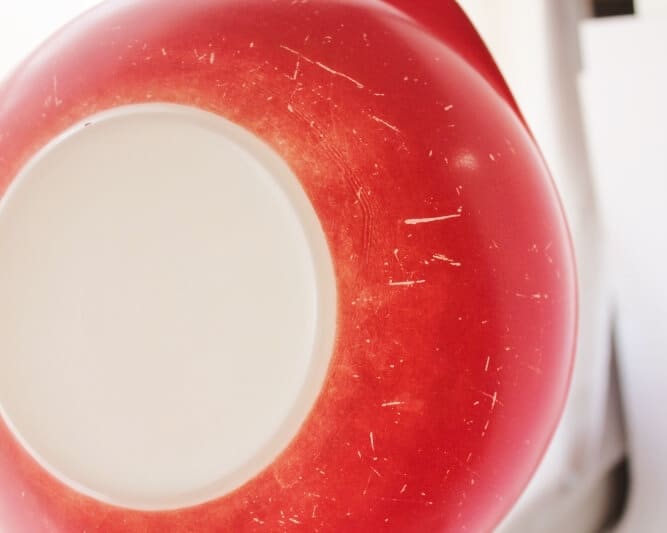
Holding this Flamingo pink casserole up to the light reveals the many scratches on its surface (you’re seeing it here after a good cleaning). Unfortunately, there’s nothing that can be done to remove or fill-in these scratches. But read on for a method that “fools the eye” and makes scratched pieces more presentable.
How to Clean Colored Vintage Pyrex
 Here’s a look at the casserole before cleaning. You can see its rough shape, exactly how I found it at Salvation Army for $1.99. Knowing that I had this cleaning post planned, I thought it would be a good piece to test cleaning methods on. Can you see all of the light browning covering the pink?
Soaking it in soapy water accomplished very little, if anything.
 So next I gave BKF applied with a scrubby a try. At all times I used the lightest pressure possible to remove the brown grime. In this photo you can see the cleaned portion of the casserole on the right and the untouched left side.
I did not notice any loss of color or sheen at all, so I feel it’s pretty safe to use BFK on colored Pyrex. It’s always a good idea to test it out on the bottom or the underside of a handle to be sure.
Before going ahead to clean the left side of the casserole, I thought I would give another product a try.
Do NOT Use This Product on Pyrex: LA’s Awesome
 Don’t use LA’s Totally Awesome cleaner
I’ve had great success using LA’s Totally Awesome cleaner to remove grime from other items (like vintage suitcases). I decided to give it a try and sprayed it on the left side of the bowl, to try to remove the browning.
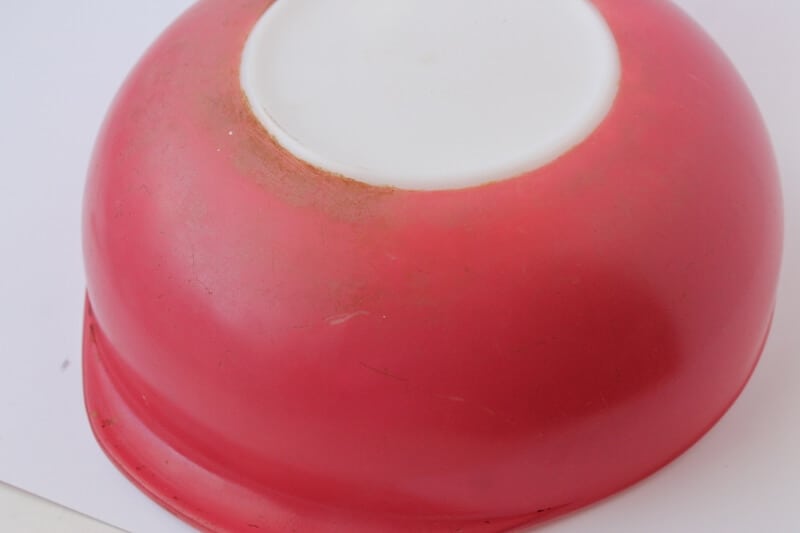
To my horror, what I actually removed was the sheen!! You can see in this photo how around the white bottom the casserole has lost its luster, while below that, along the bowl’s rim the sheen remains.
I basically “stripped” the bowl of its remaining gloss in the area where I sprayed the Awesome and where it dripped.
But hang on, there may be a way to save this casserole…
How to Restore the Shine to “Dead” Pyrex
While studying various methods for cleaning vintage Pyrex, I ran across a few people who recommended rubbing the surface of dishwasher “fried” pieces with coconut oil. By fried I mean Pyrex that has lost its sheen.
In actuality, rubbing the surface with any oil is going to make fried Pyrex look shiny again. Coconut oil is less likely to become rancid than other oils, so I guess that’s why it has been recommended. Also, people tend to think of it as a “miracle” product.
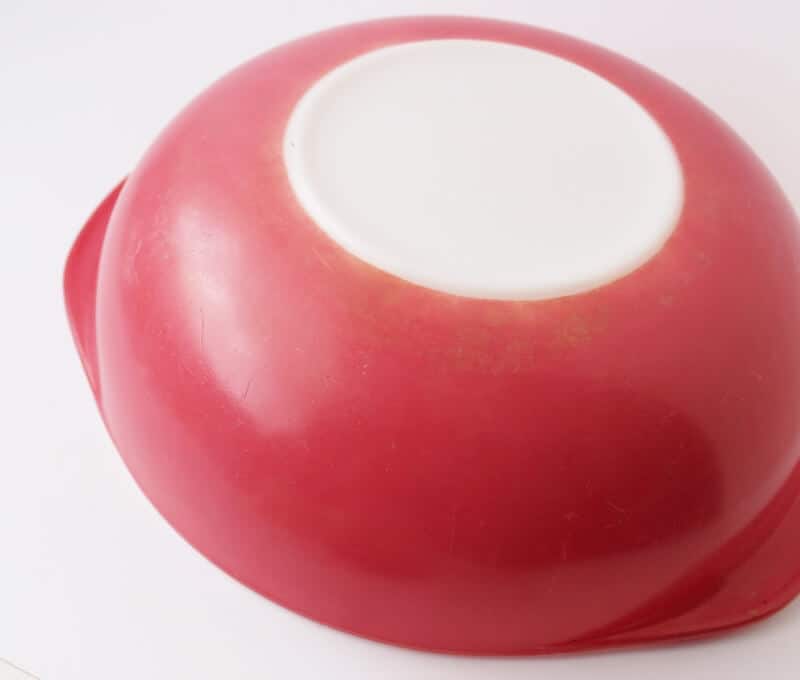 Paste Wax
But the application of oil got me thinking. How about trying paste wax? The benefit of this product is you can buff it to a hardness that cannot be achieved at all with plain old vegetable oil. In fact, coconut and other oils will attract dust and may over time create its own sort of issues.
If you want to use your piece for decoration only, then it’s worth using this restoration method because it works really well. You can see in the photo above that the portion of the casserole where the the sheen was removed by the Awesome cleanser has been completely restored. Note that the paste wax also makes scratches less noticeable.
To achieve this look, apply a thin coat of wax to the surface of the casserole; let it set for about ten minutes; buff it with a clean cotton cloth or piece of cotton cheese cloth to a nice sheen. Then, place the piece on a shelf for decoration and wipe off the dust with a dry cloth every few months or so.
Successful Methods for Cleaning Vintage Pyrex
Let’s review the methods and products that I successfully used to clean and restore these vintage Pyrex pieces:
- Soapy Water: Soak your vintage Pyrex in soapy water, wash with a sponge or dishcloth.
- Barkeeper’s Friend: Scrub with Barkeeper’s Friend–1st with a sponge, 2nd with a scrubbing pad. Be especially cautious with colored Pyrex.
- Sharp Razor Blade Scraper: Carefully use a razor blade widget to lift off thick gunk and/or to scrape off surface grime.
- Toothpick: Use a wooden toothpick to pick out grime stuck in grooves and/or scratches.
- Razor Blade or Pin: Use a razor blade edge or pin to remove grime stuck in scratches.
- Paste Wax: Apply paste wax to damaged vintage Pyrex & buff to restore shine (use for decoration only).
I realize this is a bit of a long-winded post, but as I mentioned at the outset, the process for cleaning our precious vintage Pyrex is not a straightforward one. And while we want our pieces to look good-as-new, we don’t want to use products or methods that will hurt them.
I’d love to hear in the comments which methods you’ve tried and how they worked for you. If you belong to my Facebook group–Your Vintage Headquarters–post some photos of your pieces for all of us to enjoy 🙂
Thanks so much for stopping by–
If you enjoyed your visit, I hope you’ll subscribe and never miss a post.
You’ll receive access to my MEMBER LIBRARY and get loads of FREEBIES!
SIGN UP BELOW and get a PDF cleaning vintage Pyrex cheat sheet:

Bye for now,

I’d love it if you’d pin for later–


Always enjoy your site! Thank you!!!
Your Welcome Jackie, and thank YOU for taking the time to leave a comment 🙂
I’m new here and I’m loving it all, so much to see so little time.
Haha! So glad to hear it Gerri–enjoy!
Really great review of the various cleaning options. Thank you for detailing this so well!
You’re welcome Jessie! So glad you found it useful 🙂
Thanks for the article on cleaning Pyrex.
Love the idea of using paste wax to help restore the shine.
I so appreciate your commitment to sharing your knowledgeable ideas.
Thanks
Aww that’s so kind of you to say Liz 🙂 I’m so glad you enjoyed the post and came away with a good tip!
Thanks! That was really helpful. I inherited my grandma’s set of nesting primary color mixing bowls 30 years ago and use them regularly. Fortunately I always hand wash them, but I’ll keep all this in mind for future cleaning.
I use barkeeper’s friend to clean lots of things that can’t handle abrasives. It works great. I bought some vintage Pyrex the other day, and the seller said his wife mentioned shining them up with oil. To me as a vendor, that’s cheating. The buyer will get home, wash it, and OOPS! No more shine!
I agree 100% Diane! If you use oil or paste wax to improve the look, it should be noted on the tag.
Such a wonderful blessing to have your Grandma’s bowls, Laura!! Sounds like the hand washing has kept them in good condition…
I really appreciate this info! I have some vintage Pyrex that usually just stays on the shelf but I have quite a bit of Corning Ware that I use enough to need this info! I think that if this works on baked on bits on Pyrex it will probably work on the CW too. What do you think?
After reading this I’ll be much more careful about using Dishwasher Detergent to soak things because that is my usual go to cleaner. I see that while it might work most times it will also damage things.
Thank you!
Hi Jan! I’m glad you found the post helpful. Yes, I think it’s likely that all these tips would work on Corning ware glass, especially since it was Corning that invented Pyrex 🙂 I don’t think that the dish washing detergent is as bad on white and clear glass as it is on the colored, but it’s probably a good idea to start hand washing if you want to ensure that it retains it’s “new” look and don’t lose any of the decoration.
Thanks Diana….can you believe it….that is the one thing I don’t collect 🙂 Great information!
Ha ha–no, it’s actually hard to believe, LOL! I have a few pink and aqua pieces that I just love and don’t feel I need to sell since I use them occasionally 🙂
Thank you for doing the troubleshooting for us. I have also found that an overnight soak in hot dishwater with added bleach removes o lot of nasty safely (including tape and stickers). Goo-gone helps with marker and some baked on stuff.
You’re very welcome, Leslie! Thanks for the extra tips 🙂 I’m thinking we should be cautious about bleaching colored Pyrex (as opposed to clear and white) since I’ve read that over time that might affect the finish. May be an old wives tale but we should proceed with caution!
Your instructions were A-No1! I am saving this. And you photos were great. I have some vintage pieces but never considered them vintage but I guess I myself am vintage. I have passed a few along to my granddaughter. I must get some of that wax.
You made me laugh with your comment Karla! I think we both might be vintage, LOL. Let me know how the wax works for you 🙂
This was a great tip! I have used BKF to get the baked on gunk off of Pyrex and also those black marks inside coffee cups where the spoon scratches the cups. I have a very old small red refrigerator bowl I used for storing bacon grease in the fridge for probably the last 30 years. Being young and dumb about caring for this older stuff, I always washed them in my dishwasher. No more. I saw a Pyrex bowl a friend of mine had that belonged to her grandmother that had been washed in the dishwasher so may times, you could just barely tell what color it was. Made a hand wash believer out of me! Anyway, my red was really dull, so I just used some BKF on it and rubbed it with coconut oil. It doesn’t look brand new, but it certainly looks better than it has in a long time! I originally purchased this dish about 30 years ago at a yard sale for .50, and I have been using it and it’s sister, the turquoise blue rectangular one, since then. Love them. I appreciate you sharing your knowledge with us!
Thanks for confirming that dish washing machines are NOT the way to go with Pyrex, Cecilia 🙂 So glad you enjoyed the post!
Thanks Diana for the great tips! I’ve used BKH for many things and will add the Minwax to my tool kit! Can’t wait to find more unloved Pyrex at Goodwill, etc..!
You’re welcome Cathie!! Good luck finding some unloved Pyrex and giving it new life 🙂
Great info. I guess I have more Corning Ware casseroles than Pyrex and have always put them in the dishwasher! My 3 remaining ’73 Cinderella bowls seldom get used so the colors are still bright. I am suprised Awesome dulled sheen; it is my go to for a lot! My go-to detergent is Dawn as it is supposed to be good on grease.
I know! You’re the one who introduced me to it, Kathy–and I love it. But as we both know, Awesome is pretty darn strong stuff!
A very helpful post, Diana. I have only the flat baking dishes with the little blue flowers on the sides and clear lids. I’ve never given a lot of tho’t to trying to remove some of the small baked-on spots of food. I do wash them well and try to remove all the stuck-on food each time they are used. And I have put them in the dishwasher! I didn’t realize they would be damaged so I’m glad to have that info in your post. I will never do it again! I was also glad to know that BKF is good for scrubbing Corning Ware as that is what I have been using lately.
Thanks for all the research that went into this informative post. ( I hate researching, so I’m always grateful when someone else does it for me! )
I’m so glad I could help Naomi! Like I said in the post, I don’t get to nit-picky about getting every single spec of baked on gunk off–just the worst of it. BKF is such a blessing, isn’t it??
Thanks for this information. I’ve been trying to clean some baked on stuff off of some Fire-King casseroles I inherited from my mom so this article is perfect timing! I will definitely follow your tips.
Good luck Paula! I hope you’ll report back on your success 🙂
Thanks for this very helpful info!
You’re welcome Vicki!!
Can you hear me singing!!! Yes, yes, yes, thank you for this article! As I have said before, you make me happy. Have a beautiful day.
Oh my gosh, Sharon!!! You make ME happy 🙂 🙂 I’m SO glad you enjoyed the article and even more glad that you took a moment to let me know–YOU made my day beautiful–
Something I have used with success -akin to your pastewax for display pieces – is Future floor wax.
Thank you for the good info.
On clear Pyrex or any Corning ware the easiest method I have found is take it outside inside a plastic bag. Open the bag, spray oven cleaner on the dish inside the bag while holding your breath(!). Close the bag and leave it overnight.
In the morning….all that baked on crud will rinse off.
Great idea about Future floor wax, and thanks so much for great tips on how to use oven cleaner safely to clean Pyrex. I’ll be trying that as soon as I get another cruddy piece 🙂
Chemistry background here ……. For baked-on brown gunk, place the item in a large ziplock bag and add some ordinary household ammonia to the bag or the dish, a couple of tablespoons’ worth. Seal and let sit overnight. The ammonia smells bad but that won’t kill you. If you get it on your hands, FIRST wash off with soap, and if they still feel slippery, rinse with vinegar, then water. The ammonia fumes react with the grease to form good ol’ soap. It may take a couple of treatments, or letting it sit longer, but it works beautifully.
Thanks for sharing your process with us Pat! Much appreciated 🙂 I can’t wait to give it a try 🙂
I put my vintage yellow casserole in the oven today to roast some vegetables. When I took it out of the oven, the yellow looked dirty, and I have tried BKF on the yellow with no luck. I tried baking soda, salt, glass stovetop cleaner, with no luck. It’s not caked on grime, it just discolored the yellow. Any ideas?
I wish I did Gail. I spent quite a lot of time researching and testing various “remedies” and I wrote about the ones that worked for me in the post 🙁
My table ware Pyrex has been ‘grungy’ in the colored, painted areas. A weak bleach solution was my last resort. A 1/2 dish pan full of warm water and one glug of bleach. The grunge is gone in a few minutes. Don’t put too much bleach in because it will affect the color eventually. Rinse well in warm water to get the chlorine off. I have realized that the grunge appears because the gloss is worn off of the paint. Sad.
To restore the glossiness (temporarily) apply a coat of paste wax (following the directions for buffing). You’ll be surprised at how great your pieces look afterward Lou!
Diana, thanks for getting back to me. I used the dish again last night, and the yellow turned “dirty looking” that was worse than before. The only thing I could think of is that I started storing a big pizza stone on the top rack in my oven since it’s so big to store in the cabinet. I am wondering if that has something to cause the Pyrex to discolor? I have used that casserole before and it never discolored, however with the pizza stone in the oven, I am thinking maybe something in that stone is causing the problem.
Nonetheless, I think you had some great tips to keeping the vintage Pyrex looking brand new! I have all of my mother’s Pyrex that I could not part with, and I’m so happy I stumbled upon your website!! I will keep trying to restore that yellow color, and if I’m successful, I’ll let you know!
Thank you again~
Gail Merrill
I think you may be right about the pizza stone causing the problem, Gail. If yours is anything like mine, it’s full of grease from past pizzas. In general, when you’re baking/cooking you want to take out any empty bakeware since that will affect your cooking time and the evenness of the cooking. Even cooking to filled dishes at the same time affects overall cooking time. Yes, please let me know when you find a solution for your Pyrex, and I’m so glad you like the blog!! Stay in touch–
Hello! Your tips are fabulous! I’m wondering if you can help me with this issue.. I bought a clear lid with the friendship pattern that has turned white on top of the design. Underneath you can see the normal beautiful colors of the friendship design.
Thank you!
Joan
I’m so glad you enjoyed the post, Joan 🙂 I’ve never owned a lid like the one you described but in my FB group (Your Vintage Headquarters) there are a lot of Pyrex lovers and sellers. You could post a photo and ask for some tips. Hope to see you over there!
I have been using an ice pick rather than a toothpick to clean in the grooves.
I wondered have you ever tried the plastic dish scrapers? They help me a lot and I don’t get cut. I am such a clutz I try not to use power tools or sharp blades. Lol great tips and I totally agree I will not use cleaners that require hazmat gear to be worn while in use.
Do you mean the ones that are like netting? I’ve not used them but it sounds like they’re worth a try! Thanks for the suggestion, Darla 🙂
Unscented Easy OFF Oven cleaner works Magic for baked on grease and grime!! Spray it on, let sit for 20-30 minutes and wipe clean. Been using it for years and doesn’t damage the piece at all. I prefer the “unscented” since you don’t have the heavy fumes. The dollar store or off brands do not work well, so avoid them!!
Oven cleaner sounds like a good product to use on clear or white Pyrex but harsh chemicals usually degrade the surface of colored pieces, in the same way that dishwashing them does. Thanks for the tip Linda!
I have a nice old Pyrex bowl that looks like it’s cloudy snd I believe it’s minerals left by the soft water in Florida. Do you think some of these same methods would work on it?
I don’t think it would hurt to try Judy. Let me know how it goes!
I just throw mine in the dishwasher. I’m not likely to use items that I have to hand wash, and I’d rather enjoy my beautiful bowls and cookware than have them sit, unseen and unused, in a cupboard.
Lots of research went into this post, and I’m going to try toothpicking a piece that has some recently burned on gunk 🙂
I’m a firm believer that when you own a thing, you get to decide how you’re going to use it! You be you Rachel 🙂 I hope you have success with my toothpick idea!
Hi Diana. I am also a fan of BKF for cleaning my Pyrex that I find. It also works wonders removing the grey utensil marks on dishes and inside mixing bowls. I have used oven cleaner on the baked on greasy gunk that is hard to remove. I spray the piece outside and leave it there for about an hour. The grease runs right off!! Some say use the yellow cap oven cleaner because it has lye. I use whatever is on hand and have had great success.
Glad BKF has worked for you too Carin! Thanks for the oven cleaner tip. I’ll have to give it a try next time 🙂
Hi, I just discolored my vintage butterprint pyrex at thanksgiving, I put hot cranberry sauce in the bowl, and now it is white with GREEN print instead of blue!!! Any ideas to restore the blue?
Thank you- Cathy
I really have enjoyed reading and learning from your post! I have some vintage mixing bowls that were my mother’s that have scratches on the inside. Would they still be safe to use or would you advise against using them? Thank you!
I can’t really answer your question Donna, but here’s an article that might help: https://www.creativegreenliving.com/2016/12/myth-busting-is-there-really-lead-in-vintage-pyrex-anchor-hocking-bowls-baking-dishes.html
I have a Pyrex pie dish that was my mom’s, which is likely older than I am (and I’m 64). The outside glaze is a light yellow-green. I ignorantly put it through the dishwasher (many years ago) and the glaze came out with ugly grey discoloration all over, which makes me wonder if there is aluminum or lead in the glaze? At any rate I just used a scrubby sponge with BKF on it, and it took a lot of scrubbing but almost all of the ugly grey discoloration came off. Yay! So thanks for the tip.
I also have aluminum canisters from mom that are very old, labeled coffee, tea, sugar, and flour. And I also stupidly ran them through the dishwasher. I tried Mothers brand Mag and Aluminum Polish but even after lots of elbow grease it barely brightened. I’ll try BKF later today, but if you have any other dishwasher-tarnished aluminum cleaning tips please let me know.
Oh great after going down a rabbit hole of links starting here, I found my lime green Pyrex pie dish was made 1952-1956 and the outer color does contain lead. Crud. I guess it’ll just have to be a decorative piece.