
Collecting School Related Vintage + a Free Printable
Since September is right around the corner, I thought it would be fun to take a look at collecting back to school vintage and antiques (or you can consider them “office antiques”). I found some of the information I uncovered fascinating and thought you might feel the same way.
Today’s FREEBIE is a printable student assignment book with a vintage style cover, along with matching thank you cards that you can use for any of your thankfulness needs, but I made them with teachers in mind. They work tirelessly and deserve a thank you every now and again, in my humble opinion.
When you subscribe to my newsletter, you get access to the Member Library (in my nav bar); it’s filled with project tutorials, printables, price guides, and more.
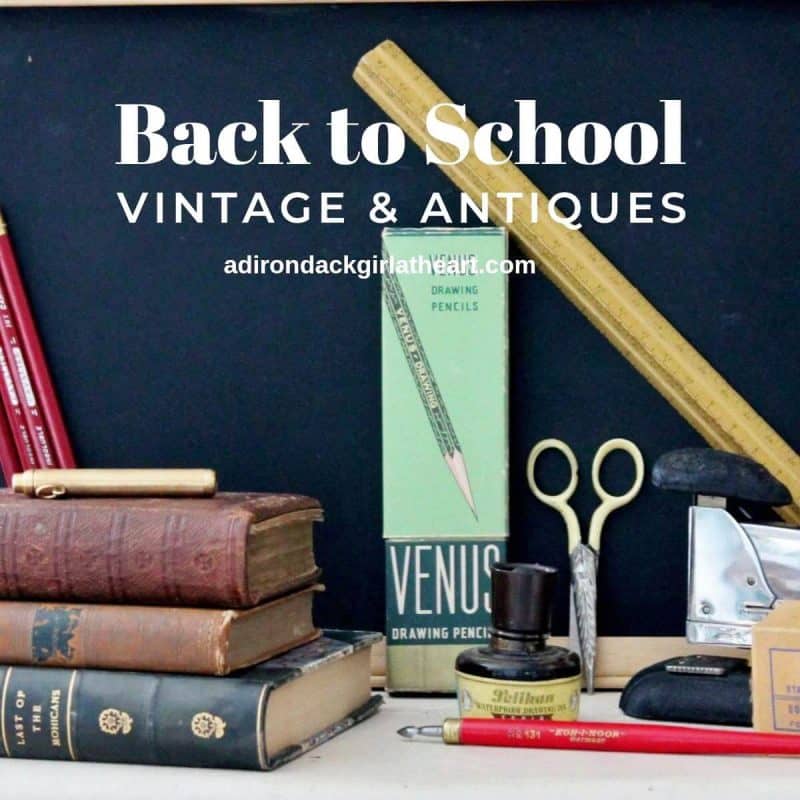
I picked up a few of these school-related items recently and dug out several others that I had packed away in the garage. I had fun rediscovering them!
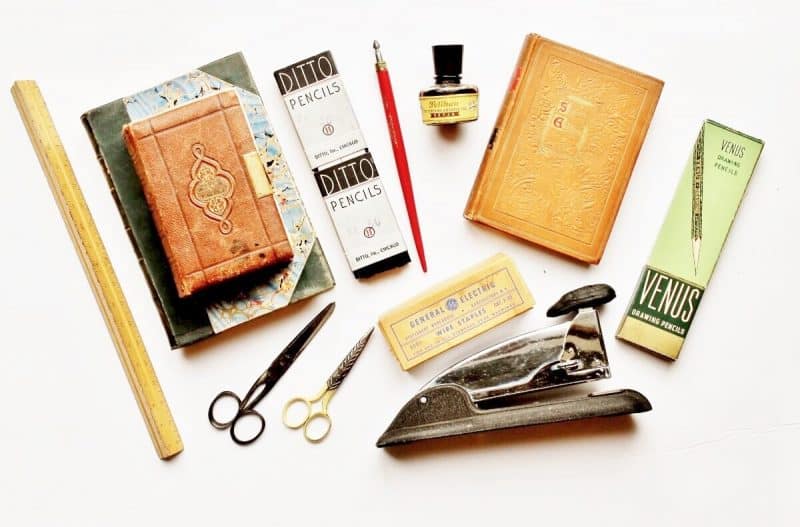
Some, like the scissors and the stapler, immediately brought back memories of elementary school. I’m not sure why these specifically. I had a happy experience at my little Catholic school (K-6) so this wasn’t a bad memory for me.
The yellow triangular ruler makes me think of my father who taught mechanical drawing in high school and the [antique] blue marbled book–a family heirloom–brings to mind my sweet grandmother.
It’s associations like these that drives us antiquers to buy the things we do, right? But enough with my personal memories, let’s jump into a little history.
Back to School Vintage Pencils
The Romans wrote on papyrus with an instrument called a stylus, a very early form of what we know as the pencil. Made of lead, it left a readable mark on papyrus paper and influenced forever the terms we use when talking about pencils today.

In the 14th century “graphite” came into widespread use as it left a darker mark than lead, but that has never stopped us from referring to it as “lead.” Eventually hollowed-out cylinders of wood housed the soft graphite, leading to what we know today as the pencil.
Later in Germany the pencil began to be mass produced by companies whose names you may recognize: Steadtler and Faber-Castell, for example. Check out History of Pencils for even more info.
Venus drawing pencils (above) were produced by the American Lead Pencil Co. beginning in 1905. In 1945 they changed their name to Venus Pen & Pencil Corp. and by 1973, they had been bought out by Faber-Castell.
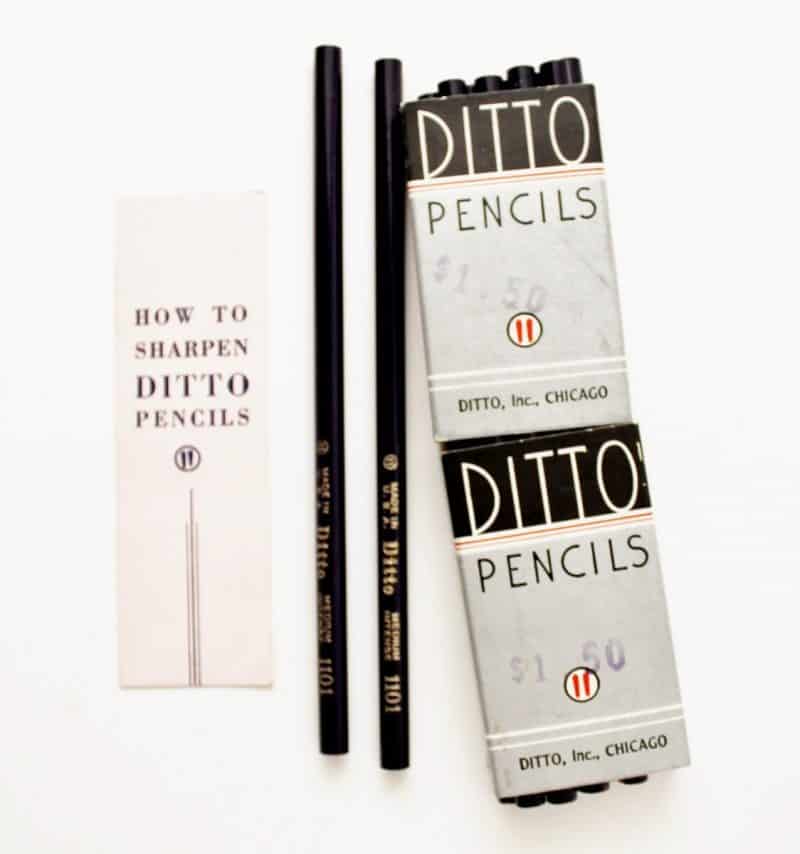
Ditto, Inc. of Chicago, which dates back to 1900, produced all sorts of school and office supplies, including duplicating machines, mechanical drawing instruments, and artists’ materials. The package shown, with it’s distinctly Art Deco vibe, dates to the 1920-30’s.
Interesting story: Did you notice that Ditto, Inc. produced duplicating machines (also known as mimeographs)? They are a prehistoric version of the copiers we use today, if you’re unfamiliar with them.
You may be old enough to remember these machines (and the smell they emitted). Interestingly, the term used to refer to the paper copies they made was “dittos,” after the name of the company that manufactured the machines.
Kind of like how we call tissues “Kleenex” and copy machines “Xerox” machines. [In England, vacuum cleaners are called “Hoovers” and the act of vacuuming is called “hoovering.”]
And still in conversation to this day we use the word “ditto” to mean “the same thing again,” all because of a company named Ditto that made duplicating machines.
Back to School Vintage Colored Pencils

Colored pencils came along a little later, in 1925 when Faber-Castell invented and began producing them in large quantities. The “lead” is made up of a number of ingredients, including wax, pigment, and binding agents.
Advances in the technology led to watercolor pencils that when moistened with water resulted in a watercolor effect. I actually own a set and have procrastinated giving them a try. Have you ever used them??
Little is know about the two companies that manufactured the red colored pencils shown here, except that they were both located in New York.
Back to School Antique Mechanical Pencils
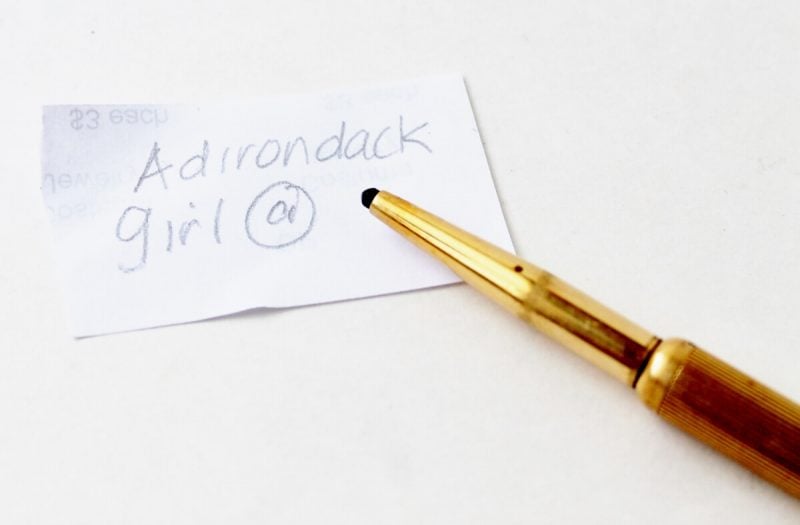
Some people love them, other people hate them. I am personally not a huge fan of mechanical pencils. Give me an old fashioned wooden pencil with a good eraser and I’m content. But they are often quite handsomely designed and that’s what attracted me to the one shown here.
Mechanical pencils, as we know them today, contain a special mechanism that allows the graphite (“lead”) to be pushed out with no need for sharpening. A Swiss biologist invented the very first mechanical-type pencil but the lead had to be manually extended.
You can learn more about the various types of mechanical pencils here: History of the Mechanical Pencil.

True story: I discovered in the process of writing this post that my mechanical pencil is not only marked “Made in France” but “Cartier Paris.” Yep, you read that right, Cartier, as in the Cartier. Pretty cool, right?
I cannot remember where I picked it up, but I know I paid very little for it. It has the look and feel of solid gold, but so far I’ve not been able to find any gold markings. I plan to take it to the place where I sell scrap gold and sterling silver (Saratoga Gold & Coin) and have it tested to help me establish a value.
In business since 1847, Cartier is known best for its exceptional quality watches and jewelry, but in 1927, due in part to the economy, they began offering writing tools of various kinds, including mechanical pencils, like mine.
Back to School Vintage Staplers

“Swingline” is a brand we’re all familiar with, but did you know it started life in 1925 as the “Parrot Speed Fastener Company?” In fact, the front of the stapler pictured has “Swingline Speed Fastener” engraved in the chrome.
Still in business today, they established themselves firmly in the market with their 1937 patented “top-loading” design that made for easy staple replacement. The version you see here, shaped like the front of a train or automobile, bears a distinctly Art Deco design that dates it to the 1930-40’s.
The GE staples, likely dating from the same period, are also collectible. Available as a set under “Smalls.”
Back to School Vintage Pen & Ink

I first used pen and ink in my high school art classes, and I still occasionally practice the “art” at times for various projects. Calligraphy and typography fascinate me but I’ve never taken time to really develop the skill. Maybe someday 🙂
Ancient Egyptians, looking for a replacement for writing on clay with styluses, developed pointed reed pens with slits in the end that would hold ink and feed it to the point to allow writing on papyrus. This ultimately led to feather quill pens, which were popular until the 19th century when steel nibs were invented.
Ink on the other hand has been used for centuries, particularly in China; however, they wrote with a paint brush rather than a pen. This is another art form I learned in high school and have actually enjoyed teaching others.
A German company in business for over 180 years produces Pelikan ink (shown above) still to this day. I like its vintage-y, squat-y shape.
The Koh-i-Noor dip pen (holder + nib) also hails from Germany, although the company is headquartered in the Czech Republic and is well-known for manufacturing all sorts of art supplies. The founder’s grandson famously established the H & B standards for pencil lead hardness (as it relates to drawing pencils).
Back to School Vintage & Antique Leather Books
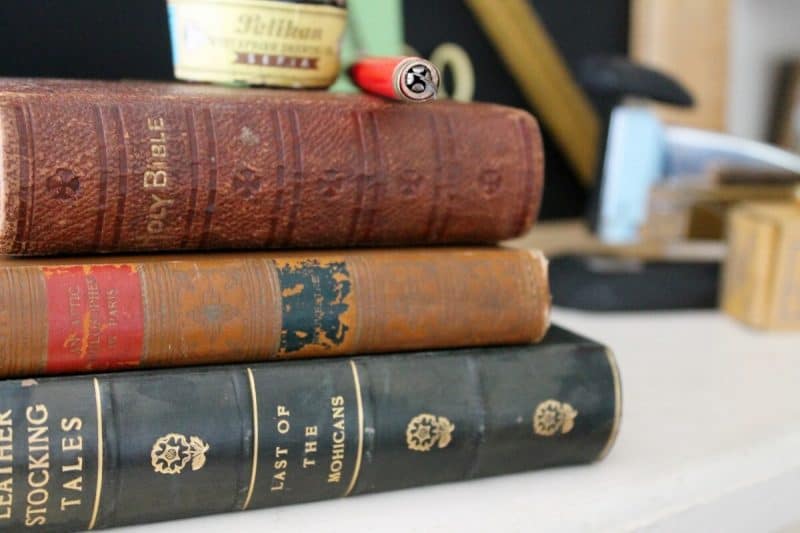
Through the ages, books have been bound in a variety of leathers: calf, goat, and seal, for example. They can be found “tooled” with images or designs impressed on them (like the Holy Bible above) and dyed in various colors (like the blue of the Last of the Mohicans above).
The middle book, An Attic Philosopher in Paris, has what I would call a “faux embossed leather” cover that makes it nice for decorating.
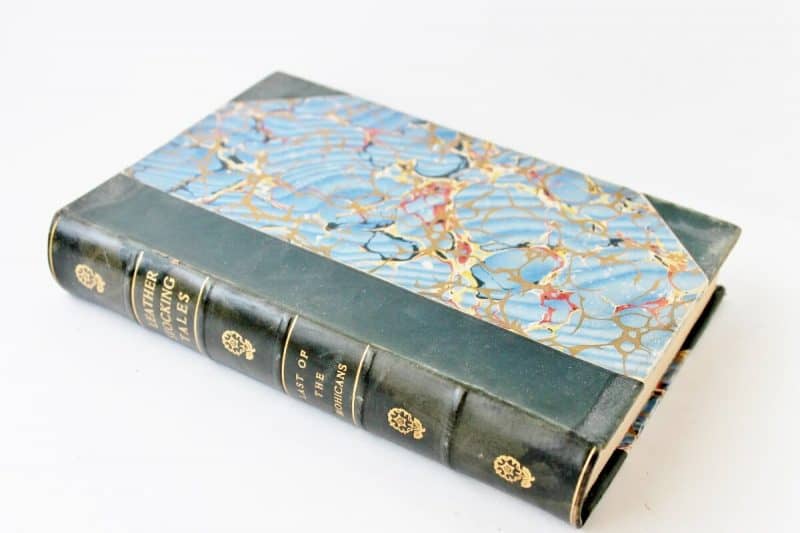
Last of the Mohicans, the family heirloom I mentioned, is made doubly beautiful by its marbleized boards and endpapers. In this art form, oil-based paints are floated atop a basin of water and swirled. The artist then lays a piece of paper atop the paint and quickly removes it, leaving a marbleized design behind.
Western society became acquainted with the art in the 16th century via Turkey and Persia, but it originated in China three to five centuries before that. Paper marbleizing has experienced a renaissance of late and classes are offered in many larger cities.
This copy does not contain a publication date, and I’ve had no success finding one like it online. My feeling is that it is quite rare and may be worth $100-200+
Related Article
- [Note: Learn How to Clean Vintage Books
Back to School Vintage Scissors

Shown are a couple of pair of scissors that I’ve collected over the years (another “accidental” collection, LOL).
I selected the yellow-handled version because they’re designed for school children and I like the embossed design on the blade. The inside of one of the blades is embossed “USA” and it likely dates to the 1950’s. The other pair I grabbed because they look old, so old in fact that it’s impossible to read the mark(!).
Related Article
Back to School Vintage Rulers

Rulers have basically two functions–to measure length and to allow the drawing of a straight line. For over 4000 years people have measured with ruler-like objects made of materials like copper, ivory, and of course wood.
The ruler pictured is a “triangular scale ruler” commonly used by engineers and architects since they are marked with a variety of different scales and ratios necessary for designing things.
Made by Keuffel & Esser (K & E Co.), it likely dates to the 1960’s. K & E was founded in 1867 by two German immigrants and is widely recognized as the first company to sell drafting instruments in the US.
It is also well-known for production of quality slide rules, but I had trouble finding much info about other types of rulers. Production stopped in 1969.
This slide show (of sorts)–The History of the Ruler–provides some interesting info you might enjoy (click on any part and it will enlarge).

I hope you enjoyed talking about collecting back to school vintage and antiques. It can create a feeling of nostalgia, I know–feel free to share your thoughts in the comments below 🙂

For today’s free printable, I created a vintage-style assignment book and teacher thank you cards (special thanks to The Graphics Fairy for the armillary design) that can be used by any student of any age. And of course the cards can be used to thank anybody, not just teachers(!).
The PDF contains instructions on the last page about how to print them out properly. I printed mine on brown card stock to add to the vintage look, but they can obviously be printed on any color. Each page can be printed separately, so if you’re only interested in the thank you cards, they are on the 3rd page. Enjoy!
Thanks so much for stopping by!
If you enjoyed your visit, I hope you’ll subscribe and never miss a post.
You’ll receive access to my MEMBER LIBRARY and get loads of FREEBIES!
Sign up and get your FREE assignment book & thank you card printables:

Bye for now,


Sweet Cartier find! I bet it is gold. We enjoy gathering vintage school finds too, and having a photograph of kids from the 20s, 30s is always another fun prop in the booth. Happy school days!
Here’s hoping!! I’d love to find a school photo someday–that would be perfect 🙂
What an interesting post. I hope you try your watercolor pencils; I use them occasionally when coloring details on rubberstamped cards. I color the flower, then wet the area with something like a damp Q-tip (so the ink doesn’t run).It is great for shading, too. I think you will enjoy it. A good friend misplaced her expensive Mont Blanc pen (retirement gift, I think); if you know the Cartier IS gold, you will HAVE to know where it is !I n college (’69-’73), I was the work study kid, low person on the totem pole, so I got to use that old stapler! Great memories!
I’m so glad you enjoyed the post, Kathy! I have put trying out the watecolor pencils on my to do list, and I put the (possibly) Cartier pencil in a safe place 🙂
Super fun post with items that I find myself attracted to as well. I love staplers, scissors and wooden rulers and kind of have a hoarding problem with them, but I do use them in my day to day life.
What a fantastic surprise to find that Cartier pencil! I had no idea they made them, so that is a great nugget to tuck into my brain for future hunting expeditions!
Keep up the great work, this blog is super fun to read!
I adore old desk items and tend to pick them up at sales, although I shouldn’t. Certainly don’t need them. But I do have a small collection of receipt spikes….just love them! Even though hubby accused me of trying to kill them when they were put somewhere he needed to place his arm. 🙂 Some things I saved from mom and dad’s belongings were old nib pens. I think they are so pretty and a gentle reminder of more quaint times in our past. I also have a set of colored pencils that belonged to my dad. Not sure why he had them, but I can’t bear to throw them out. One of my favorite things is a Hummel-like stapler I received from my friend, Lorraine, when I turned 11. Still working and in perfect shape.
So many fun items of yester-year. I have collected over 500 OOP vintage books for my children when they were homeschooled. Now, they get to use them for their children! So good to see you at TTA, Diana!
I am sure drawn to those sweet embossed scissors. All of the collection is terrific. I do have a few old vintage school supplies, I should gather them together and display…thanks for the inspiration.
Does anybody remember the green Ballpoint pens we used to use back in the 60s In grammar school?