
An Historic Tour of the New York State Capitol
On a lovely spring day not too long ago, my sweet husband and I had the chance to take a [free] tour of our [New York] state capitol. Right out of law school, I worked in the Legislative Office Building, located right across the street. However, I spent a good deal of my time in the capitol itself, so I’m quite familiar with it, but I’d never taken an official tour.
I should note that Kingston, not Albany, was New York’s first capital. You can read about some of that history in this post: Kingston: New York’s First Capital. In another post, The Best Way to See Albany’s Downtown, you can get the flavor of the city’s historic, downtown area.
 It’s a fascinating building that took three teams of architects 32 years to build (1867-1899), and technically, it’s still incomplete, since it never received its finishing touch–a domed tower. The total construction cost of $25 million translates into over half a billion [current] dollars, making it one of the most expensive public buildings of its time (NY Times, 2013).
Historians tell an amusing story about Governor Teddy Roosevelt and the 77 stairs you see leading up to the capitol. Apparently, he would challenge reporters to try and keep up with him as he ran the steps. If they did, then he would give them an exclusive interview. It has a ring of truth, doesn’t it?
 From the Capitol’s State Street entrance, you find this terrific view of the Empire State Plaza: (L-R) the Egg theater, the Corning Tower office building, and the NYS Museum. The central, flat area contains large water features with fountains and amazing modern art sculptures.
The plaza, both above and below ground, contain one of the largest public collections of modern art in the world (amassed by former Gov. Nelson Rockefeller). The Legislative Office Building where I worked is immediately to the right of this photo.
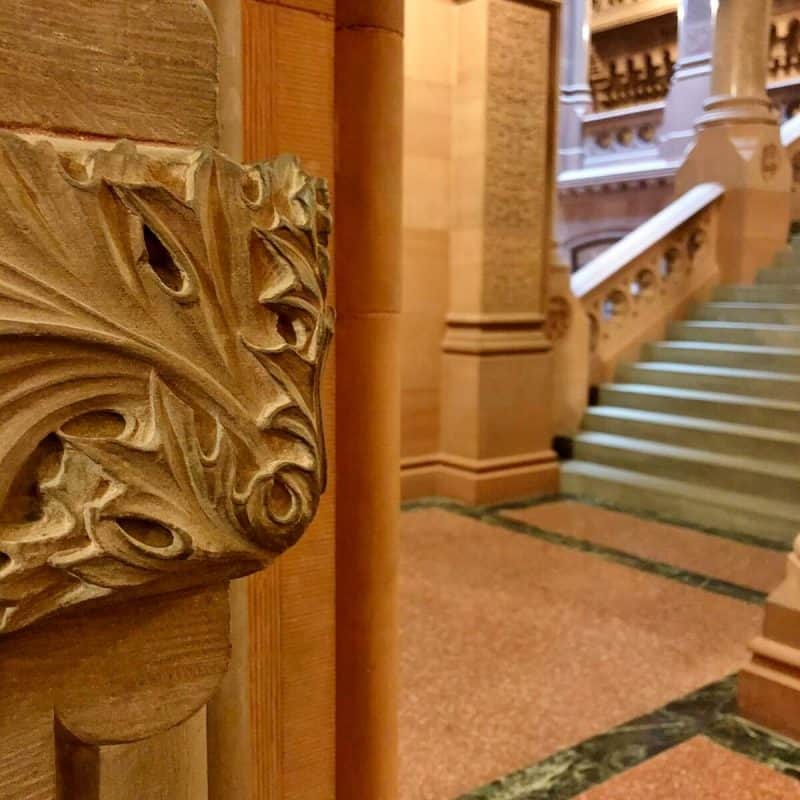 Inside the building, you find amazing stone carving and beautiful marble flooring at every turn. In the background one of three magnificent staircases leads you up through four floors. Massive skylights, covered since WWII, now illuminate each staircase after recent restoration.
 The piece de resistance of the building, for many, is the “Million Dollar Staircase,” so named because of it’s million dollar (plus) price tag. The architects utilized easily-carved, Corsehill sandstone from Scotland and paid European sculptors $5 day for fourteen years to complete this staircase. In recent (2000-2014) renovations, craftsmen restored the stonework, which had become severely darkened over time, to its original rosy taupe seen here.
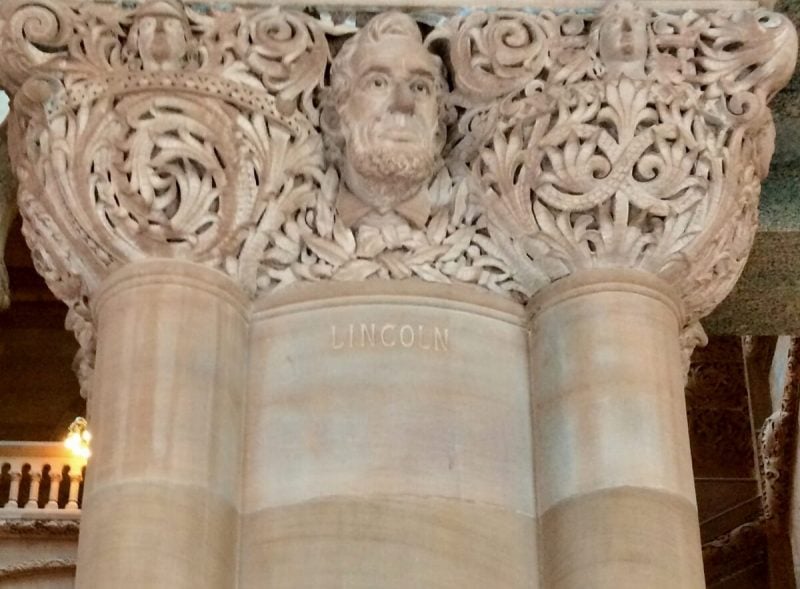 One can find seventy-seven faces tucked in amongst the ornate carvings along the stairs, including this one of President Lincoln. You can even find some famous women, like Susan B. Anthony.
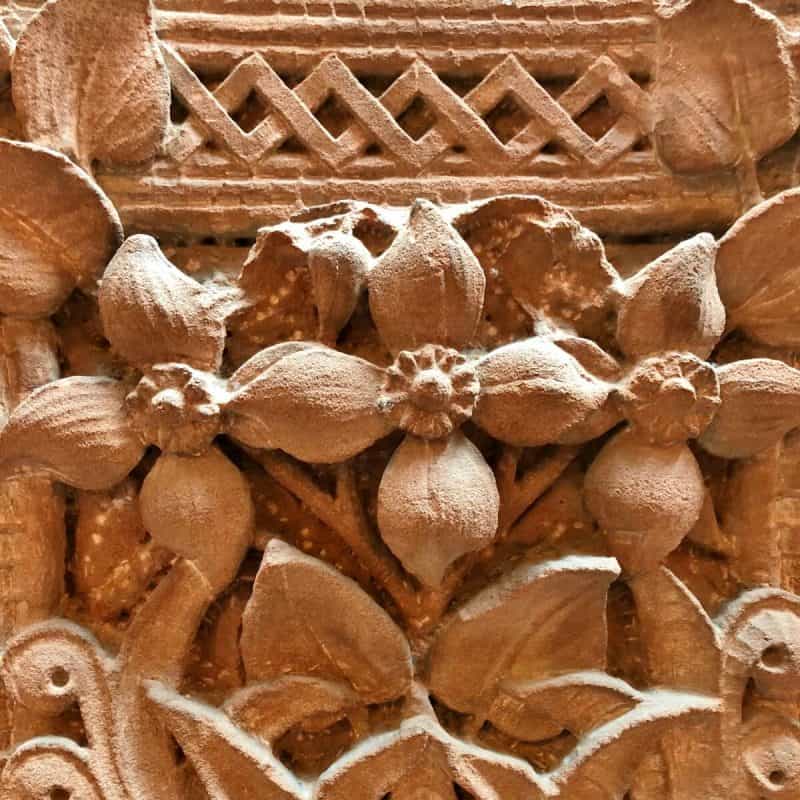 A close-up of some of the carved detail.
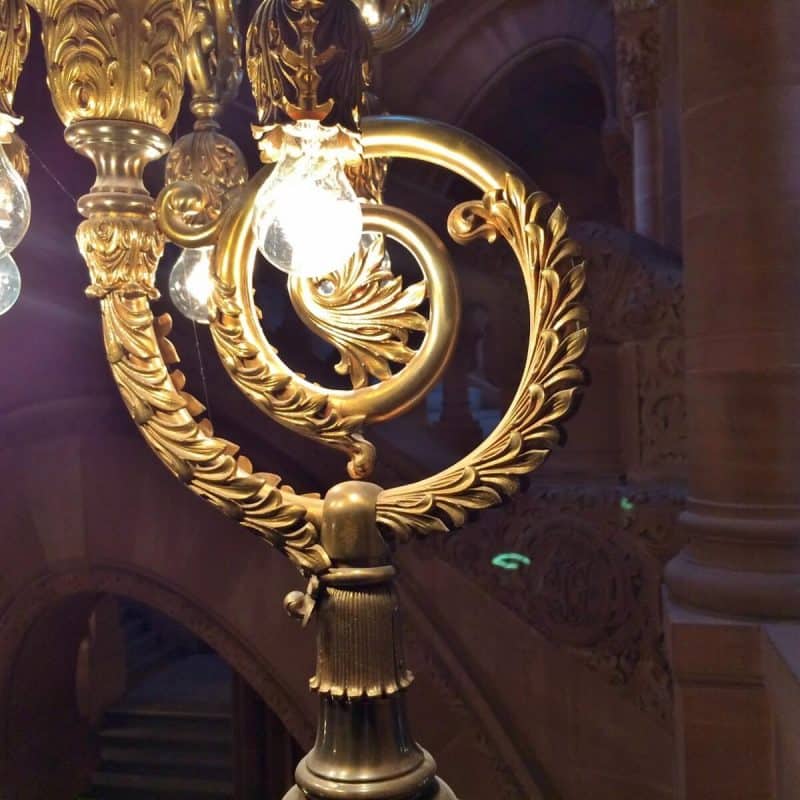 Adding to the ambiance of the Million Dollar staircase are these brass light fixtures posted regularly along the way.
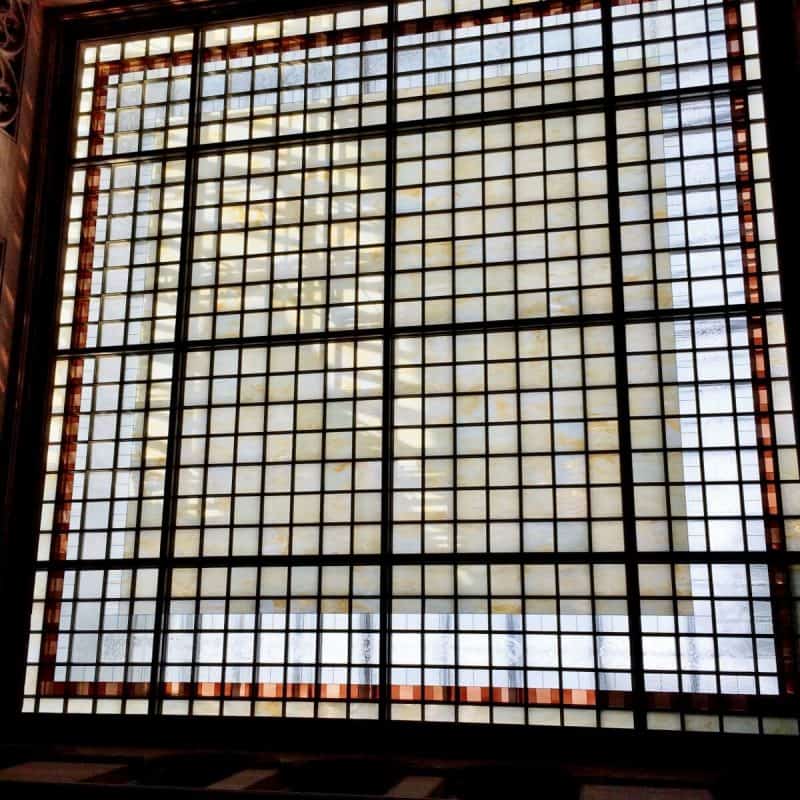 The skylights over the three main staircases are comprised of two layers–clear outer glass and translucent inner glass to cut down on glare and heat.
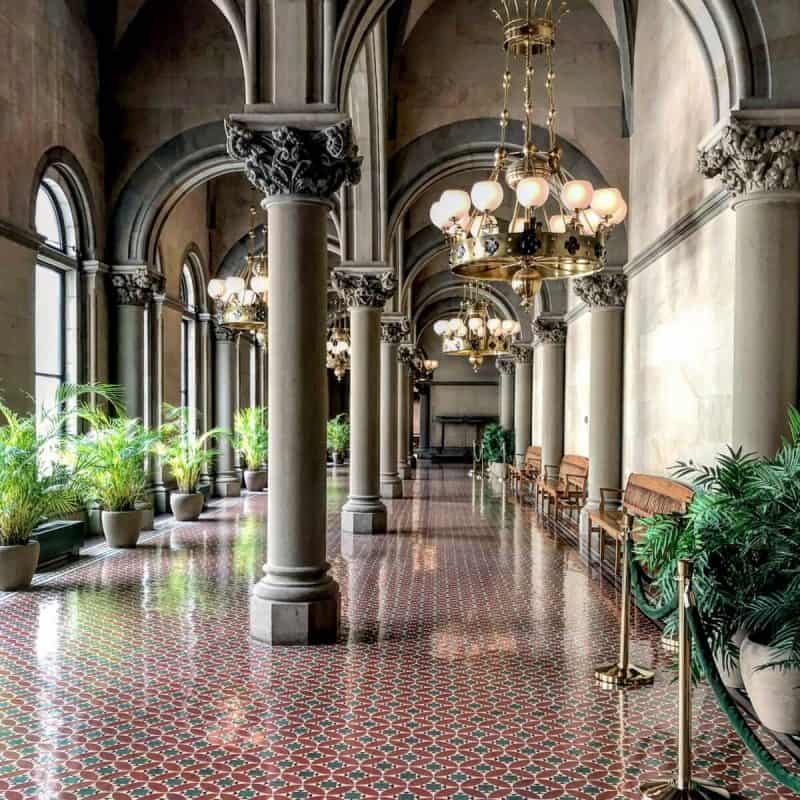
Senators congregate here in the Senate Lobby, to talk with each other and with special interest groups, hence the term “lobbyist.”
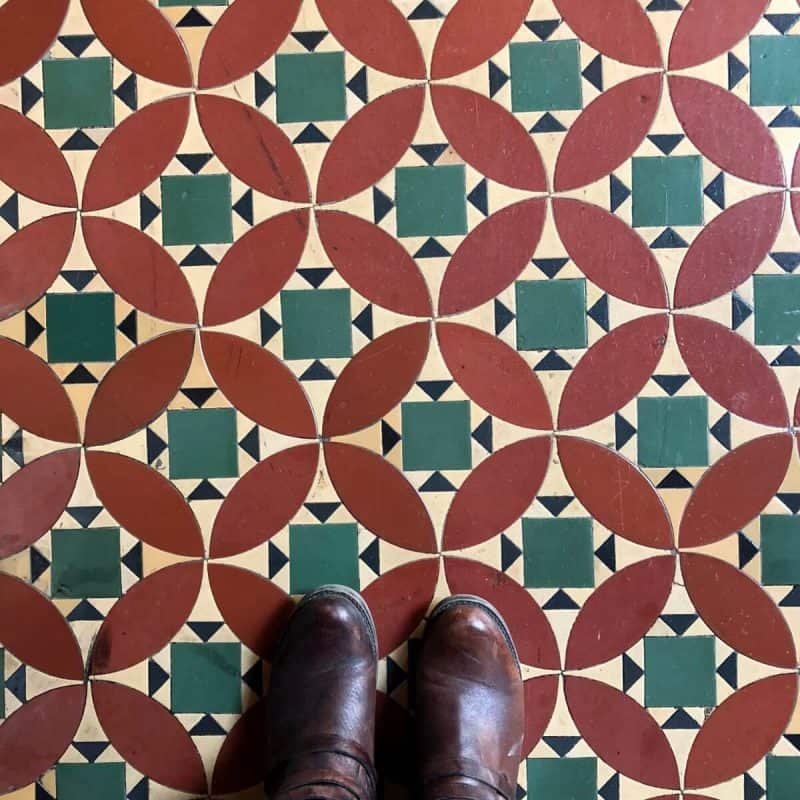 The original cut-mosaic tile floor, only recently rediscovered, was manufactured by Minton, an English pottery.
 One of several architects who worked on the project, H. H. Richardson, designed the Senate Chambers, using Scottish red granite for the columns and Italian marble for the arches. The rich, opulent style, “Richardson Romanesque,” is named after him.
The room contains a large fireplace that has never been used to heat the room. Instead, because one can stand in it, members use it for quiet tête à têtes between Senators, who prefer to their conversations private. Apparently the acoustics in the chamber are remarkable, and it’s difficult to have private discussions anywhere but the fireplace.
 Another stunning light fixture, this one in the Assembly chamber, which I am very familiar with, as I worked for the Chairman of the Assembly Environmental Conservation Committee from 1987 to 1992.
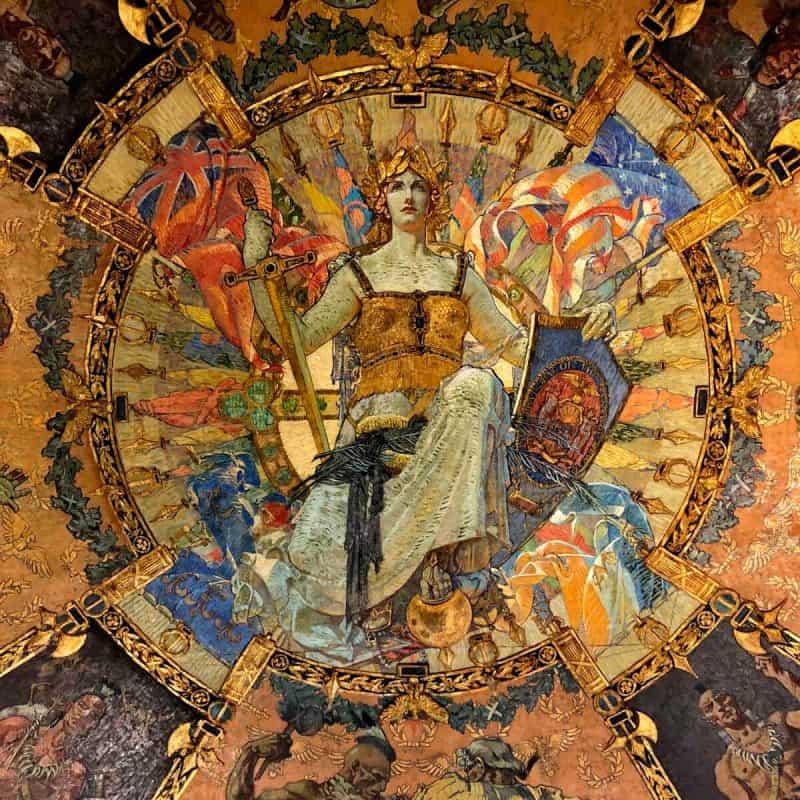 Artist William deLeftwich Dodge painted this remarkable ceiling mural in the “War Room,” featuring the “Spirit of New York” based on the Goddess of War. Interestingly, the room serves as the Governor’s waiting room.
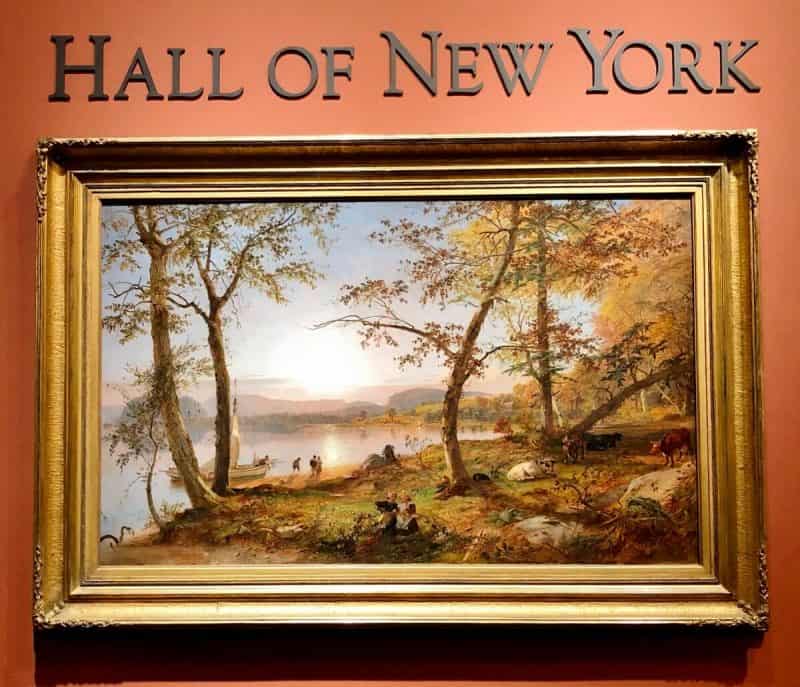 The hallways of almost an entire floor are dedicated to artwork representing every region of the state, a few of which I’ll share with you. This 1862 watercolor, “Greenwood Lake,” by J.F. Cropsey (a Hudson River School Painter) represents the southern part of the state, bordering New Jersey.
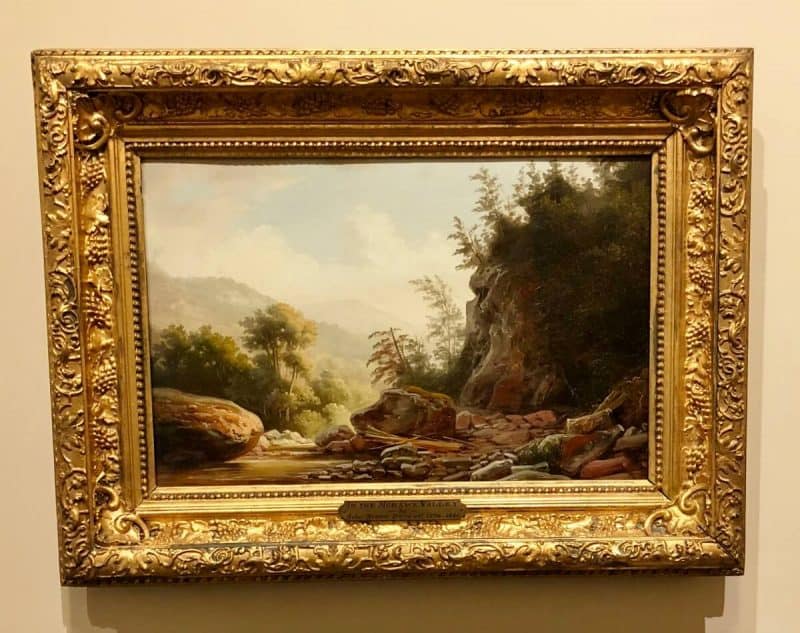 We’re taken to the Mohawk Valley in this 1845 painting of “East Canada Creek” by Asher B. Durand (another Hudson River School painter).
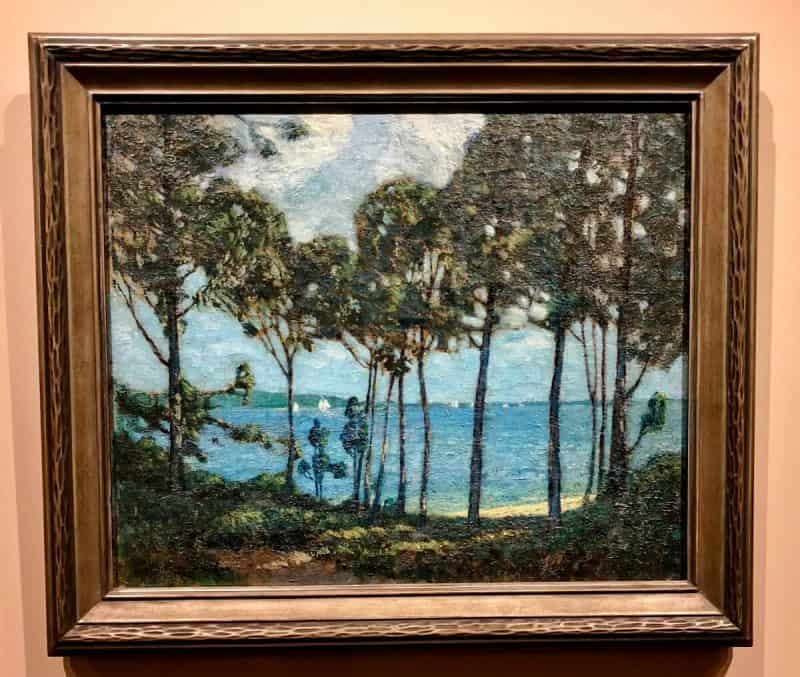 This landscape of Long Island called, “Paradise Woods,” is one of my favorites. Painted by Whitney M. Hubbard sometime during his lifetime (1875-1965), it reflects a distinctly impressionist style that I love.
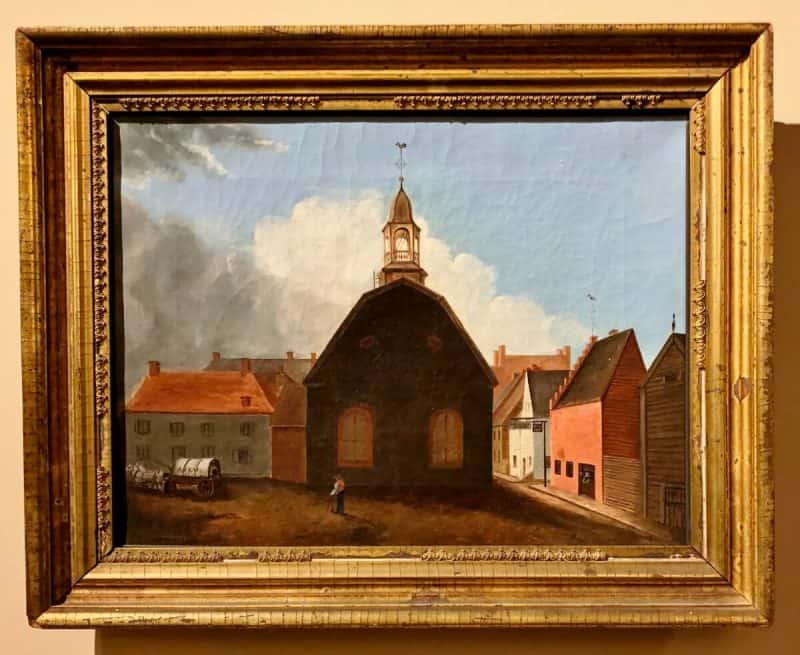 “Old Dutch Church,” painted by Samuel Hayden Sexton (1813-1890), a livelong resident of Schenectady (NY), portrays the early history of the Capital District region, which was originally settled by the Dutch in 1609. Once part of the Schenectady Stockade, this church no longer stands.
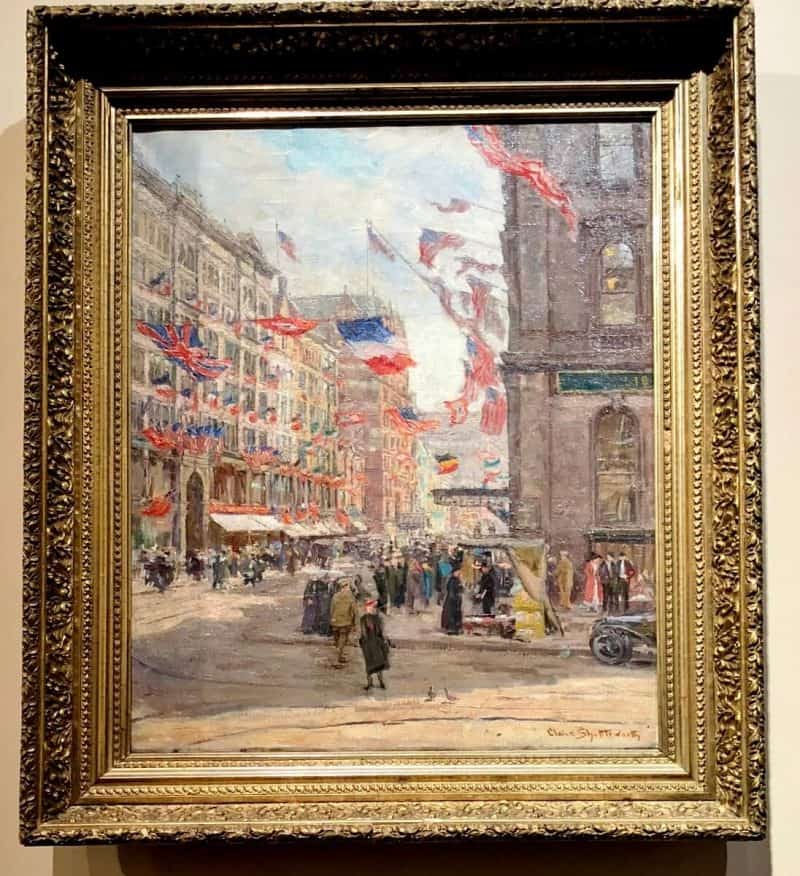 This impressionist painting, “Avenue of the Allies,” by Claire Shuttleworth (1918), depicts the streets of Buffalo and honors the men and women who fought in the Great War.
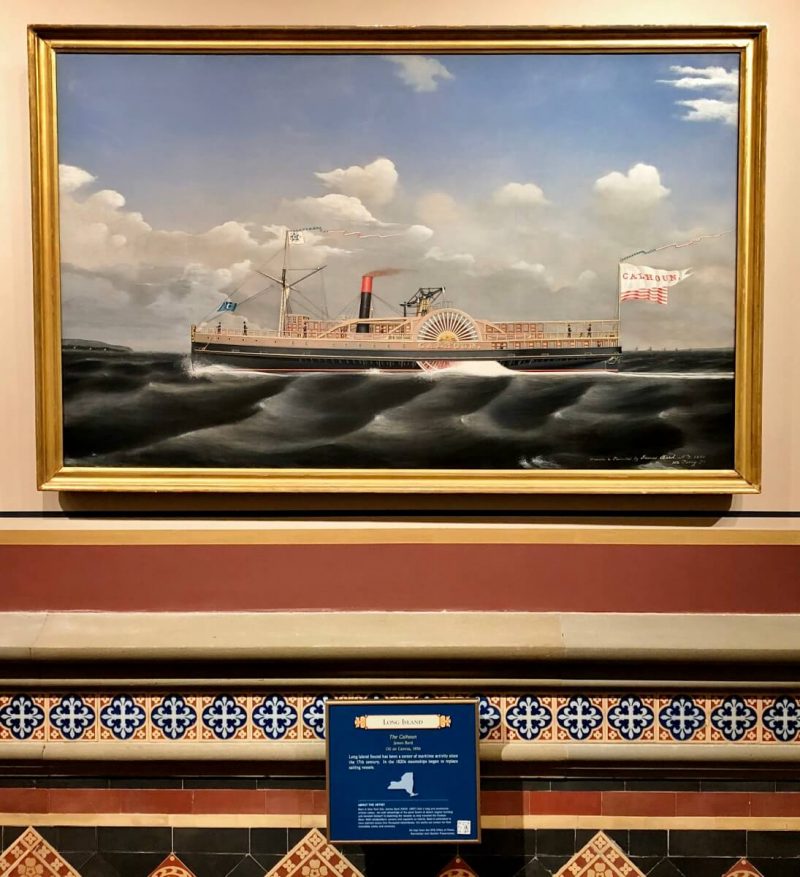 This painting honors Long Island Sound as an early maritime center. “The Calhoun” (1856) was one of over 4000 steamboats painted by James Bard for ship builders, owners, and captains.
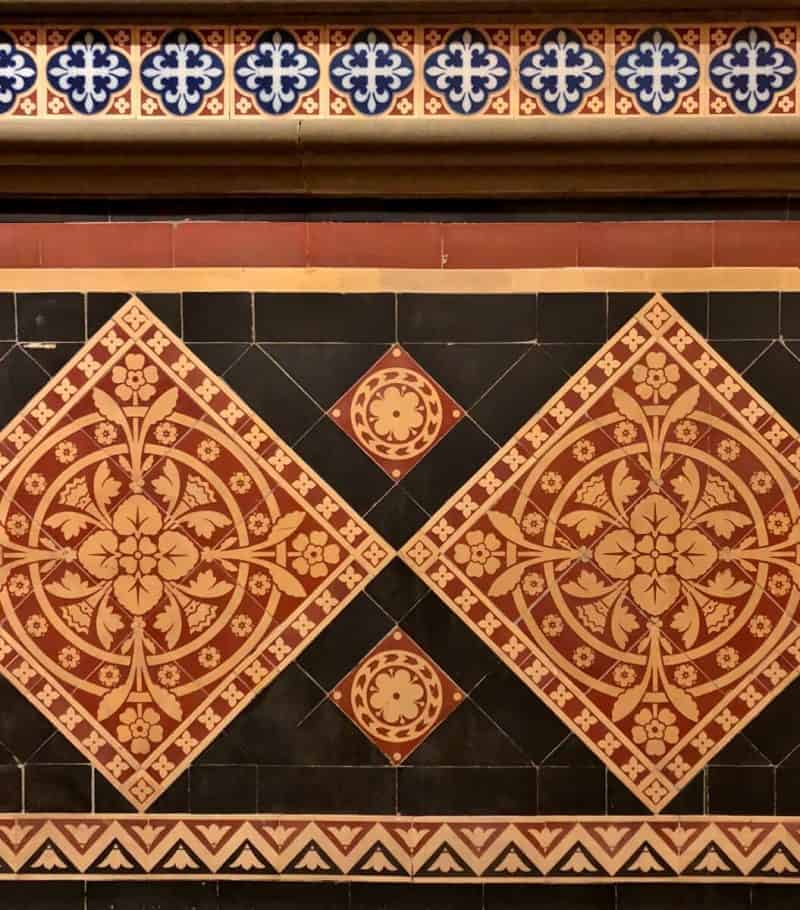 Beneath these beautiful works of art the walls are covered with stunning, original tile work that just takes your breath away. In actual fact, the entire building is breath-taking, which was the goal of the original planners and designers for the building–to create the most magnificent building of its era. I think in many ways, they succeeded.
Thanks so much for stopping by–
If you enjoyed your visit, I hope you’ll subscribe and never miss a post.
You’ll receive access to my brand new
Adirondack Girl Member Library
When You Click Here To
With your subscription, you’ll receive the PASSWORD to give you access
to the Library where you’ll find free price guides like this one:

Bye for now,


Other posts you might enjoy:
The Best Way to See Downtown Albany
Kingston: New York’s First Capital
What to See & Do in the Albany Area
I’d love it if you’d pin me 🙂


Gorgeous architecture and lovely art work, thanks for the tour, Diana!
You’re so welcome!! Thanks for stopping by–hope to chat with you again 🙂
Thank you so much for sharing this beautiful building. It must have been a pleasure to go to work every day in this building. Years ago when I lived in Indianapolis, Indiana, the beautiful City County Building was torn down so an ugly new building could be put in its place. Yes, I know they needed the space but what a shame.
You’re so welcome, Sharon; I’m glad you enjoyed the tour. Unfortunately, I don’t think I got as much out of the history of the building back in my 20’s as I do now–live and learn, I guess 🙂 Several neighborhoods were [controversially] torn down to build the Empire State Plaza, but activists were able to save a cathedral that sits on one end, next to the NYS Museum. It’s a gem.
Diana, this is my favorite post you have ever done! Thank you so much for the tour – I pinned so many from this to my board “Interesting Architecture”. This really rang my bell!
Oh my gosh, I’m so glad you like it! And thanks so much for the pin, too 🙂
Diana,
I live in western New York, the southern end near Pennsylvania, and have always thought that this was one of the prettiest buildings, Now, based on your photos, I know I was right. The inside is just as lovely as the outside. If I worked here, I’d probably have spent a lot of my time wandering the halls taking pictures or just being inspired. Like the painting of the streets of Buffalo as I lived and worked there for about 30 years. Thanks for a beautiful post.
You’re so welcome, Mary-Camille–I’m glad you enjoyed the post! It was truly an inspiring place to work. We had a lovely day “wandering the halls and taking pictures and being inspired!!” Stay in touch!
Thank you for the lovely tour! I live to be a tourist–sleep in a bed someone else makes, eat meals that someone else cooks and cleans up after, and buy “souvenirs”, usually something vintage. Being a tourist doesn’t happen often enough for me, so this is a close second. Your photography was awesome!
You’re very welcome, Kathy, and thank so much for your sweet compliments–you are too kind. Glad you could live vicariously through me 🙂
Lovely tour, thanks so much for sharing with your readers. I especially love the tile floors;. I am extreme fans of the Roosevelts and I am so appreciative of seeing where those wonderful men walked. So many think we have to go to other countries to see such treasures and often, they’re right under our noses, if we stop to look. You can share photos from here any time, love seeing Lincoln, too.
Your welcome, Susan! Yes, that tile is just lovely. Interestingly, it took living in Europe for two years to really awaken my interest in the treasures right under my nose, as you say.
One of the most gorgeous buildings of the 19th century and you’ve made wonderful (detail) pics of course!!
Thanks for your short architectural and political introducing of that institution.
Please release more more of such sight-seeings maybe from the stunning NY public library etc.
Best wishes from Germany.
I’m so glad you enjoyed the post, Tanja! I have several others that you can find here: https://adirondackgirlatheart.com/what-to-see-do-in-the-albany-area Next time I get to the NY Public Library I’ll take some photos and be sure to write a post 🙂
What beautiful art and architecture! Thanks for sharing this historical tour at Vintage Charm!
Thanks, Cecilia, and thanks for hosting a great party!!
Oh, my! Thank you for the gorgeous tour, and I so love the paintings…history snapshots—as they saw it then. Makes it all so real.
I’m SO glad you enjoyed it Sandi–thanks for stopping by!! Hope you have a great weekend–